Cognitive-behavioral therapy for depression among menopausal woman: A randomized controlled trial
- PMID: 31041241
- PMCID: PMC6482762
- DOI: 10.4103/jfmpc.jfmpc_396_18
Cognitive-behavioral therapy for depression among menopausal woman: A randomized controlled trial
Abstract
Context: Menopause is associated with high risk of depression among women. Studies have shown that group cognitive behavioral theory (CBT) is safe and effective treatment for depression among menopausal women; however, only limited studies are conducted in India.
Aims: To examine the efficacy of group CBT for depression among menopausal woman.
Settings and design: A randomized, controlled trial design was adopted with longitudinal measurement of outcomes for 6 months. The study was conducted from January 2017 to November 2017 at selected Primary Health Centre (PHC) area, urban Bengaluru.
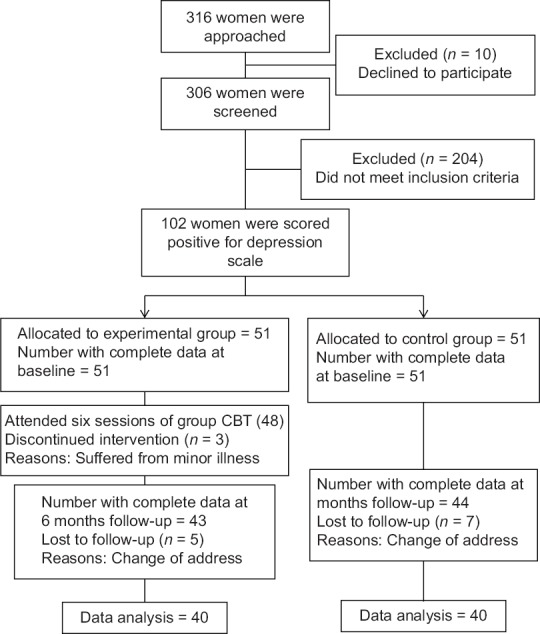
Subject and methods: Participants were 80 women from selected PHC areas, Bengaluru, India. The participants were randomly assigned to either the experimental or control group by computer-generated random numbers. The experimental group received six weekly group CBT sessions. Depression was evaluated for both groups at the baseline and at two follow-up assessments in the 1st and 6th month. Treatment effects of the group CBT were analyzed by repeated-measures analysis of variance.
Statistical analysis used: Data were analyzed using Statistical Package for the Social Sciences software package (Version 23).
Results: The results showed that comparisons of depression scores between the two groups before initiating group CBT were not significant. Statistically significant reduction in depression scores were seen among experimental group compared to control group over the 6-month period.
Conclusion: This study concluded that group CBT is effective for reducing depression among menopausal woman.
Keywords: Depression and menopause; group cognitive behavioral therapy; menopause.
Conflict of interest statement
There are no conflicts of interest.
Figures
References
-
- Depression and other common mental disorders: Global health estimates. Geneva: World Health Organization; 2017. [Last accessed on 2018 Sep 19]. Available from: http://apps.who.int/iris/handle/10665/254610 .
-
- Charlson FJ, Baxter AJ, Cheng HG, Shidhaye R, Whiteford HA. The burden of mental, neurological, and substance use disorders in China and India: A systematic analysis of community representative epidemiological studies. Lancet. 2016;388:376–89. - PubMed
-
- Behera P, Sharan P, Mishra AK, Nongkynrih B, Kant S, Gupta SK. Prevalence and determinants of depression among elderly persons in a rural community from northern India. Natl Med J India. 2016;29:129–35. - PubMed
-
- Sengupta P, Benjamin AI. Prevalence of depression and associated risk factors among the elderly in urban and rural field practice areas of a tertiary care institution in Ludhiana. Indian J Public Health. 2015;59:3–8. - PubMed
-
- Cohen LS, Soares CN, Vitonis AF, Otto MW, Harlow BL. Risk for new onset of depression during the menopausal transition: The Harvard study of moods and cycles. Arch Gen Psychiatry. 2006;63:385–90. - PubMed