


The Use of Artificially Intelligent Self-Diagnosing Digital Platforms by the General Public: Scoping Review
- PMID: 31042151
- PMCID: PMC6658267
- DOI: 10.2196/13445
The Use of Artificially Intelligent Self-Diagnosing Digital Platforms by the General Public: Scoping Review
Abstract
Background: Self-diagnosis is the process of diagnosing or identifying a medical condition in oneself. Artificially intelligent digital platforms for self-diagnosis are becoming widely available and are used by the general public; however, little is known about the body of knowledge surrounding this technology.
Objective: The objectives of this scoping review were to (1) systematically map the extent and nature of the literature and topic areas pertaining to digital platforms that use computerized algorithms to provide users with a list of potential diagnoses and (2) identify key knowledge gaps.
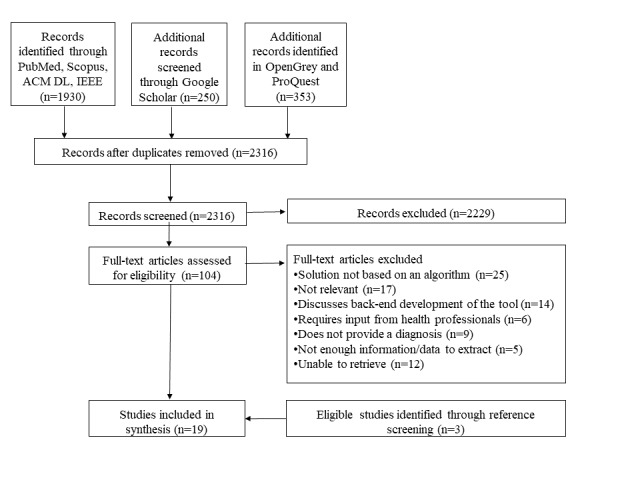
Methods: The following databases were searched: PubMed (Medline), Scopus, Association for Computing Machinery Digital Library, Institute of Electrical and Electronics Engineers, Google Scholar, Open Grey, and ProQuest Dissertations and Theses. The search strategy was developed and refined with the assistance of a librarian and consisted of 3 main concepts: (1) self-diagnosis; (2) digital platforms; and (3) public or patients. The search generated 2536 articles from which 217 were duplicates. Following the Tricco et al 2018 checklist, 2 researchers screened the titles and abstracts (n=2316) and full texts (n=104), independently. A total of 19 articles were included for review, and data were retrieved following a data-charting form that was pretested by the research team.
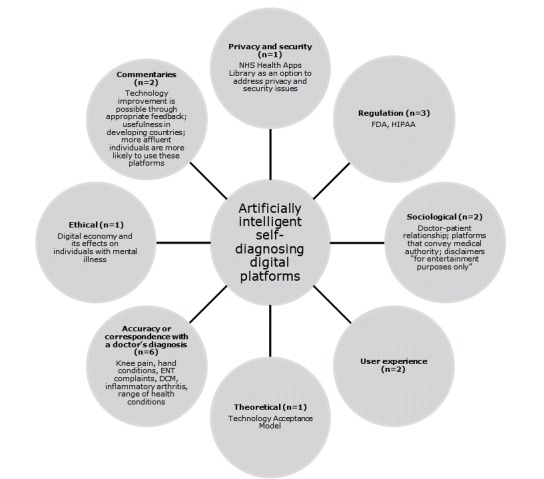
Results: The included articles were mainly conducted in the United States (n=10) or the United Kingdom (n=4). Among the articles, topic areas included accuracy or correspondence with a doctor's diagnosis (n=6), commentaries (n=2), regulation (n=3), sociological (n=2), user experience (n=2), theoretical (n=1), privacy and security (n=1), ethical (n=1), and design (n=1). Individuals who do not have access to health care and perceive to have a stigmatizing condition are more likely to use this technology. The accuracy of this technology varied substantially based on the disease examined and platform used. Women and those with higher education were more likely to choose the right diagnosis out of the potential list of diagnoses. Regulation of this technology is lacking in most parts of the world; however, they are currently under development.
Conclusions: There are prominent research gaps in the literature surrounding the use of artificially intelligent self-diagnosing digital platforms. Given the variety of digital platforms and the wide array of diseases they cover, measuring accuracy is cumbersome. More research is needed to understand the user experience and inform regulations.
Keywords: artificial intelligence; diagnosis; diagnostic self evaluation; self-care; symptom checkers.
©Stephanie Aboueid, Rebecca H Liu, Binyam Negussie Desta, Ashok Chaurasia, Shanil Ebrahim. Originally published in JMIR Medical Informatics (http://medinform.jmir.org), 01.05.2019.
Conflict of interest statement
Conflicts of Interest: None declared.
Figures
References
-
- Statistics Canada. [2019-04-06]. 2009 Canadian Internet use survey https://www150.statcan.gc.ca/n1/daily-quotidien/100510/dq100510a-eng.htm .
-
- Beck F, Richard JB, Nguyen-Thanh V, Montagni I, Parizot I, Renahy E. Use of the internet as a health information resource among French young adults: results from a nationally representative survey. J Med Internet Res. 2014;16(5):e128. doi: 10.2196/jmir.2934. http://www.jmir.org/2014/5/e128/ v16i5e128 - DOI - PMC - PubMed
-
- Pew Research Centre. [2019-04-06]. Health Online 2013 https://www.pewinternet.org/2013/01/15/health-online-2013/
-
- Amante DJ, Hogan TP, Pagoto SL, English TM, Lapane KL. Access to care and use of the internet to search for health information: results from the US National Health Interview Survey. J Med Internet Res. 2015;17(4):e106. doi: 10.2196/jmir.4126. http://www.jmir.org/2015/4/e106/ v17i4e106 - DOI - PMC - PubMed
Publication types
LinkOut - more resources
Full Text Sources
