Upcoming direct acting antivirals for hepatitis C patients with a prior treatment failure
- PMID: 31042864
- PMCID: PMC6933124
- DOI: 10.3350/cmh.2019.0022
Upcoming direct acting antivirals for hepatitis C patients with a prior treatment failure
Abstract
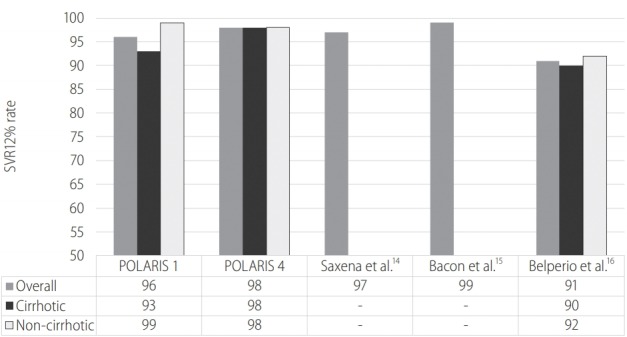
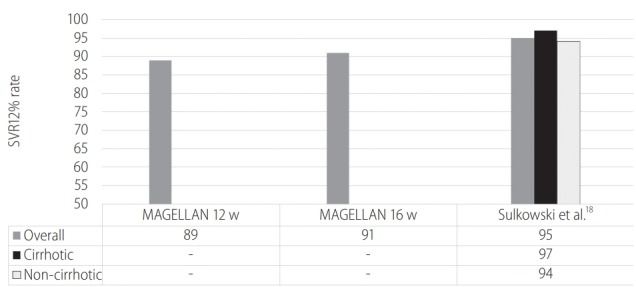
Despite the high efficacy of direct acting antivirals (DAAs) not all patients successfully clear hepatitis C virus infection, in fact, approximately 1-3% fail to reach a sustained virological response 12 weeks after end of treatment. DAA failures are characterized by advanced liver disease, specific genotypes/subtypes and resistance associated substitutions to the DAA class they have been treated with. Current European Association for the Study of the Liver guidelines recommend three therapeutic options for such patients. The first is a 12 week course of sofosbuvir (SOF), velpatasvir (VEL) and voxilaprevir (VOX), which has shown to be effective in 90-99% of patients and was granted A1 level recommendation. The second option, reserved for patients who have predictors of failure consists in 12 weeks regimen with glecaprevir (GLE) and pibrentasvir (PIB), effective in 90-97%. Finally, although not supported by published data, for especially difficult to treat patients there should theoretically be a benefit in prolonged combinations of SOF+GLE/PIB or SOF/VEL/VOX±ribavirin. This review presents the latest evidence from both clinical trials and real-life on such therapeutic strategies.
Keywords: Antivirals; Hepatitis C virus (HCV); Re-treatment; Sofosbuvir.
Conflict of interest statement
TLP, MCPT have nothing to discolose.
AA has received research grants from Gilead and Abbvie, and is an advisor for MSD, Gilead, Abbvie and Intercept.
Figures
References
-
- Aghemo A, De Francesco R. New horizons in hepatitis C antiviral therapy with direct-acting antivirals. Hepatology. 2013;58:428–438. - PubMed
-
- Pawlotsky JM. Hepatitis C virus resistance to direct-acting antiviral drugs in interferon-free regimens. Gastroenterology. 2016;151:70–86. - PubMed
-
- D’Ambrosio R, Degasperi E, Colombo M, Aghemo A. Direct-acting antivirals: the endgame for hepatitis C? Curr Opin Virol. 2017;24:31–37. - PubMed
-
- D’Ambrosio R, Pasulo L, Puoti M, Vinci M, Schiavini M, Lazzaroni S, et al. Real-world effectiveness and safety of glecaprevir/pibrentasvir in 723 patients with chronic hepatitis C. J Hepatol. 2019;70:379–387. - PubMed
-
- Mettikanont P, Bunchorntavakul C, Reddy KR. Systematic review: epidemiology and response to direct-acting antiviral therapy in genotype 6 chronic hepatitis C virus infection. Aliment PharmacolTher. 2019;49:492–505. - PubMed
Publication types
MeSH terms
Substances
LinkOut - more resources
Full Text Sources
Medical