


Validation of the Malay Version of Addenbrooke's Cognitive Examination III in Detecting Mild Cognitive Impairment and Dementia
- PMID: 31043965
- PMCID: PMC6477467
- DOI: 10.1159/000495107
Validation of the Malay Version of Addenbrooke's Cognitive Examination III in Detecting Mild Cognitive Impairment and Dementia
Abstract
Background/aims: This study aimed to investigate the validity and reliability of the Malay version of Addenbrooke's Cognitive Examination III (ACE-III) for detecting mild cognitive impairment (MCI) and dementia.
Methods: A total of 152 participants (dementia = 53, MCI = 38, controls = 61) were recruited from two teaching hospitals. The Malay version of ACE-III was translated following the standard guidelines for cross-cultural adaptation of measure. All the participants were assessed with the Malay version of ACE-III and Mini-Mental State Examination (MMSE).
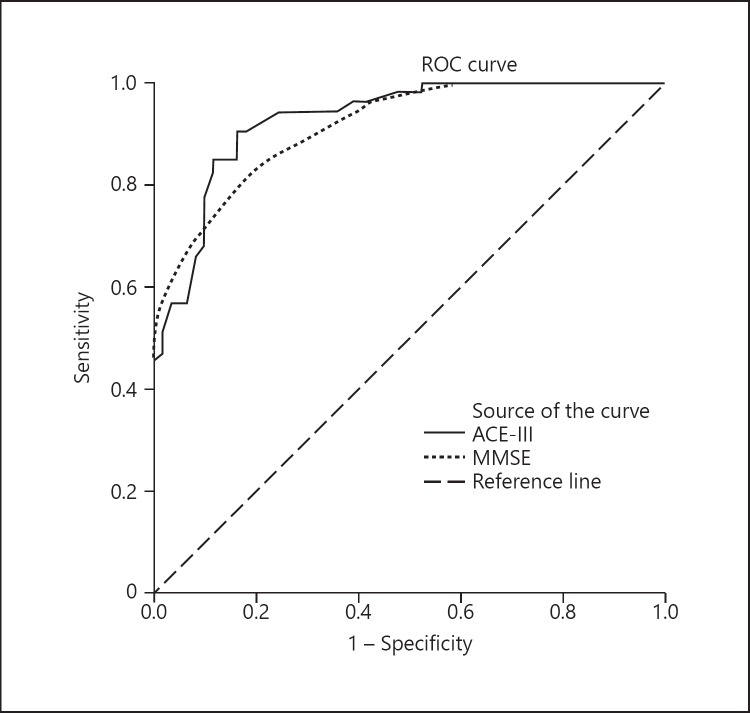
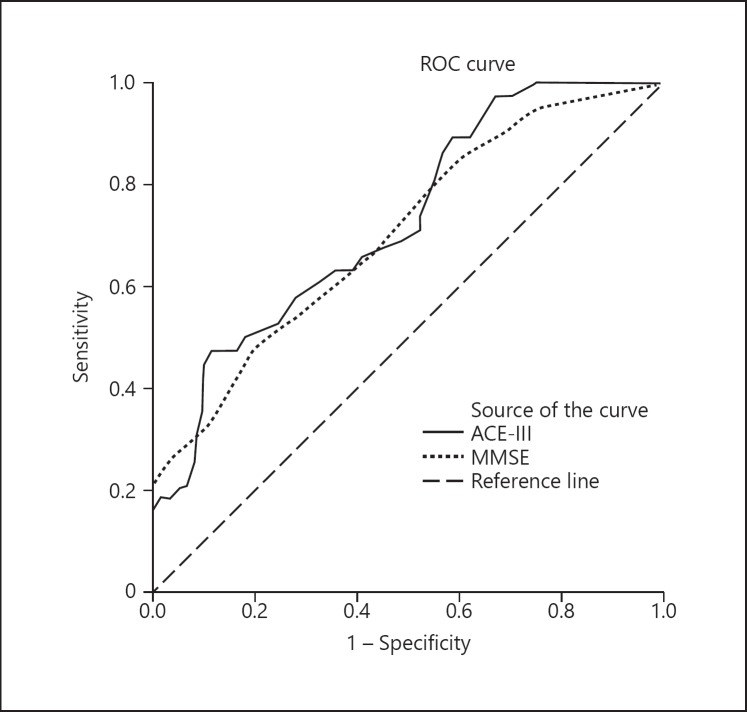
Results: The reliability of the Malay version of ACE-III was good with Cronbach's α coefficient of 0.829 and intraclass correlation coefficient of 0.959. There was a strong positive correlation between the Malay version of ACE-III and MMSE (r = 0.806). Age (r = -0.335) and years of education (r = 0.536) exerted a significant correlation with total score performance. The cutoff score to discriminate dementia from healthy controls was 74/75 (sensitivity = 90.6%, specificity = 82.0%) whereas to discriminate MCI, the cutoff score was 77/78 (sensitivity = 63.2%, specificity = 63.9%). The diagnostic accuracy of ACE-III was higher than that of MMSE in the detection of dementia (area under the curve: ACE-III = 0.929 vs. MMSE = 0.915).
Conclusions: The Malay version of ACE-III demonstrated to be a reliable and valid screening tool for dementia.
Keywords: Addenbrooke's Cognitive Examination III; Dementia; Malay language; Mild cognitive impairment.
Figures
References
-
- Prince MJ, Comas-Herrera A., Knapp M., Guerchet M. M., Karagiannidou M. World Alzheimer Report 2016 - Improving healthcare for people living with dementia: Coverage, quality and costs now and in the future. 2016
-
- Folstein MF, Folstein SE, McHugh PR. “Mini-mental state”. A practical method for grading the cognitive state of patients for the clinician. J Psychiatr Res. 1975 Nov;12((3)):189–98. - PubMed
-
- Galasko D, Abramson I, Corey-Bloom J, Thal LJ. Repeated exposure to the Mini-Mental State Examination and the Information-Memory-Concentration Test results in a practice effect in Alzheimer's disease. Neurology. 1993 Aug;43((8)):1559–63. - PubMed
-
- Franco-Marina F, García-González JJ, Wagner-Echeagaray F, Gallo J, Ugalde O, Sánchez-García S, et al. The Mini-mental State Examination revisited: ceiling and floor effects after score adjustment for educational level in an aging Mexican population. Int Psychogeriatr. 2010 Feb;22((1)):72–81. - PubMed
-
- Arevalo-Rodriguez I, Smailagic N, Roqué I Figuls M, Ciapponi A, Sanchez-Perez E, Giannakou A, et al. Mini-Mental State Examination (MMSE) for the detection of Alzheimer's disease and other dementias in people with mild cognitive impairment (MCI) Cochrane Database Syst Rev. 2015 Mar;((3)):CD010783. - PMC - PubMed
LinkOut - more resources
Full Text Sources
Miscellaneous
