


Electrical storm - still an extremely poor prognosis. Do these acute states of life-threatening arrhythmias require a multidirectional approach from the start?
- PMID: 31043979
- PMCID: PMC6488832
- DOI: 10.5114/aic.2019.83769
Electrical storm - still an extremely poor prognosis. Do these acute states of life-threatening arrhythmias require a multidirectional approach from the start?
Abstract
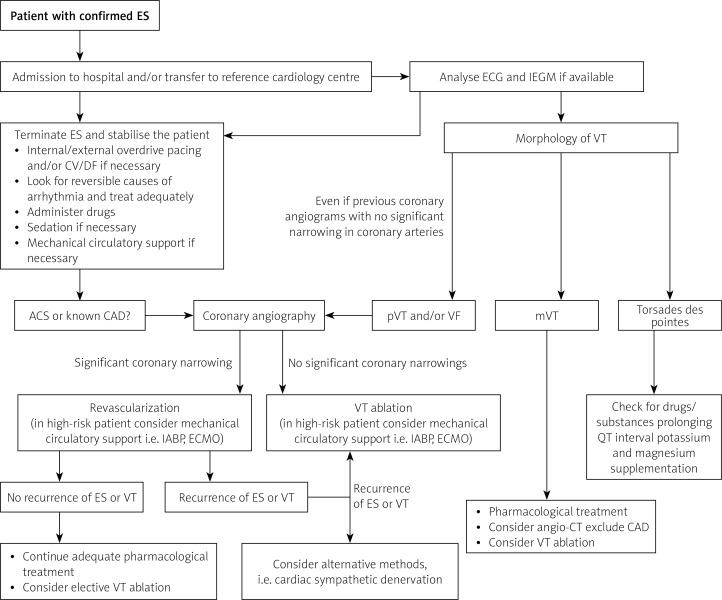
Electrical storm (ES) is a state of electrical instability of the heart manifesting as multiple and potentially lethal recurring ventricular arrhythmias such as ventricular tachycardia or ventricular fibrillation. This definition is not related to the condition of each patient, who can present from asymptomatic to unconscious and in deep cardiogenic shock. Most patients affected by ES have heart failure (HF) of ischaemic origin. Ischaemia, exacerbation of HF, low ejection fraction, previous ventricular arrhythmias, infection or electrolyte disturbances together with other factors, or a few factors combined, may result in ES. The prognosis of ES survivors is very poor, with 1-year mortality exceeding 40%, which should draw attention to this group of patients as one of extremely high risk. The number of patients with cardioverter-defibrillators is increasing and so is the number of patients suffering from ES. Therefore, each patient should be supported with tailored therapy, and not only restricted to pharmacotherapy or ablation procedures. This paper was written to analyse the most frequent causes of ES and prompt the most appropriate clinical pathways and possibilities, underlining the need for a comprehensive invasive approach to diagnosis, treatment and circulatory stabilization in addition to adequate pharmacotherapy. This approach might help to reduce the mortality rate in this group of patients and improve the prognosis.
Keywords: ablation; electrical storm; implantable cardioverter-defibrillator; invasive treatment; mechanical circulatory support; ventricular tachycardia.
Conflict of interest statement
The authors declare no conflict of interest.
Figures
References
-
- Bardy GH, Lee KL, Mark DB, et al. ; the Sudden Cardiac Death in Heart Failure Trial (SCD-HeFT) Investigators. Amiodarone or an implantable cardioverter-defibrillator for congestive heart failure. N Engl J Med. 2005;352:225–37. - PubMed
-
- Connolly SJ, Hallstrom AP, Cappato R, et al. Meta-analysis of the implantable cardioverter defibrillator secondary prevention trials. AVID, CASH and CIDS studies. Antiarrhythmics vs Implantable Defibrillator study. Cardiac Arrest Study Hamburg. Canadian Implantable Defibrillator Study. Eur Heart J. 2000;21:2071–8. - PubMed
-
- Kowey PR. An overview of antiarrhythmic drug management of electrical storm. Can J Cardiol. 1996;12(Suppl B):3B–8B. - PubMed
-
- Priori SG, Blomström-Lundqvist C, Mazzanti A, et al. Authors/Task Force Members; Document Reviewers: 2015 ESC Guidelines for the management of patients with ventricular arrhythmias and the prevention of sudden cardiac death: The Task Force for the Management of Patients with Ventricular Arrhythmias and the Prevention of Sudden Cardiac Death of the European Society of Cardiology (ESC)Endorsed by: Association for European Paediatric and Congenital Cardiology (AEPC) Eur Heart J. 2015;36:2793–867. - PubMed
-
- Al-Khatib SM, Stevenson WG, Ackerman MJ, et al. 2017 AHA/ACC/HRS Guideline for management of patients with ventricular arrhythmias and the prevention of sudden cardiac death: executive summary. A report of the American College of Cardiology/American Heart Association Task Force on clinical practice guidelines and the Heart Rhythm Society. Heart Rhythm. 2018;15:73–189. - PubMed
Publication types
LinkOut - more resources
Full Text Sources
Research Materials
Miscellaneous
