


Influence of abnormal potassium levels on mortality among hospitalized heart failure patients in the US: data from National Inpatient Sample
- PMID: 31044040
- PMCID: PMC6484484
- DOI: 10.1080/20009666.2019.1593778
Influence of abnormal potassium levels on mortality among hospitalized heart failure patients in the US: data from National Inpatient Sample
Abstract
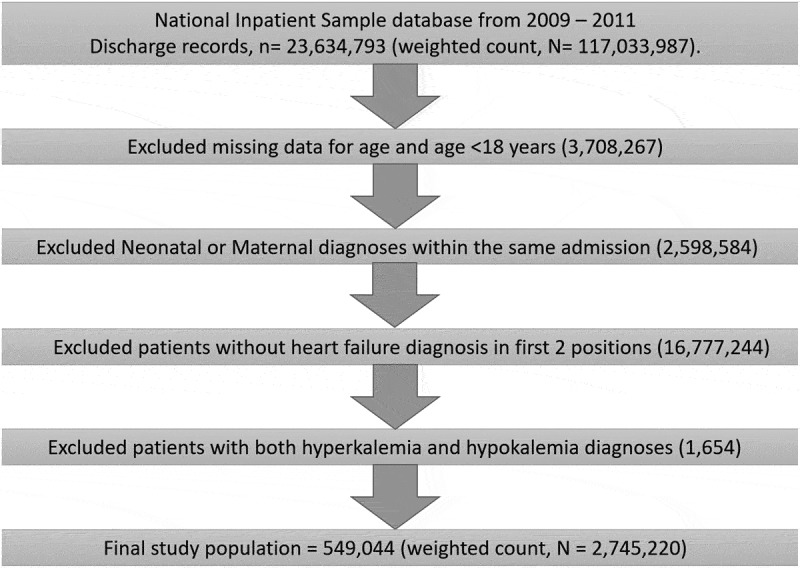
Background: Abnormalities in serum potassium levels have been associated with variable mortality risk among hospitalized patients with heart failure (HF). We aim to use a large database study to further characterize risk of mortality, demographic factors, and associated comorbidities among heart failure inpatients. Methods: Our sample population was from the US National Inpatient Sample database from the year 2009-2011. The inclusion criteria used to identify patients was those with a diagnosis of heart failure as per ICD-9 classification. Other demographic factors considered in data collection included income, and cardiac risk factors. Taking these factors into consideration, a univariate association of potassium level and mortality was performed, as well as multivariable logistic regression controlling for demographic factors and associated conditions. Results: Of the 2,660,609 patients who were discharged with a diagnosis of heart failure during this time period, patients with hypokalemia during hospitalization had increased mortality risk (OR: 1.96, 95% CI: 1.91-2.01) when compared with those with hyperkalemia who had decreased inpatient mortality risk OR: 0.94,95% CI: 0.91-0.96) versus those not coded for potassium abnormalities. This finding was significant even regardless of the etiology of the hypokalemia while the hyperkalemic patients were noted to have no difference or a decreased risk in all subtypes and groups. Conclusion: Unlike heart failure patients with hyperkalemia, those with hypokalemia are at an increased inpatient mortality risk. Whether our mortality findings translate to longer-term outpatient settings where significantly less monitoring is possible is a matter for further study.
Keywords: Heart failure; National Inpatient Sample; hyperkalemia; hypokalemia; mortality.
Figures
References
-
- Hoss S, Elizur Y, Luria D, et al. Serum potassium levels and outcome in patients with chronic heart failure. Am J Cardiol. 2016;118(12):1868–1874. - PubMed
LinkOut - more resources
Full Text Sources
Research Materials
Miscellaneous