


DECIDE: a cluster-randomized controlled trial to reduce unnecessary caesarean deliveries in Burkina Faso
- PMID: 31046752
- PMCID: PMC6498483
- DOI: 10.1186/s12916-019-1320-y
DECIDE: a cluster-randomized controlled trial to reduce unnecessary caesarean deliveries in Burkina Faso
Abstract
Background: In Burkina Faso, facility-based caesarean delivery rates have markedly increased since the national subsidy policy for deliveries and emergency obstetric care was implemented in 2006. Effective and safe strategies are needed to prevent unnecessary caesarean deliveries.
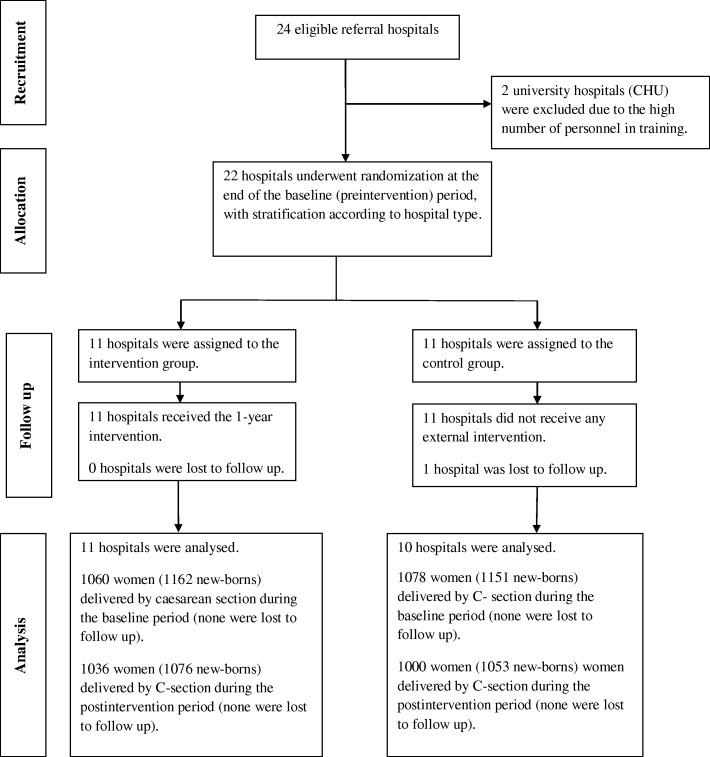
Methods: We conducted a cluster-randomized controlled trial of a multifaceted intervention at 22 referral hospitals in Burkina Faso. The evidence-based intervention was designed to promote the use of clinical algorithms for caesarean decision-making using in-site training, audits and feedback of caesarean indications and SMS reminders. The primary outcome was the change in the percentage of unnecessary caesarean deliveries. Unnecessary caesareans were defined on the basis of the literature review and expert consensus. Data were collected daily using a standardized questionnaire, in the same way at both the intervention and control hospitals. Caesareans were classified as necessary or unnecessary in the same way, in both arms of the trial using a standardized computer algorithm.
Results: A total of 2138 and 2036 women who delivered by caesarean section were analysed in the pre and post-intervention periods, respectively. A significant reduction in the percentage of unnecessary caesarean deliveries was evident from the pre- to post-intervention period in the intervention group compared with the control group (18.96 to 6.56% and 18.27 to 23.30% in the intervention and control groups, respectively; odds ratio [OR] for incremental change over time, adjusted for hospital and patient characteristics, 0.22; 95% confidence interval [CI], 0.14 to 0.34; P < 0.001; adjusted risk difference, - 17.02%; 95% CI, - 19.20 to - 13.20%). The intervention did not significantly affect the rate of maternal death (0.75 to 0.19% and 0.92 to 0.40% in the intervention and control groups, respectively; adjusted OR 0.32; 95% CI 0.04 to 2.23; P = 0.253) or intrapartum-related neonatal death (4.95 to 6.32% and 5.80 to 4.29% in the intervention and control groups, respectively, adjusted OR 1.73; 95% CI 0.82 to 3.66; P = 0.149). The overall perinatal mortality data were not available.
Conclusion: Promotion and training on clinical algorithms for decision-making, audit and feedback and SMS reminders reduced unnecessary caesarean deliveries, compared with usual care in a low-resource setting.
Trial registration: The DECIDE trial is registered on the Current Controlled Trials website: ISRCTN48510263 .
Keywords: Caesarean section; Clinical audit; Mobile phone-based interventions; Training.
Conflict of interest statement
Ethics approval and consent to participate
This trial protocol [29] was approved by the Ethics Committee of the University of Montreal Hospital Research Centre (CRCHUM) in Canada on March 26, 2014 (#13.356) (Additional file 9) and by the National Ethics Committee in Burkina Faso on February 5, 2014 (#2014-02-016) (Additional file 10). The DECIDE trial is registered on the Current Controlled Trials website: ISRCTN48510263. Participating hospitals were included on the basis of informed consent given by local authorities (hospital director and maternity service chief). The authorities were informed that (1) all hospitals are free to withdraw from the project at any time, (2) the intervention will be offered in hospitals in the control group at the end of the study if proven effective and (3) data collection will continue until the end of the study, even for hospitals that withdraw from the study. The collection of clinical data from hospital registers and medical records has been authorized by the hospital administrations and does not require patient consent.
All information collected on patients, health professionals and health facilities is confidential.
Consent for publication
Not applicable.
Competing interests
The authors declare that they have no competing interests.
Publisher’s Note
Springer Nature remains neutral with regard to jurisdictional claims in published maps and institutional affiliations.
Figures
References
-
- Fawcus S, Pattinson RC, Moodley J, Moran NF, Schoon MG, Mhlanga RE, Baloyi S, Bekker E, Gebhardt GS, for the National Committee on Confidential Enquiries into Maternal Deaths Maternal deaths from bleeding associated with caesarean delivery: a national emergency. S Afr Med J. 2016;106(5):472–476. doi: 10.7196/SAMJ.2016.v106i5.10821. - DOI - PubMed
-
- Sobhy S, Arroyo-Manzano D, Murugesu N, Karthikeyan G, Kumar V, Kaur I, Fernandez E, Gundabattula, S, Betran AP, Khan K, Zamora J, Thangaratinam S. Maternal and perinatal mortality and complications associated with caesarean section in low and middle-income countries: a systematic review and meta-analysis of 12 million pregnancies. Lancet 2018 (accepted). - PubMed
Publication types
MeSH terms
Associated data
Grants and funding
LinkOut - more resources
Full Text Sources
Medical
