


Comment
doi: 10.1016/j.biopsych.2019.03.975.
Do Sensitive Periods Exist for Exposure to Adversity?
Affiliations
- PMID: 31046937
- PMCID: PMC6580180
- DOI: 10.1016/j.biopsych.2019.03.975
Item in Clipboard
Comment
Do Sensitive Periods Exist for Exposure to Adversity?
Biol Psychiatry.
.
No abstract available
Conflict of interest statement
The authors report no biomedical financial interests or potential conflicts of interest.
Figures
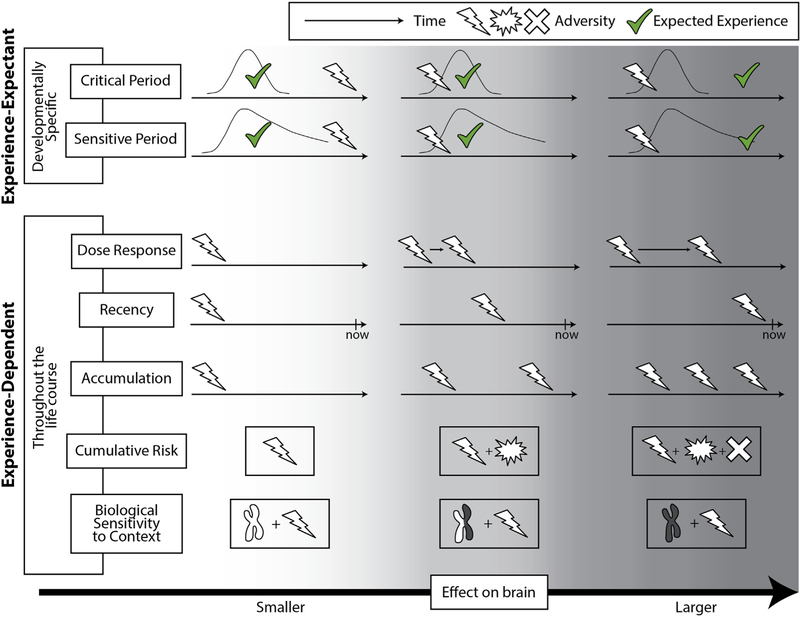
Conceptual models of environmental influence on neurodevelopment.
Numerous models explain how adverse environmental experiences influence brain
development. These models differ in their underlying neurobiological mechanisms,
involving either experience-expectant or experience-dependent processes.
Experience-expectant mechanisms are specific to development. They reflect neural
preparation by specific brain substrates to encode particular types of expected
experience (green checkmark) during specific windows of heightened
neuroplasticity (developmental changes in neuroplasticity levels shown as
curves). Critical and sensitive period models rely on experience-expectant
neuroplasticity, either solely within one window (critical periods) or with some
residual malleability thereafter (sensitive periods). Although most adversities
do not represent expected experiences that constitute critical/sensitive period
substrates, they may still influence these processes, depending on their timing.
(Left panels) Adverse experiences that happen after a critical/sensitive period
is completed have relatively little impact on that neural substrate. (Middle
panels) Adverse experience occurring before or during critical/sensitive periods
may alter their progression (e.g., accelerate or truncate the period). (Right
panels) Adversities that involve the deprivation or delay of expected experience
directly impact critical/sensitive period encoding of that experience. In
contrast, experience-dependent mechanisms reflect neural learning in response to
individual experiences. Experience-dependent mechanisms are available throughout
life, though the degree of neuroplasticity associated with these mechanisms can
vary across development. Dose-response, recency, and accumulation models
prioritize different dimensions of experience in terms of quantity and timing.
Dose-response models apply to contiguous, graded exposures like environmental
toxins and predict that adversity effects scale continuously with the degree or
duration of exposure. The recency model tested by Dunn et al.
(1) posits that adverse events closest
to the present time have the greatest effect on neurodevelopment. The
accumulation model they tested posits that the effect of an adversity varies
with the number of occurrences over a given window. Alternatively, the
cumulative risk model predicts that the effect of experience varies as a
function of the number of unique adversities experienced (regardless of timing),
rather than the number of occurrences of a single adversity. Biological
sensitivity to context models expect the effects of adversity to differ as a
function of individual traits like physiology and (epi)genetics (e.g., genetic
polymorphisms). No single conceptual model likely accounts for the entire range
of complex effects of adversity on neurodevelopment.
Comment in
-
The role of mild stressors in children's cognition and inflammation: positive and negative impacts depend on timing of exposure.Eur Psychiatry. 2023 Oct 26;66(1):e95. doi: 10.1192/j.eurpsy.2023.2468. Eur Psychiatry. 2023. PMID: 37881843 Free PMC article.
Comment on
-
Sensitive Periods for the Effect of Childhood Adversity on DNA Methylation: Results From a Prospective, Longitudinal Study.Biol Psychiatry. 2019 May 15;85(10):838-849. doi: 10.1016/j.biopsych.2018.12.023. Epub 2019 Jan 21. Biol Psychiatry. 2019. PMID: 30905381 Free PMC article.
References
-
- Evans GW, Li D, Whipple SS (2013): Cumulative risk and child development. Psychol Bull 139:1342–1396. - PubMed
-
- Gilbert ME (1997): Towards the development of a biologically based dose-response model of lead neurotoxicity. Amer Zool 37:389–398.
-
- Belsky J, Pluess M (2009): Beyond diathesis stress: Differential susceptibility to environmental influences. Psychol Bull 135:885–908. - PubMed
Publication types
MeSH terms
Grants and funding
LinkOut - more resources
Full Text Sources
Medical
