


Resurgence as Choice: Implications for promoting durable behavior change
- PMID: 31049954
- PMCID: PMC6625346
- DOI: 10.1002/jaba.573
Resurgence as Choice: Implications for promoting durable behavior change
Abstract
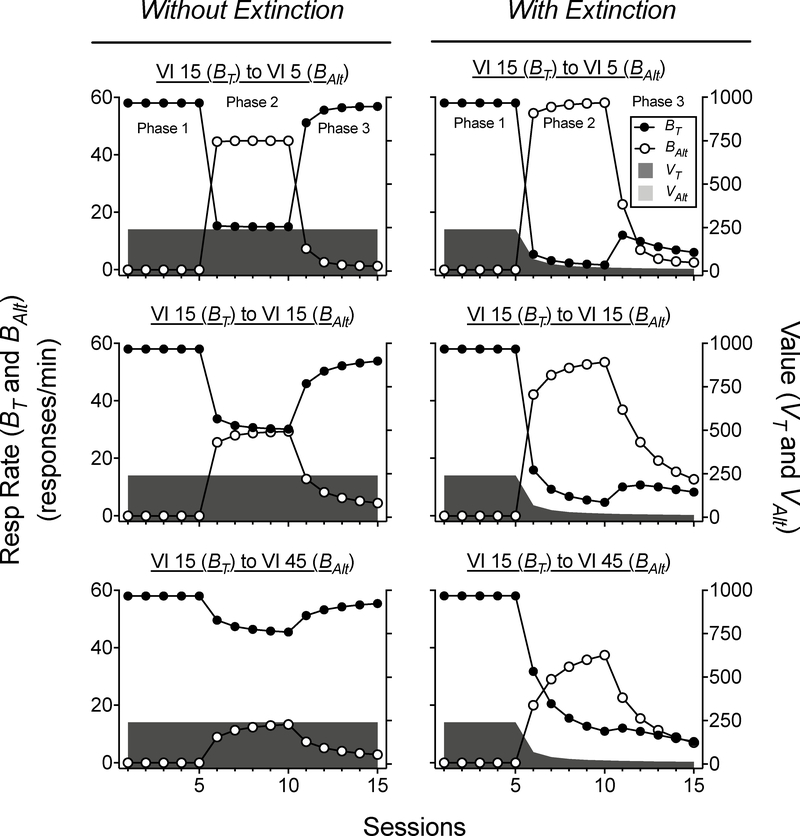
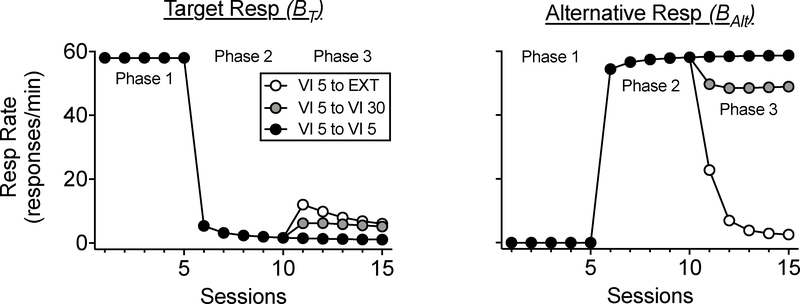
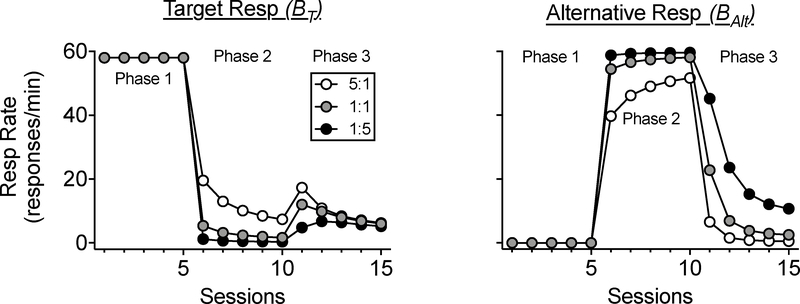
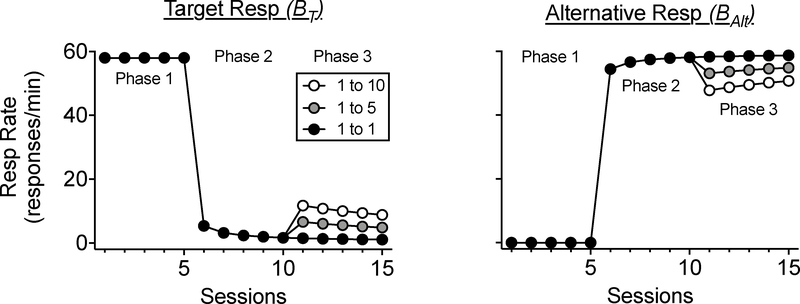
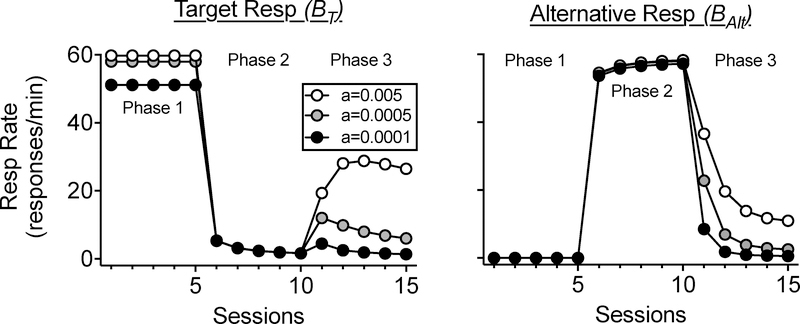
Resurgence is an increase in a previously suppressed behavior resulting from a worsening in reinforcement conditions for current behavior. Resurgence is often observed following successful treatment of problem behavior with differential reinforcement when reinforcement for an alternative behavior is subsequently omitted or reduced. The efficacy of differential reinforcement has long been conceptualized in terms of quantitative models of choice between concurrent operants (i.e., the matching law). Here, we provide an overview of a novel quantitative model of resurgence called Resurgence as Choice (RaC), which suggests that resurgence results from these same basic choice processes. We review the failures of the only other quantitative model of resurgence (i.e., Behavioral Momentum Theory) and discuss its shortcomings with respect to the limited range of circumstances about which it makes predictions in applied settings. Finally, we describe how RaC overcomes these shortcomings and discuss implications of the model for promoting durable behavior change.
Keywords: choice; differential reinforcement; problem behavior; relapse; resurgence.
© 2019 Society for the Experimental Analysis of Behavior.
Figures
References
-
- Bouton ME (2010). The multiple forms of “context” in associative learning theory In Mesquita B, Barrett LF, & Smith ER (Eds.), The mind in context (pp. 233–258). New York, NY: Guilford Press.
Publication types
MeSH terms
Grants and funding
LinkOut - more resources
Full Text Sources
Medical
Miscellaneous
