


Self-regulatory ability, fatigue, and the experience of pain: Mechanistic insights from pain-free undergraduates
- PMID: 31049991
- PMCID: PMC6699908
- DOI: 10.1111/psyp.13388
Self-regulatory ability, fatigue, and the experience of pain: Mechanistic insights from pain-free undergraduates
Abstract
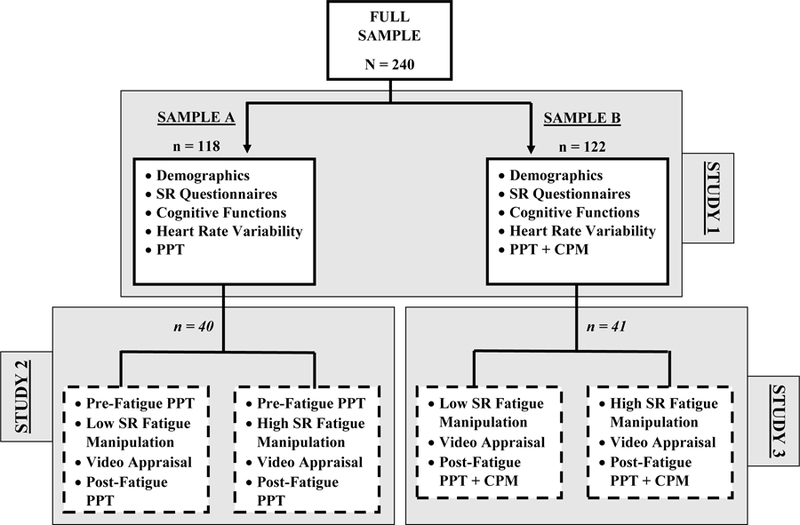
Self-regulatory (SR) ability is an important resource for managing pain, but chronic pain patients experience chronic self-regulatory fatigue even when they are not in pain. Pressure pain thresholds (PPT) and pain inhibition are two mechanisms that differentiate people with and without chronic pain. It was hypothesized that trait SR ability would be associated with higher PPT and better pain inhibition and that PPT and pain inhibition would be lower following high versus low SR fatigue. Three studies tested these hypotheses. Study 1 had 240 pain-free undergraduates complete measures of trait SR ability and PPT; 122 also provided data on pain inhibition. Study 2 had 38 of Study 1's participants return for two additional sessions in which they underwent PPT testing under conditions of high or low SR fatigue (within-person, counterbalanced). Study 3 repeated these procedures with pain inhibition as the outcome (n = 39). Results revealed that individual differences in SR ability were not associated with PPT or pain inhibition (all ps > 0.05). Within people, neither PPT (F(1, 36) = 1.57, p = 0.22) nor pain inhibition (F(1, 37) = 1.79, p = 0.19) were significantly different under conditions of low versus high SR fatigue. Results do not support the hypotheses that PPT or pain inhibition associate with individual differences in trait SR ability or transient changes in state SR fatigue in the absence of pain. Instead, the SR deficits in chronic pain patients may arise from the experience of chronic pain.
Keywords: fatigue; heart rate variability; pain; young adults.
© 2019 Society for Psychophysiological Research.
Conflict of interest statement
The Authors declare that there is no conflict of interest.
Figures
References
-
- Aviv AL, Zelenski JM, Rallo L, & Larsen RJ (2002). Who comes when: Personality differences in early and later participation in a university subject pool. Personality and Individual Differences, 33(3), 487–496. 10.1016/S0191-8869(01)00199-4 - DOI
-
- Baumeister RF, Tice DM, & Vohs KD (2018). The strength model of self-regulation: Conclusions from the second decade of willpower research. Perspectives on Psychological Science, 13(2), 141–145. Doi: 1o0i.1or1g7/170/.1177475/617941561971761767914669 - PubMed
-
- Baumeister RF, & Tierney J (2012). Willpower: Rediscovering the greatest human strength Penguin.
Publication types
MeSH terms
Grants and funding
LinkOut - more resources
Full Text Sources
Medical
Research Materials
