


Fractionating auditory priors: A neural dissociation between active and passive experience of musical sounds
- PMID: 31051008
- PMCID: PMC6499420
- DOI: 10.1371/journal.pone.0216499
Fractionating auditory priors: A neural dissociation between active and passive experience of musical sounds
Abstract
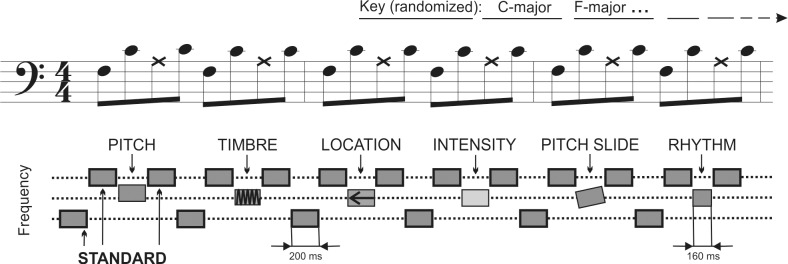
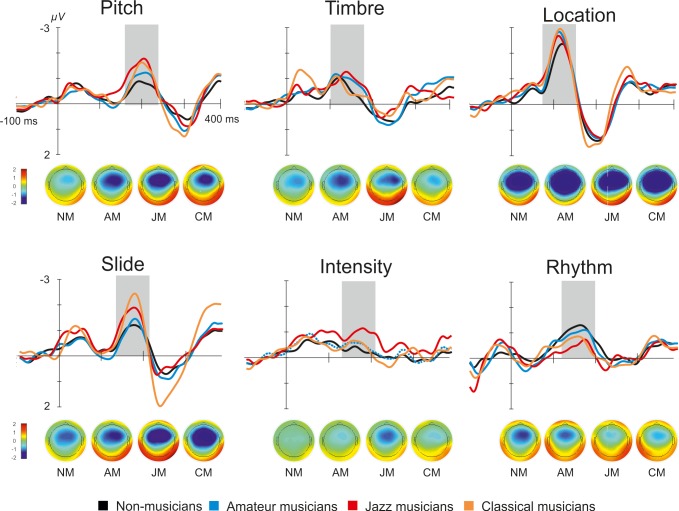
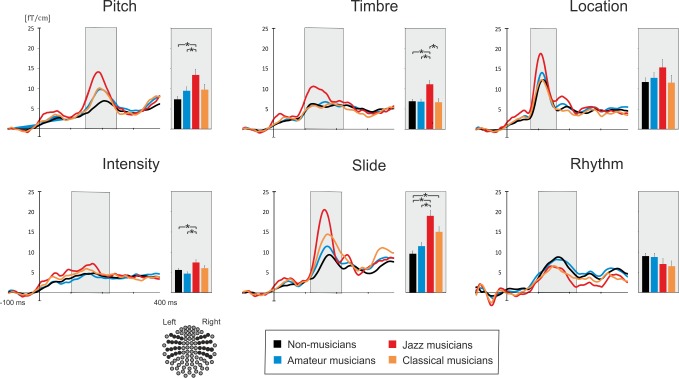
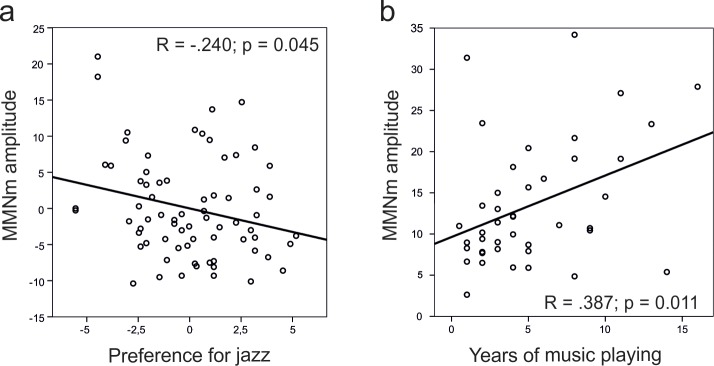
Learning, attention and action play a crucial role in determining how stimulus predictions are formed, stored, and updated. Years-long experience with the specific repertoires of sounds of one or more musical styles is what characterizes professional musicians. Here we contrasted active experience with sounds, namely long-lasting motor practice, theoretical study and engaged listening to the acoustic features characterizing a musical style of choice in professional musicians with mainly passive experience of sounds in laypersons. We hypothesized that long-term active experience of sounds would influence the neural predictions of the stylistic features in professional musicians in a distinct way from the mainly passive experience of sounds in laypersons. Participants with different musical backgrounds were recruited: professional jazz and classical musicians, amateur musicians and non-musicians. They were presented with a musical multi-feature paradigm eliciting mismatch negativity (MMN), a prediction error signal to changes in six sound features for only 12 minutes of electroencephalography (EEG) and magnetoencephalography (MEG) recordings. We observed a generally larger MMN amplitudes-indicative of stronger automatic neural signals to violated priors-in jazz musicians (but not in classical musicians) as compared to non-musicians and amateurs. The specific MMN enhancements were found for spectral features (timbre, pitch, slide) and sound intensity. In participants who were not musicians, the higher preference for jazz music was associated with reduced MMN to pitch slide (a feature common in jazz music style). Our results suggest that long-lasting, active experience of a musical style is associated with accurate neural priors for the sound features of the preferred style, in contrast to passive listening.
Conflict of interest statement
The authors have declared that no competing interests exist.
Figures
References
-
- Tervaniemi M, Maury S, Näätänen R. Neural representations of abstract stimulus features in the human brain as reflected by the mismatch negativity. Neuroreport. 1994;5: 844–846. - PubMed
Publication types
MeSH terms
LinkOut - more resources
Full Text Sources
