. 2019 May 2;104(5):896-913.
doi: 10.1016/j.ajhg.2019.03.020.

Genes with High Network Connectivity Are Enriched for Disease Heritability

Affiliations

Genes with High Network Connectivity Are Enriched for Disease Heritability

Samuel S Kim et al. Am J Hum Genet. .

Erratum in

Abstract

Recent studies have highlighted the role of gene networks in disease biology. To formally assess this, we constructed a broad set of pathway, network, and pathway+network annotations and applied stratified LD score regression to 42 diseases and complex traits (average N = 323K) to identify enriched annotations. First, we analyzed 18,119 biological pathways. We identified 156 pathway-trait pairs whose disease enrichment was statistically significant (FDR < 5%) after conditioning on all genes and 75 known functional annotations (from the baseline-LD model), a stringent step that greatly reduced the number of pathways detected; most significant pathway-trait pairs were previously unreported. Next, for each of four published gene networks, we constructed probabilistic annotations based on network connectivity. For each gene network, the network connectivity annotation was strongly significantly enriched. Surprisingly, the enrichments were fully explained by excess overlap between network annotations and regulatory annotations from the baseline-LD model, validating the informativeness of the baseline-LD model and emphasizing the importance of accounting for regulatory annotations in gene network analyses. Finally, for each of the 156 enriched pathway-trait pairs, for each of the four gene networks, we constructed pathway+network annotations by annotating genes with high network connectivity to the input pathway. For each gene network, these pathway+network annotations were strongly significantly enriched for the corresponding traits. Once again, the enrichments were largely explained by the baseline-LD model. In conclusion, gene network connectivity is highly informative for disease architectures, but the information in gene networks may be subsumed by regulatory annotations, emphasizing the importance of accounting for known annotations.

Keywords: baseline LD; functional annotations; gene network; genetic architecture; heritability enrichment; hub genes; network analysis; network connectivity; pathway; pathway analysis.


Figures

Figure 1
Figure 1
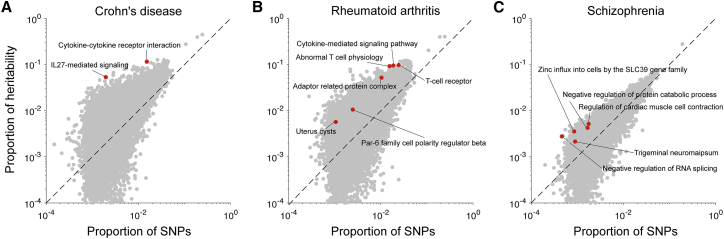
Enriched Pathways for Three Representative Traits For (A) Crohn disease, (B) rheumatoid arthritis, and (C) schizophrenia, we report the proportion of heritability explained and proportion of SNPs for each of 18,119 pathways analyzed. Red points indicate significantly enriched pathways (FDR < 5%) and gray points indicate non-significant pathways. Numerical results for all 42 diseases and complex traits are reported in Table S4.
Figure 2
Figure 2
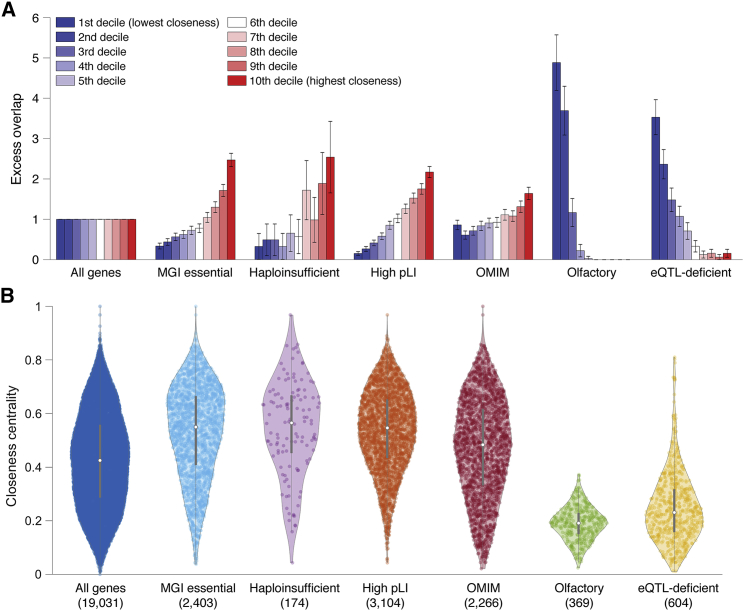
Comparison of Closeness Centrality to Other Metrics that Quantify the Biological Importance of Each Gene (A) For each of 7 gene sets, we report the excess overlap of genes in each decile bin of closeness centrality for the Greene thyroid network. Error bars represent 95% confidence intervals. (B) For each of 7 gene sets, we report the distribution of closeness centrality for the Greene thyroid network. Colored dots denote genes, white dots denote medians, and gray lines denote boxplots. Numbers in parentheses below each gene set denote the number of genes. Results for all four networks and all 18 gene sets analyzed are reported in Figure S3 and Table S13 (for A) and Figure S4 and Table S14 (for B). Lists of genes for each of the 18 gene sets are provided in Table S3.
Figure 3
Figure 3
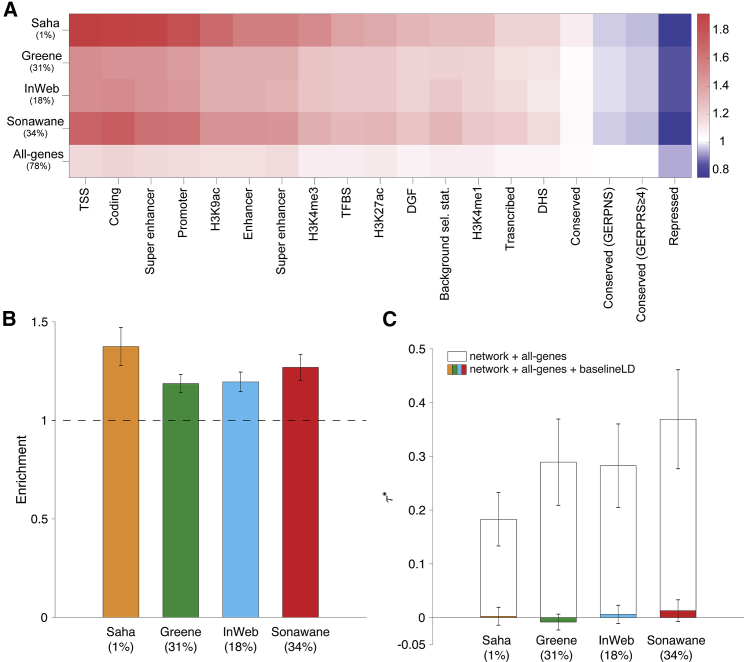
Heritability Enrichment of Network Annotations We report (A) excess (fold) overlap between network annotations and baseline-LD functional categories; (B) heritability enrichment of network annotations, meta-analyzed across 42 independent traits; and (C) τ values of network annotations, conditioned on either just the all-genes annotation, or the all-genes annotation and the baseline-LD model, meta-analyzed across 42 independent traits. The percentage under each bar indicates the proportion of SNPs in each annotation (defined for probabilistic annotations as the average value of the annotation), and error bars represent 95% confidence intervals. Numerical results for (A) are reported in Table S16, and numerical results for (B) and (C) are reported in Table S22. The S-LDSC results for the complete set of 168 network-trait pairs are reported in Table S22.
Figure 4
Figure 4
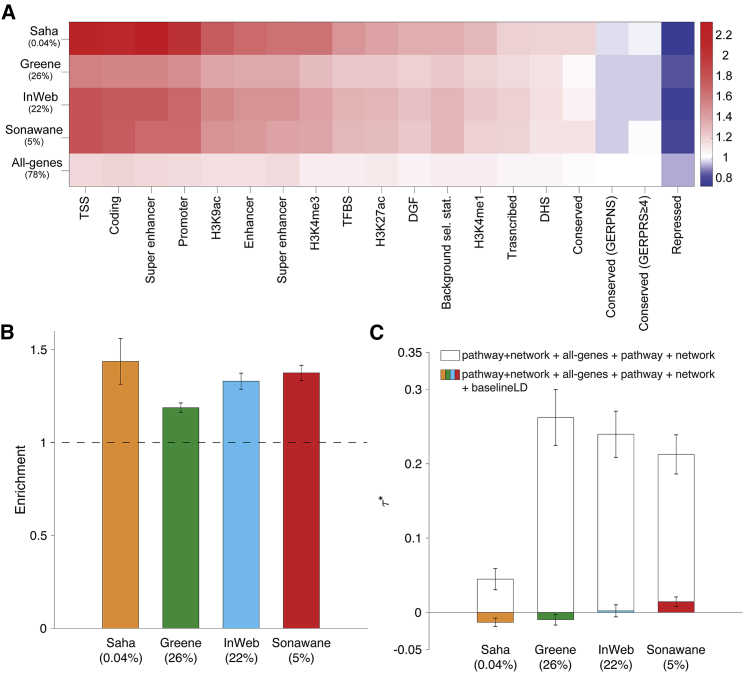
Heritability Enrichment of Pathway+Network Annotations We report (A) excess (fold) overlap between pathway+network annotations (averaged across up to 156 pathway-trait pairs); (B) heritability enrichment of pathway+network annotations, meta-analyzed across up to 156 pathway-trait pairs; and (C) τ values of pathway+network annotations, conditioned on either just the all-genes annotation and the corresponding pathway and network annotations, or the baseline-LD model as well, meta-analyzed across up to 156 pathway-trait pairs. The percentage under each bar indicates the proportion of SNPs in each annotation (defined for probabilistic annotations as the average value of the annotation), and error bars represent 95% confidence intervals. Numerical results for (A) are reported in Table S16, and numerical results for (B) and (C) are reported in Table S34. The S-LDSC results for the complete set of 590 pathway-trait pairs are reported in Table S34.
Figure 5
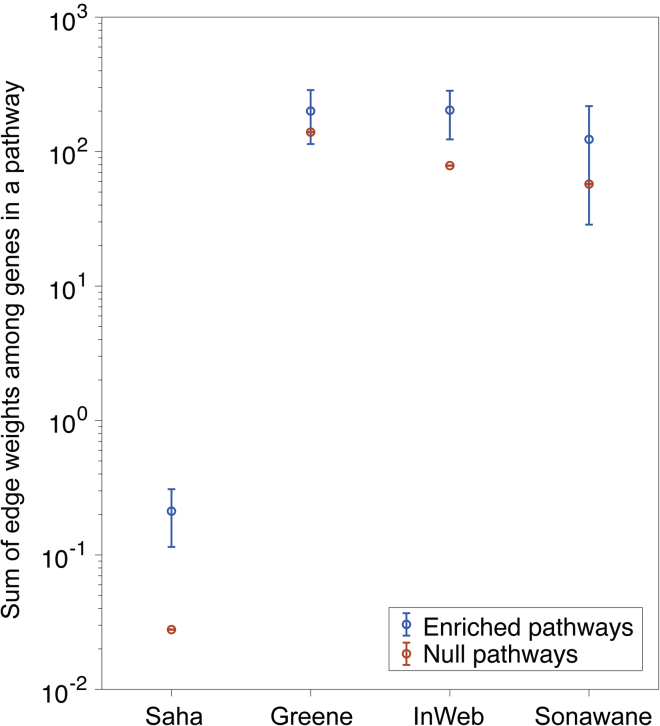
Figure 5
Genes in Enriched Pathways Have High Network Connectivity For each of four networks, we report the sum of edge weights in the network between genes in the pathway, averaged across 141 enriched pathways. For comparison purposes, we report the same quantity averaged across 10,000 null pathways with the same number of genes. Error bars represent 95% confidence intervals (smaller than data points for null pathways). Numerical results and analogous results for network connectivity between a pathway and interacting genes outside the pathway are reported in Table S36.

References

    1. Visscher P.M., Wray N.R., Zhang Q., Sklar P., McCarthy M.I., Brown M.A., Yang J. 10 years of gwas discovery: biology, function, and translation. Am. J. Hum. Genet. 2017;101:5–22. - PMC - PubMed
    1. Boyle E.A., Li Y.I., Pritchard J.K. An expanded view of complex traits: from polygenic to omnigenic. Cell. 2017;169:1177–1186. - PMC - PubMed
    1. Menche J., Sharma A., Kitsak M., Ghiassian S.D., Vidal M., Loscalzo J., Barabási A.-L. Disease networks. Uncovering disease-disease relationships through the incomplete interactome. Science. 2015;347:1257601. - PMC - PubMed
    1. Barabási A.-L., Gulbahce N., Loscalzo J. Network medicine: a network-based approach to human disease. Nat. Rev. Genet. 2011;12:56–68. - PMC - PubMed
    1. Chen Y., Zhu J., Lum P.Y., Yang X., Pinto S., MacNeil D.J., Zhang C., Lamb J., Edwards S., Sieberts S.K. Variations in DNA elucidate molecular networks that cause disease. Nature. 2008;452:429–435. - PMC - PubMed

Publication types