


Changing epidemiology of Listeria monocytogenes outbreaks, sporadic cases, and recalls globally: A review of ProMED reports from 1996 to 2018
- PMID: 31051276
- PMCID: PMC6579688
- DOI: 10.1016/j.ijid.2019.04.021
Changing epidemiology of Listeria monocytogenes outbreaks, sporadic cases, and recalls globally: A review of ProMED reports from 1996 to 2018
Abstract
Background: The purpose of this study was to identify global trends in Listeria monocytogenes epidemiology using ProMED reports. ProMED is a publicly available, global outbreak reporting system that uses both informal and formal sources. In the context of Listeria, ProMED reports on atypical findings such as higher than average case counts, events from unusual sources, and multinational outbreaks.
Methods: Keywords "Listeria" and "listeriosis" were utilized in the ProMED search engine covering the years 1996-2018. Issue date, countries involved, source, suspected and confirmed case counts, and fatalities were extracted. Data unique to each event, including commentary by content experts, were evaluated. When multiple reports regarding the same outbreak or recall were obtained, the last report pertaining to that outbreak was utilized. Rates of Listeria events over time were compared using a normal approximation to the Poisson distribution; p < 0.05 was considered to be statistically significant.
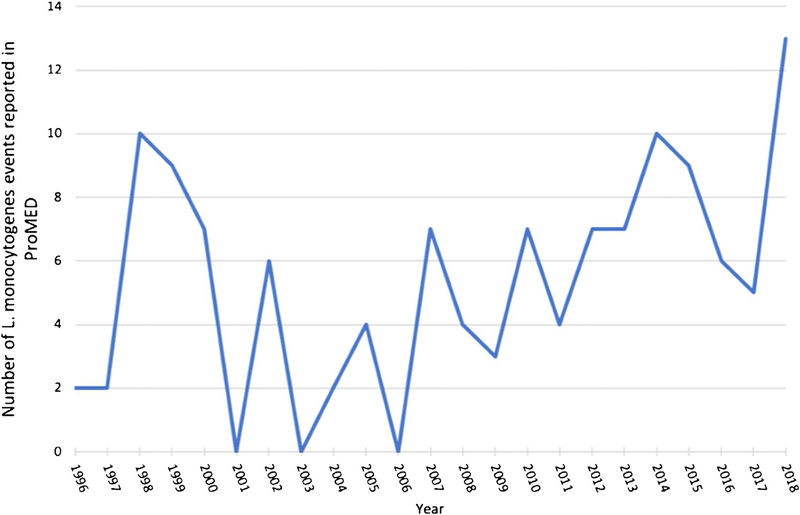
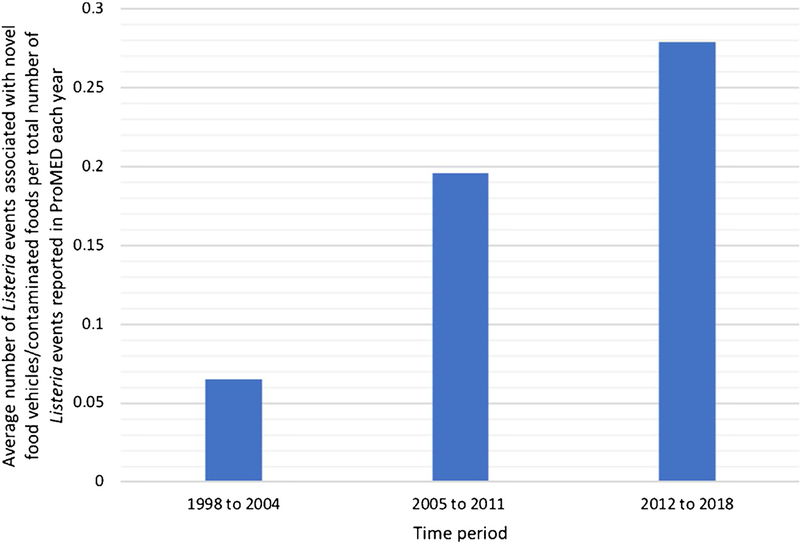
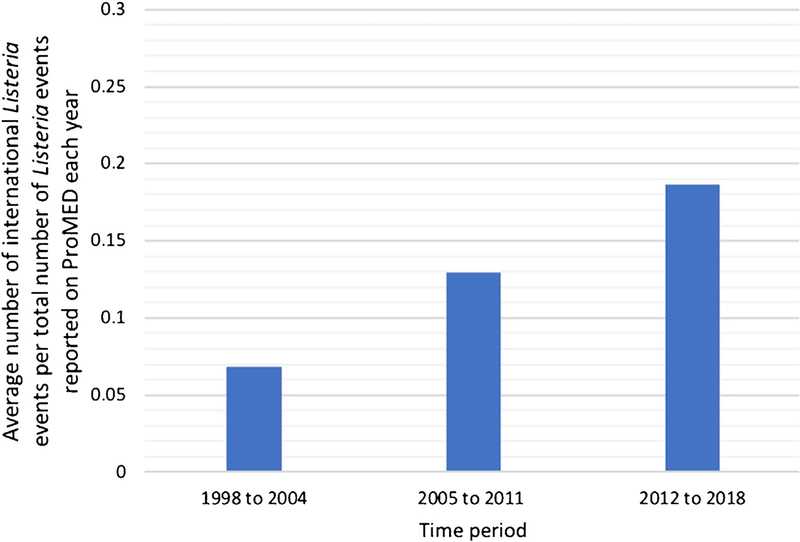
Results: From 1996 through 2018, 123 Listeria events were identified in the ProMED database. Eighty-one events (65%) were associated with two or more human cases (outbreak events), 13 events (11%) were associated with only one human case (sporadic cases), and 29 events (24%) were precautionary food product recalls due to the presence of bacterial contamination without associated human cases. The implicated food vehicle was identified in 69 (85%) outbreak events and in 10 (77%) sporadic case events. Listeria contaminated foods were identified in all precautionary recall events. Overall, 28 events (23%) implicated novel food vehicles/sources. Events associated with novel food vehicles increased over the study period (p < 0.02), as did international events with more than one country involved (p < 0.02). Ten reports (8%) described hospital-acquired events.
Conclusions: This study demonstrates the use of publicly available data to document Listeria epidemiological trends, particularly in settings where foodborne disease surveillance is weak or non-existent. Over the last decade, an increasing number of events have been associated with foods not traditionally recognized as vehicles for Listeria transmission, and a rise in international events was noted. Informing high-risk individuals such as pregnant women and immunocompromised individuals of safe food handling practices is warranted. To ensure timely recall of contaminated food products, open data sharing and communication across borders is critical. Changes in food production and distribution, and improved diagnostics may have contributed to the observed changes.
Keywords: Disease surveillance; Epidemiology; Food safety; Listeria.
Copyright © 2019 The Author(s). Published by Elsevier Ltd.. All rights reserved.
Conflict of interest statement
Conflict of interest
The authors declare that they have no competing interests.
Figures
References
-
- Allerberger F, Wagner M. Listeriosis: a resurgent foodborne infection. Clin Microbiol Infect 2010;16(January (1)):16–23. - PubMed
-
- Auvolat A, Besse NG. The challenge of enumerating Listeria monocytogenes in food. Food Microbiol 2016;53(February (Pt B)):135–49. - PubMed
-
- Buchanan RL, Gorris LGM, Hayman MM, Jackson TC, Whiting RC. A review of Listeria monocytogenes: an update on outbreaks, virulence, dose-response, ecology, and risk assessments. Food Control 2017;75(May):1–13.
