Review
. 2019 Apr 30;11(5):404.
doi: 10.3390/v11050404.

Giant Viruses-Big Surprises

Affiliations
Review

Giant Viruses-Big Surprises

Nadav Brandes et al. Viruses. .

Abstract

Viruses are the most prevalent infectious agents, populating almost every ecosystem on earth. Most viruses carry only a handful of genes supporting their replication and the production of capsids. It came as a great surprise in 2003 when the first giant virus was discovered and found to have a >1 Mbp genome encoding almost a thousand proteins. Following this first discovery, dozens of giant virus strains across several viral families have been reported. Here, we provide an updated quantitative and qualitative view on giant viruses and elaborate on their shared and variable features. We review the complexity of giant viral proteomes, which include functions traditionally associated only with cellular organisms. These unprecedented functions include components of the translation machinery, DNA maintenance, and metabolic enzymes. We discuss the possible underlying evolutionary processes and mechanisms that might have shaped the diversity of giant viruses and their genomes, highlighting their remarkable capacity to hijack genes and genomic sequences from their hosts and environments. This leads us to examine prominent theories regarding the origin of giant viruses. Finally, we present the emerging ecological view of giant viruses, found across widespread habitats and ecological systems, with respect to the environment and human health.

Keywords: Amebae viruses; NCLDV; dsdna viruses; mimivirus; pandoravirus; protein domains; translation machinery; viral evolution.


Conflict of interest statement

The authors declare no conflict of interest.

Figures
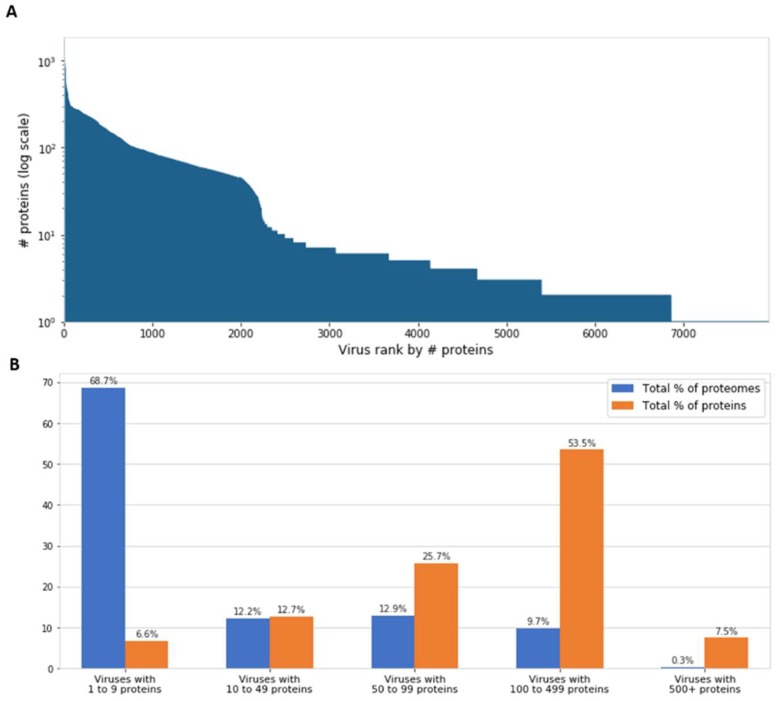
Figure 1
Figure 1
Number of proteins encoded by viruses. (A) The number of encoded proteins (y-axis) in all 7,959 viral representatives, ranked in descending order. (B) Partitioning of the 7959 viral proteomes by the number of encoded proteins. The 0.3% viral proteomes with the highest number of proteins (over 500) encode 7.5% of the total number of viral proteins.
Figure 2
Figure 2
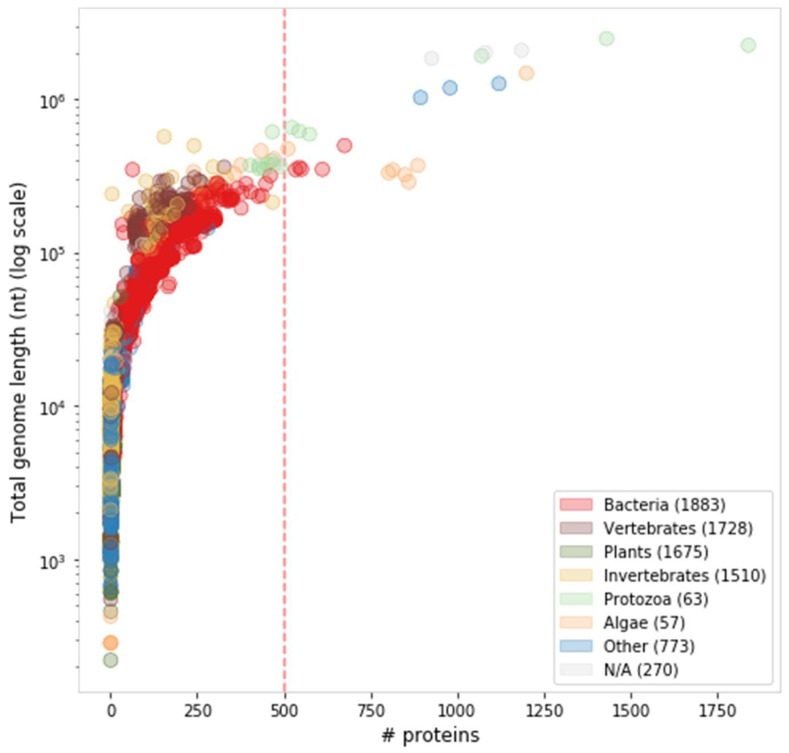
Distribution of viral proteome and genome sizes, colored by host taxonomy. There are 24 represented genomes that meet the threshold of ≥500 proteins (dashed red line), comprising five bacteria-infecting and 19 eukaryote-infecting viruses.
Figure 3
Figure 3
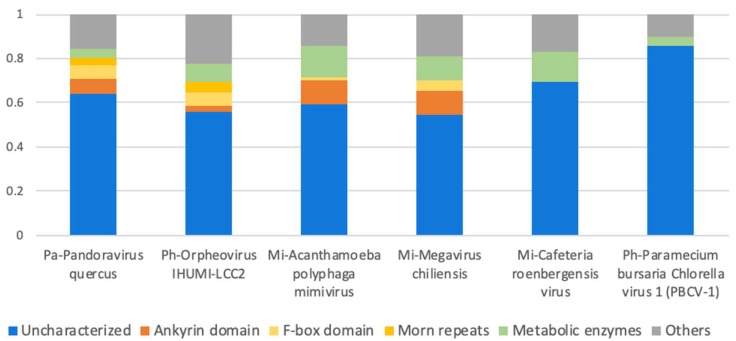
Protein function categories in six giant virus representatives from three families: Mimiviridae (Mi), Pandoviridae (Pa) and Phycodnaviridae (Ph). In all proteomes, the majority of proteins are uncharacterized. Short repeated domains such as ankyrin, F-box and MORM repeats are abundant in the proteomes of amebae-infecting giant viruses [71].

References

    1. Holmes E.C. What does virus evolution tell us about virus origins? J. Virol. 2011;85:5247–5251. doi: 10.1128/JVI.02203-10. - DOI - PMC - PubMed
    1. Forterre P. The origin of viruses and their possible roles in major evolutionary transitions. Virus Res. 2006;117:5–16. doi: 10.1016/j.virusres.2006.01.010. - DOI - PubMed
    1. Yutin N., Koonin E.V. Evolution of DNA ligases of nucleo-cytoplasmic large DNA viruses of eukaryotes: A case of hidden complexity. Biol. Direct. 2009;4:51. doi: 10.1186/1745-6150-4-51. - DOI - PMC - PubMed
    1. Forterre P. Viruses in the 21st Century: From the Curiosity-Driven Discovery of Giant Viruses to New Concepts and Definition of Life. Clin. Infect. Dis. 2017;65:S74–S79. doi: 10.1093/cid/cix349. - DOI - PubMed
    1. Moelling K., Broecker F. Viruses and Evolution - Viruses First? A Personal Perspective. Front. Microbiol. 2019;10:523. doi: 10.3389/fmicb.2019.00523. - DOI - PMC - PubMed

LinkOut - more resources