


Antioxidant and Photoprotective Activity of Apigenin and its Potassium Salt Derivative in Human Keratinocytes and Absorption in Caco-2 Cell Monolayers
- PMID: 31052292
- PMCID: PMC6539602
- DOI: 10.3390/ijms20092148
Antioxidant and Photoprotective Activity of Apigenin and its Potassium Salt Derivative in Human Keratinocytes and Absorption in Caco-2 Cell Monolayers
Abstract
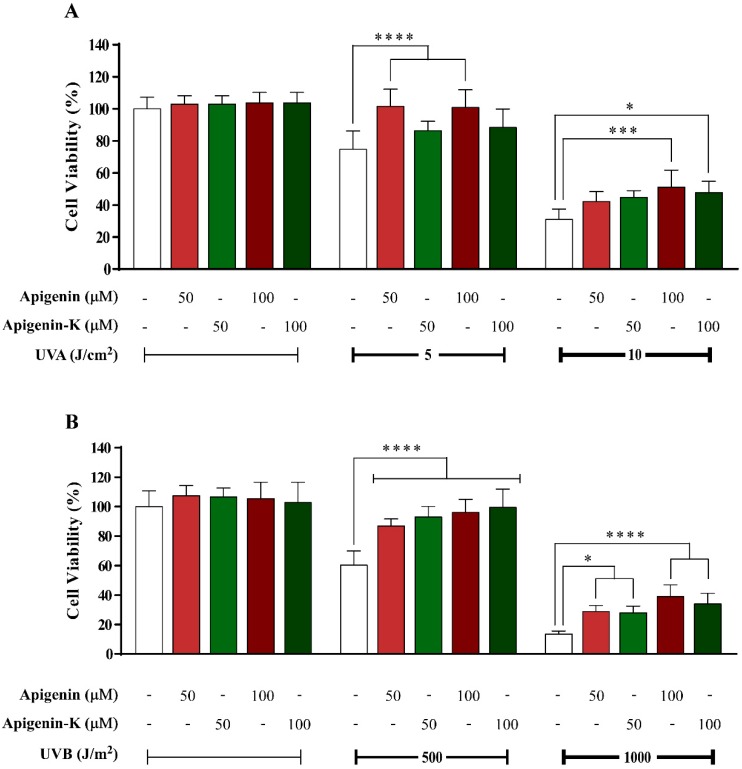
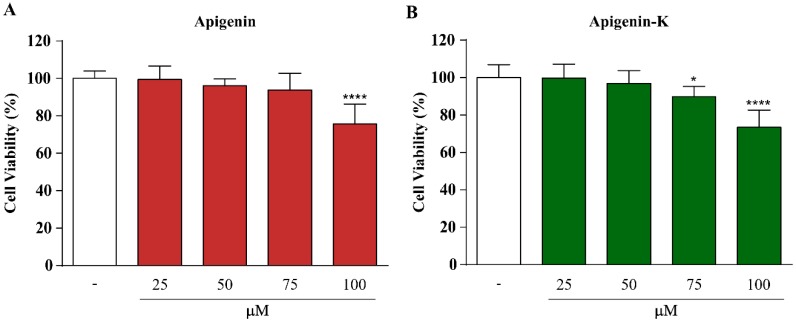
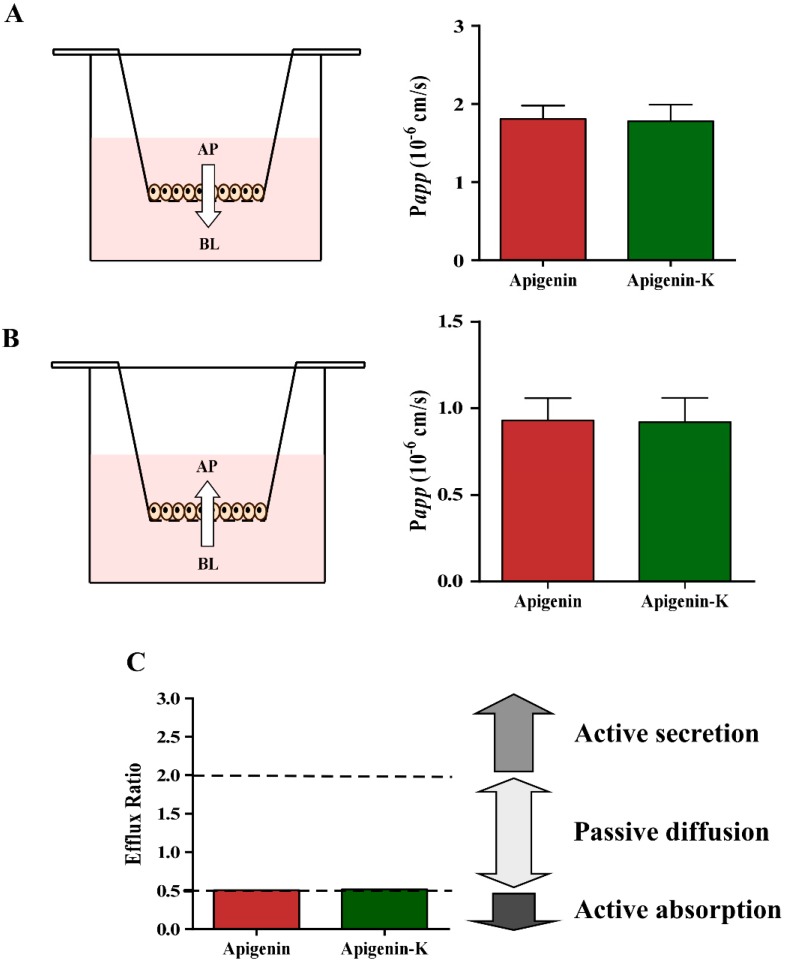
Ultraviolet (UV) radiation, especially types A (UVA) and B (UVB), is one of the main causes of skin disorders, including photoaging and skin cancer. Ultraviolent radiation causes oxidative stress, inflammation, p53 induction, DNA damage, mutagenesis, and oxidation of various molecules such as lipids and proteins. In recent decades, the use of polyphenols as molecules with an antioxidant and anti-inflammatory capacity has increased. However, some of these compounds are poorly soluble, and information regarding their absorption and bioavailability is scarce. The main objective of this study was to compare the intestinal absorption and biological activity of apigenin and its more soluble potassium salt (apigenin-K) in terms of antioxidant and photoprotective capacity. Photoprotective effects against UVA and UVB radiation were studied in human keratinocytes, and antioxidant capacity was determined by different methods, including trolox equivalent antioxidant capacity (TEAC), ferric reducing antioxidant power (FRAP) and oxygen radical absorbance capacity (ORAC) assays. Finally, the intestinal absorption of both apigenins was determined using an in vitro Caco-2 cell model. Apigenin showed a slightly higher antioxidant capacity in antioxidant activity assays when compared with apigenin-K. However, no significant differences were obtained for their photoprotective capacities against UVA or UVB. Results indicated that both apigenins protected cell viability in approximately 50% at 5 J/m2 of UVA and 90% at 500 J/m2 of UVB radiation. Regarding intestinal absorption, both apigenins showed similar apparent permeabilities (Papp), 1.81 × 10⁻⁵ cm/s and 1.78 × 10⁻⁵ cm/s, respectively. Taken together, these results suggest that both apigenins may be interesting candidates for the development of oral (nutraceutical) and topical photoprotective ingredients against UVA and UVB-induced skin damage, but the increased water solubility of apigenin-K makes it the best candidate for further development.
Keywords: UV radiation; absorption; antioxidant; apigenin; flavonoid; keratinocytes; photoprotection.
Conflict of interest statement
The authors declare no conflict of interest.
Figures
References
MeSH terms
Substances
Grants and funding
- AGL2011-29857-C03-03 and IDI-20120751/Ministerio de Ciencia e Innovación
- AGL2015-67995-C3-1-R, AGL2015-67995-C3-2-R and AGL2015-67995-C3-3-R/Ministerio de Economía, Industria y Competitividad, Gobierno de España
- PROMETEO/2016/006, ACOMP/2013/093, ACIF/2015/158, APOTIP/2017/003 and APOSTD/2018/097/Generalitat Valenciana
- CB12/03/30038/CIBER (CB12/03/30038, Fisiopatología de la Obesidad y la Nutrición, CIBERobn, Instituto de Salud Carlos III
LinkOut - more resources
Full Text Sources
Medical
Research Materials
Miscellaneous
