Review
. 2019 May 1;20(9):2158.
doi: 10.3390/ijms20092158.

Quiescence Entry, Maintenance, and Exit in Adult Stem Cells

Affiliations
Review

Quiescence Entry, Maintenance, and Exit in Adult Stem Cells

Karamat Mohammad et al. Int J Mol Sci. .

Abstract

Cells of unicellular and multicellular eukaryotes can respond to certain environmental cues by arresting the cell cycle and entering a reversible state of quiescence. Quiescent cells do not divide, but can re-enter the cell cycle and resume proliferation if exposed to some signals from the environment. Quiescent cells in mammals and humans include adult stem cells. These cells exhibit improved stress resistance and enhanced survival ability. In response to certain extrinsic signals, adult stem cells can self-renew by dividing asymmetrically. Such asymmetric divisions not only allow the maintenance of a population of quiescent cells, but also yield daughter progenitor cells. A multistep process of the controlled proliferation of these progenitor cells leads to the formation of one or more types of fully differentiated cells. An age-related decline in the ability of adult stem cells to balance quiescence maintenance and regulated proliferation has been implicated in many aging-associated diseases. In this review, we describe many traits shared by different types of quiescent adult stem cells. We discuss how these traits contribute to the quiescence, self-renewal, and proliferation of adult stem cells. We examine the cell-intrinsic mechanisms that allow establishing and sustaining the characteristic traits of adult stem cells, thereby regulating quiescence entry, maintenance, and exit.

Keywords: adult stem cells; cell cycle; cell signaling; cellular quiescence; mechanisms of quiescence entry and exit; mechanisms of quiescence maintenance; metabolism; mitochondria; proteostasis; reactive oxygen species.


Conflict of interest statement

The authors declare no conflict of interest.

Figures
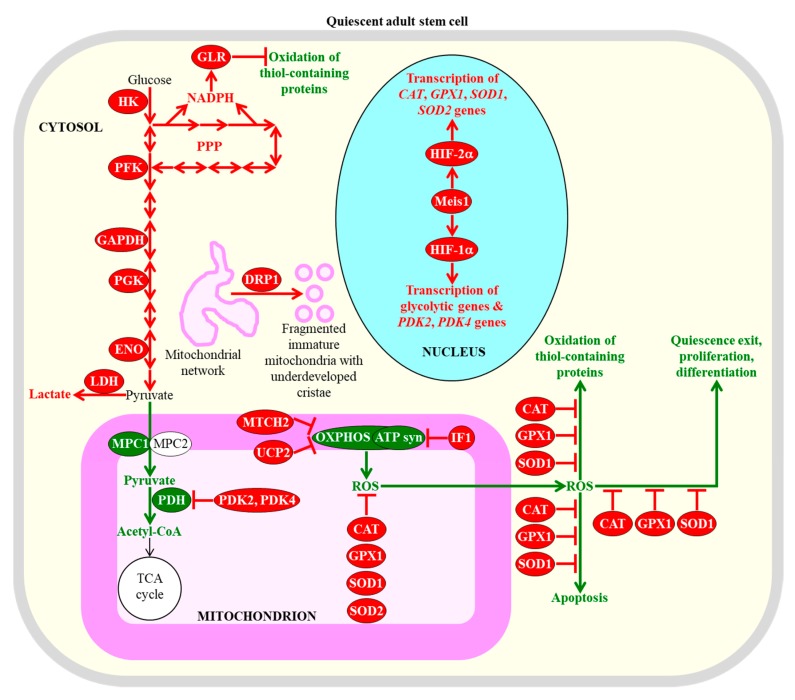
Figure 1
Figure 1
Some common metabolic features of adult stem cells are essential for the maintenance of their quiescence, number, proliferation potential, and differentiation ability. Among these metabolic features are carbohydrate metabolism mainly through aerobic glycolysis in the cytosol, suppressed carbohydrate oxidation in mitochondria, mitochondrial network fragmentation into globular and immature mitochondria with underdeveloped cristae, and stimulated ROS detoxification in several cellular locations. Enzymes, metabolites and processes whose activities, concentrations and rates are increased or decreased in quiescent adult stem cells (as compared to their fully differentiated progeny) are displayed in red or green color, respectively. The red one-way arrows and the red two-way arrows define irreversible and reversible (respectively) chemical reactions whose rates are increased in quiescent adult stem cells. The red inhibitory bars define inhibitory effects whose intensities are increased in quiescent adult stem cells. The green arrows define chemical reactions or processes whose rates or intensities are decreased in quiescent adult stem cells. The black arrow defines the irreversible chemical reaction whose rate is not changed in quiescent adult stem cells. See text for more details. Abbreviations: ATP syn, ATP synthase; CAT, catalase; DRP1, dynamin-related protein 1; ENO, enolase; GAPDH, glyceraldehyde 3-phosphate dehydrogenase; GLR, glutathione reductase; GPX1, glutathione peroxidase type 1; HIF-1α and HIF-2α, transcription factor hypoxia-inducible factors 1α and 2α, respectively; HK, hexokinase; IF1, inhibitory factor 1; LDH, lactate dehydrogenase; Meis1, myeloid ecotropic viral insertion site 1; MPC1 and MPC2, mitochondrial pyruvate carrier subunits 1 and 2; MTCH2, mitochondrial carrier homolog 2; OXPHOS, oxidative phosphorylation; PDH, pyruvate dehydrogenase; PDK2 and PDK4, pyruvate dehydrogenase kinases 2 and 4 (respectively); PFK, phosphofructokinase; PGK, phosphoglycerate kinase; PPP, pentose phosphate pathway; ROS, reactive oxygen species; SOD1 and SOD2, superoxide dismutases 1 and 2 (respectively); UCP2, uncoupling protein 2.
Figure 2
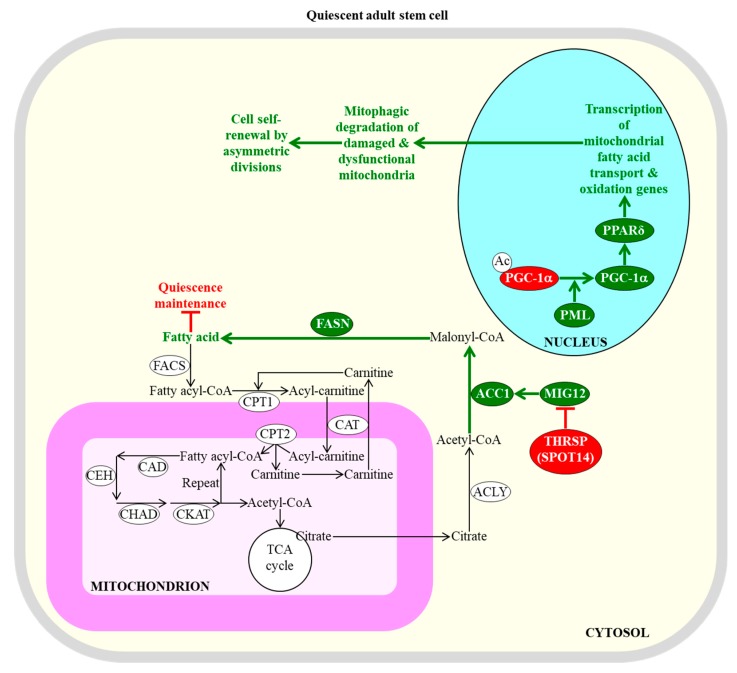
Figure 2
Mitochondrial β-oxidation of fatty acids and their synthesis in the cytosol of adult stem cells control the efficiency with which these cells can sustain quiescence or self-renew by asymmetric divisions. An inhibition of fatty acid synthesis in the cytosol is needed to sustain the quiescent state of adult neural stem cells. An activation of the transcription of nuclear genes that are involved in mitochondrial fatty acid transport and β-oxidation within adult stem cells is essential for the self-renewal of these cells by asymmetric divisions; such divisions lead to the formation of a new quiescent stem cell and an actively dividing daughter progenitor cell. Enzymes, metabolites, and processes whose activities, concentrations, and rates must be increased to maintain the quiescence of adult stem cells are displayed in red. Enzymes, metabolites, and processes whose activities, concentrations, and rates need be decreased to promote the self-renewal of adult stem cells by asymmetric divisions are displayed in green. The back arrows define chemical reactions whose rates are not essential for the maintenance of quiescence by adult stem cells. The green arrows define chemical reactions or processes whose rates or intensities must be decreased to maintain the quiescence of adult stem cells. The red inhibitory bars define inhibitory effects whose intensities must be increased to maintain the quiescence of adult stem cells. See text for more details. Abbreviations: Ac, acetyl group; ACC1, acetyl-CoA carboxylase 1; ACLY, ATP citrate lyase; CAD, acyl-CoA dehydrogenase; CAT, carnitine acylcarnitine translocase; CEH, enoyl-CoA hydratase; CHAD, hydroxyacyl-CoA dehydrogenase; CKAT, ketothiolase; CPT1 and CPT2, carnitine palmitoyltransferases 1 and 2 (respectively); FACS, fatty acyl-CoA synthase; FASN, fatty acid synthase; MIG12, midline-1-interacting G12-like protein; PGC-1α, peroxisome proliferator-activated receptor-gamma coactivator 1α; PML, promyelocytic leukaemia protein; PPARδ, peroxisome proliferator-activating receptor type δ; SPOT14, the 14th spot of proteins; THRSP, thyroid hormone-inducible hepatic protein.
Figure 3
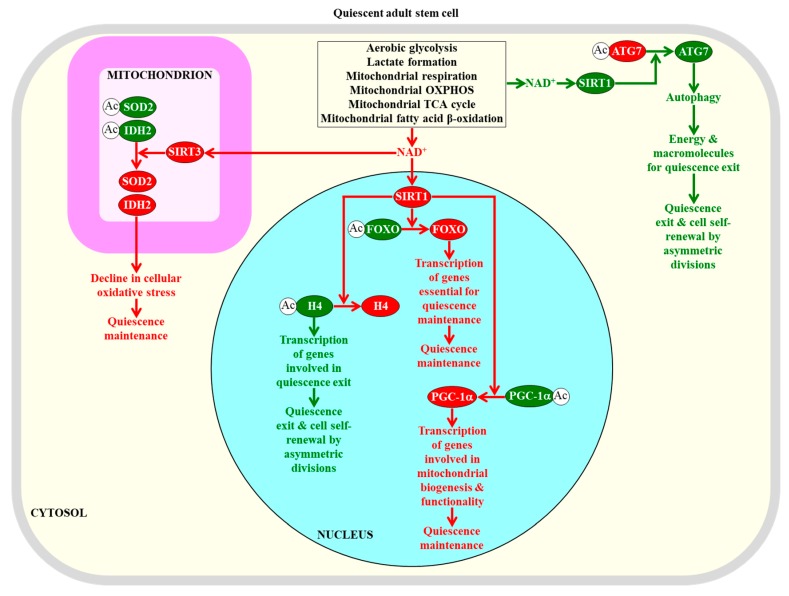
Figure 3
NAD+ concentration within adult stem cells defines how efficiently these cells can maintain quiescence or self-renew by undergoing asymmetric divisions. The NAD+-activated sirtuin SIRT1 in the nucleus is required for the maintenance of quiescence in adult stem cells, because this SIRT1 deacetylates histone H4 and the transcriptional factors FOXO and PGC-1α. The NAD+-activated sirtuin SIRT3 in mitochondria is essential for quiescence maintenance by adult stem cells, because this SIRT3 deacetylates and activates superoxide dismutase SOD2 and isocitrate dehydrogenase IDH2, both of which weaken cellular oxidative stress. The NAD+-activated sirtuin SIRT1 in the cytosol is required for the transition from quiescence to self-renewal by asymmetric divisions, because this SIRT1 deacetylates and activates the autophagy-related protein ATG7 to promote autophagy, which provides the energy and macromolecules required for such transitions. Proteins, metabolites, and processes whose activities, concentrations, and rates must be increased to maintain the quiescence of adult stem cells are displayed in red. Proteins, metabolites, and processes whose activities, concentrations, and rates must be increased to promote the self-renewal of adult stem cells by asymmetric divisions are displayed in green. The red arrows define processes whose intensities must be increased to maintain the quiescence of adult stem cells. The green arrows define processes whose intensities must be decreased to maintain the quiescence of adult stem cells. See text for more details. Abbreviations: Ac, acetyl group; ATG7, the autophagy-related protein 7; FOXO, transcriptional factors of the Forkhead family; H4, histone H4; IDH2, mitochondrial isocitrate dehydrogenase 2; OXPHOS, oxidative phosphorylation; PGC-1α, peroxisome proliferator-activated receptor-gamma coactivator 1α; SIRT1 and SIRT3, NAD+-dependent protein deacetylases sirtuin 1 and sirtuin 3 (respectively); SOD2, mitochondrial manganese superoxide dismutase.
Figure 4
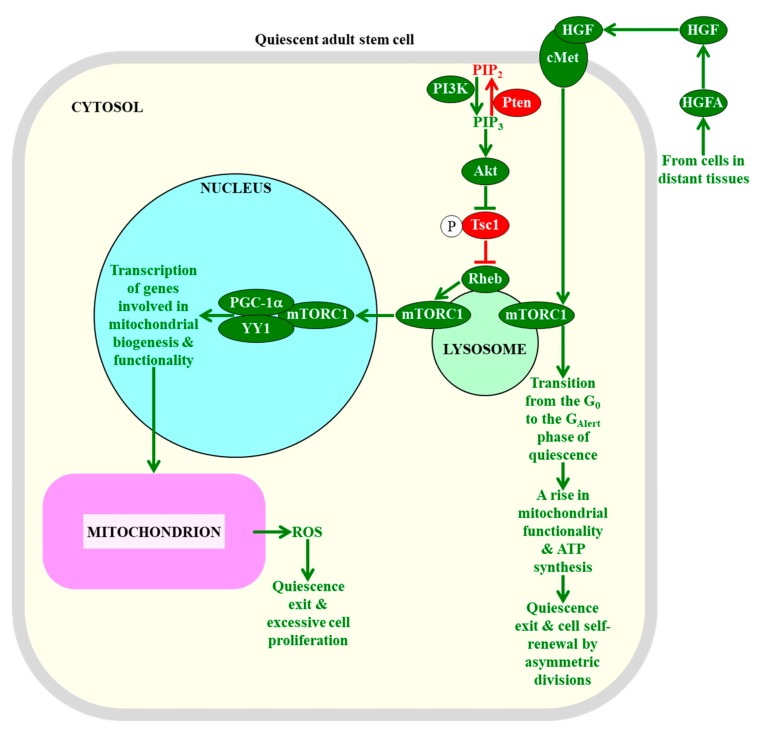
Figure 4
The intensity of information flow through the mTORC1-signaling pathway defines the fate of quiescent adult stem cells. A low intensity of mTORC1 signaling in adult stem cells decreases the extent of mitochondrial ROS production and release, thereby preventing the exit of these cells from the quiescent state and their excessive proliferation. An activation of mTORC1 signaling in response to hepatocyte growth factor, a cell-extrinsic pro-mitogenic signal, commits quiescent adult stem cells to cell cycle entry, proliferation, and differentiation. Proteins, metabolites, and processes whose activities, concentrations, and rates must be increased to maintain the quiescence of adult stem cells are displayed in red. Proteins, metabolites, and processes whose activities, concentrations, and rates need to be increased to promote the exit of adult stem cells from the state of quiescence are displayed in green. The red arrow defines the chemical reaction whose rate must be increased to maintain the quiescence of adult stem cells. The red inhibitory bar defines the inhibitory effect whose intensity must be increased to maintain the quiescence of adult stem cells. The green arrows define chemical reactions or processes whose rates or intensities must be increased to promote the exit of adult stem cells from the state of quiescence. See the text for more details. Abbreviations: Akt1, RAC-alpha serine/threonine protein kinase 1 or v-akt murine thymoma viral oncogene homolog 1; cMet, mesenchymal–epithelial transition factor; GAlert, the “alert” phase of quiescence; HGF, hepatocyte growth factor; HGFA, hepatocyte growth factor activator; mTORC1, the mammalian (or mechanistic) target of rapamycin complex 1; PGC-1α, peroxisome proliferator-activated receptor-gamma coactivator 1α; PIP2, phosphatidylinositol 4,5-bisphosphate; PIP3, phosphatidylinositol (3,4,5)-trisphosphate; PI3K, phosphoinositide 3-kinase; Pten, phosphatase and tensin homologue; Rheb, Ras homolog enriched in brain; ROS, reactive oxygen species; Tsc1, tuberous sclerosis 1; YY1, yin-yang 1 transcription factor.
Figure 5
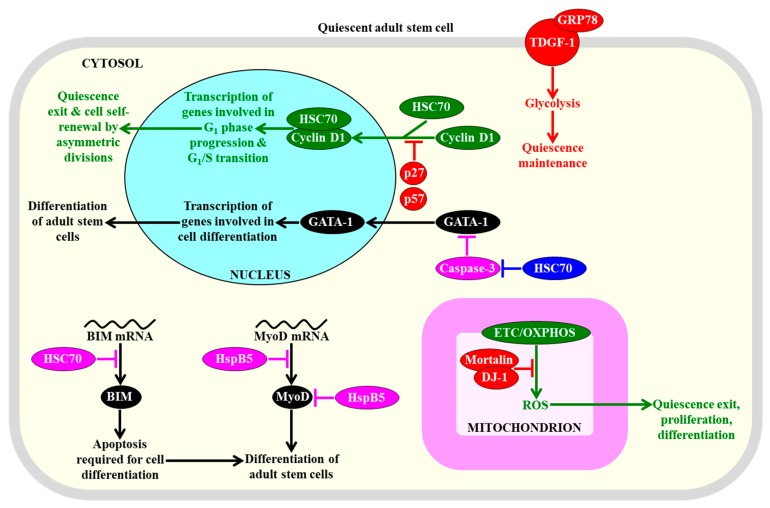
Figure 5
Several heat shock proteins (HSPs) play essential roles in preserving the quiescence, affecting the proliferation, and influencing the differentiation of adult stem cells. These HSPs control the nuclear import and degradation of some transcription factors, as well as the translation and stability of certain proteins that promote cell differentiation, glycolysis, and concentrations of mitochondrially-generated reactive oxygen species (ROS). Proteins, metabolites, and processes whose activities, concentrations, and rates must be increased to maintain the quiescence of adult stem cells are displayed in red. Proteins, metabolites, and processes whose activities, concentrations, and rates must be increased to promote the exit of adult stem cells from the state of quiescence are displayed in green. Proteins and processes whose activities and rates must be increased to promote the differentiation of adult stem cells are displayed in black. Proteins whose activities must be increased to suppress the differentiation of adult stem cells are displayed in pink. See text for more details. Abbreviations: BIM, Bcl-2-like protein 11; GATA-1, GATA-binding factor 1; GRP78, immunoglobulin heavy chain-binding protein homolog; HSC70, heat shock cognate 71 kDa protein; HspB5, alpha-crystallin B chain; MyoD, myoblast determination protein D; TDGF-1, teratocarcinoma-derived growth factor 1.
Figure 6
Figure 6
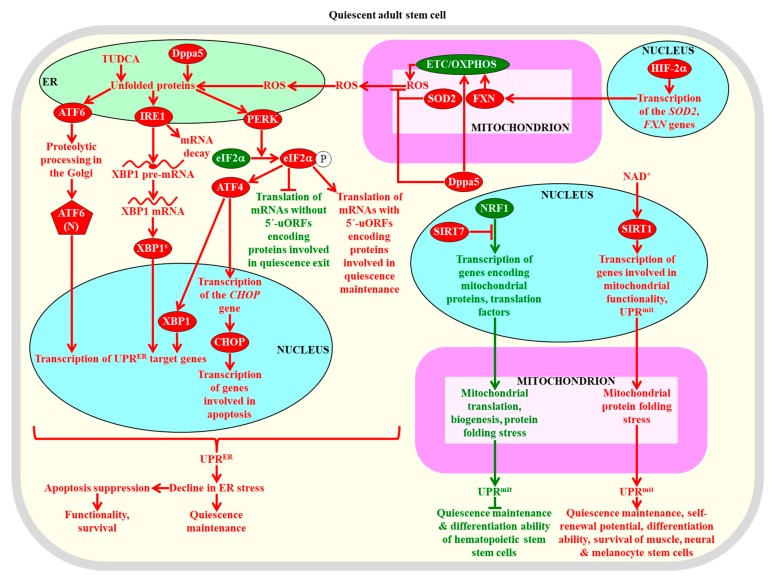
The unfolded protein response (UPRER) and (UPRmit) systems of proteostasis restoration in adult stem cells are required for the maintenance of their quiescence, self-renewal proficiency, proliferation potential, differentiation competence, functionality, and viability. A stimulation of the ATF6 (activating transcription factor 6), IRE1 (inositol requiring enzyme 1), and PERK (PKR-like endoplasmic reticulum kinase) branches of the UPRER system is essential for the maintenance, self-renewal, functionality, and survival of adult stem cells. A SIRT7-dependent inhibition of the UPRmit system is indispensable for sustaining the quiescence and differentiation capability of hematopoietic stem cells. A NAD+/SIRT1-dependent stimulation of the UPRmit system is required for the maintenance of the quiescence, self-renewal potential, differentiation ability, and viability of muscle stem cells, neural stem cells, and melanocyte stem cells. Proteins, metabolites, and processes whose activities, concentrations, and rates must be increased to maintain the quiescence of adult stem cells are displayed in red. Proteins, metabolites, and processes whose activities, concentrations, and rates need to be increased to promote the exit of adult stem cells from the state of quiescence are displayed in green. See text for more details. Abbreviations: ATF4, activating transcription factor 4; ATF6(N), N-terminal cytosolic fragment; CHOP, C/EBP homologous protein; Dppa5, developmental pluripotency-associated 5 protein; eIF2α, eukaryotic translation initiation factor 2α; ER, the endoplasmic reticulum; ETC, electron transport chain; FXN, frataxin; HIF-2α, hypoxia-inducible factor 2α; NRF1, nuclear respiratory factor 1; OXPHOS, oxidative phosphorylation; ROS, reactive oxygen species; SIRT1 and SIRT7, sirtuin 1 and sirtuin 7 (respectively); SOD2, mitochondrial manganese superoxide dismutase; TUDCA, tauroursodeoxycholic acid; uORFs, upstream open reading frames; XBP1, X-box binding protein 1; XBP1s, X-box binding protein 1 translated as a protein product the spliced mRNA for XBP1.

References

    1. Gray J.V., Petsko G.A., Johnston G.C., Ringe D., Singer R.A., Werner-Washburne M. “Sleeping beauty”: Quiescence in Saccharomyces cerevisiae. Microbiol. Mol. Biol. Rev. 2004;68:187–206. doi: 10.1128/MMBR.68.2.187-206.2004. - DOI - PMC - PubMed
    1. Cheung T.H., Rando T.A. Molecular regulation of stem cell quiescence. Nat. Rev. Mol. Cell. Biol. 2013;14:329–340. doi: 10.1038/nrm3591. - DOI - PMC - PubMed
    1. Dhawan J., Laxman S. Decoding the stem cell quiescence cycle—Lessons from yeast for regenerative biology. J. Cell Sci. 2015;128:4467–4474. doi: 10.1242/jcs.177758. - DOI - PMC - PubMed
    1. Rumman M., Dhawan J., Kassem M. Concise Review: Quiescence in Adult Stem Cells: Biological Significance and Relevance to Tissue Regeneration. Stem Cells. 2015;33:2903–2912. doi: 10.1002/stem.2056. - DOI - PubMed
    1. Pardee A.B. A restriction point for control of normal animal cell proliferation. Proc. Natl. Acad. Sci. USA. 1974;71:1286–1290. doi: 10.1073/pnas.71.4.1286. - DOI - PMC - PubMed

LinkOut - more resources