Review
. 2019 May 1;20(9):2161.
doi: 10.3390/ijms20092161.

Targeting Apolipoprotein E for Alzheimer's Disease: An Industry Perspective

Affiliations
Review

Targeting Apolipoprotein E for Alzheimer's Disease: An Industry Perspective

Georgette L Suidan et al. Int J Mol Sci. .

Abstract

Apolipoprotein E (apoE), a key lipid transport protein in the brain, is predominantly produced by astrocytes. Astrocytes are the most numerous cell type in the brain and are the main support network for neurons. They play a critical role in the synthesis and delivery of cholesterol in the brain. Humans have three common apoE isoforms, apoE2, apoE3 and apoE4, that show a strong genotype effect on the risk and age of onset for sporadic and late onset forms of Alzheimer's disease (AD). Carriers of an ε4 allele have an increased risk of developing AD, while those with an ε2 allele are protected. Investigations into the contribution of apoE to the development of AD has yielded conflicting results and there is still much speculation about the role of this protein in disease. Here, we review the opposing hypotheses currently described in the literature and the approaches that have been considered for targeting apoE as a novel therapeutic strategy for AD. Additionally, we provide our perspective on the rationale for targeting apoE and the challenges that arise with respect to "drug-ability" of this target.

Keywords: Alzheimer’s disease; apolipoprotein E; astrocytes.


Conflict of interest statement

The authors declare no conflict of interest.

Figures
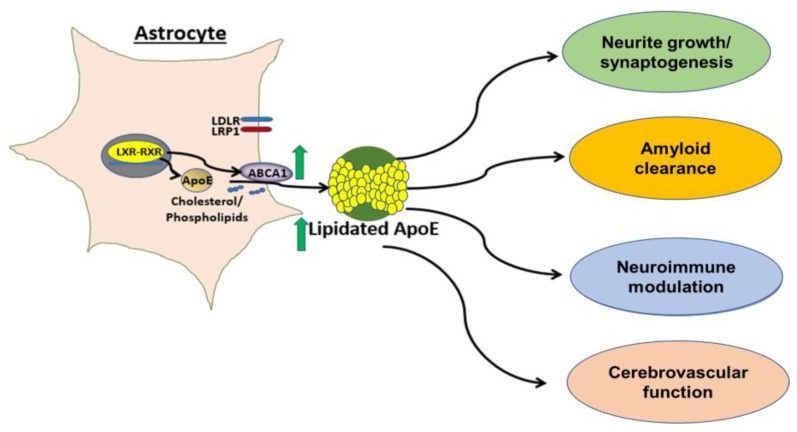
Figure 1
Figure 1
Increasing lipidation of the astrocytic pool of apoE. Astrocytes are the primary producer of apoE in the brain. Common mechanisms of apoE and abca1 expression are driven by nuclear hormone receptor (such as LXR and RXR) activation. Abca1 is critical for lipidation of apoE and increasing expression of abca1 leads to increased lipidation of all apoE isoforms (indicated by green arrows). We hypothesize that increasing apoE lipidation will be beneficial for several AD-relevant endpoints.
Figure 2
Figure 2
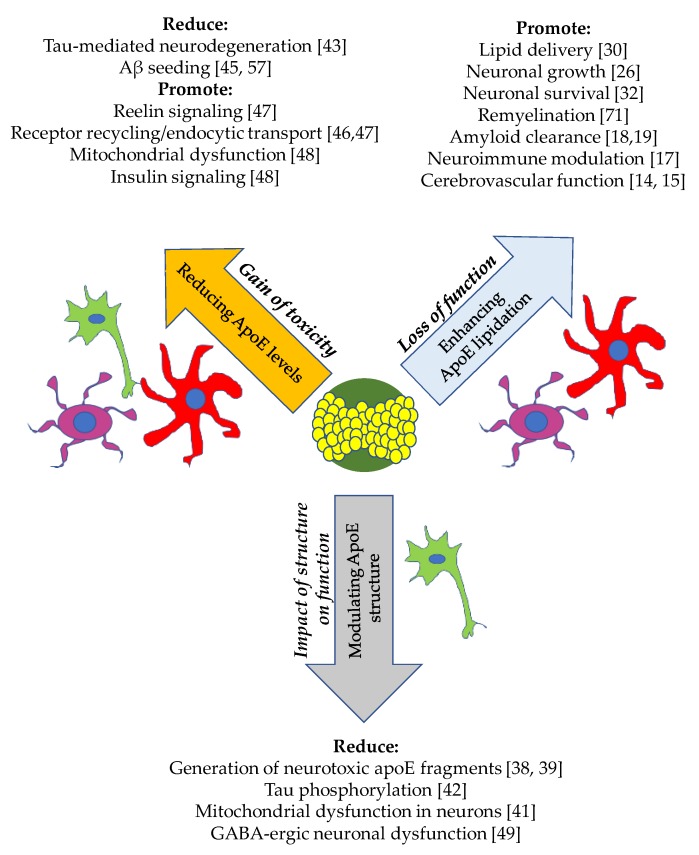
Multiple hypotheses for targeting apoE and their downstream effects. There are many reported findings in the literature which support the hypotheses (italicized) aimed at unveiling the function of apoE in the brain. The approach for targeting apoE in relation to each hypothesis is listed within the arrow. Cell types involved are astrocytes (red), microglia (purple) and neurons (green). A lipidated apoE particle is depicted in the center.

References

    1. Selkoe D.J., Hardy J. The amyloid hypothesis of Alzheimer’s disease at 25 years. EMBO Mol. Med. 2016;8:595–608. doi: 10.15252/emmm.201606210. - DOI - PMC - PubMed
    1. Jadhav S. A walk through tau therapeutic strategies. Acta Neuropathol. Commun. 2019;7:22. doi: 10.1186/s40478-019-0664-z. - DOI - PMC - PubMed
    1. Foley P. Lipids in Alzheimer’s disease: A century-old story. Biochim. Biophys. Acta. 2010;1801:750–753. doi: 10.1016/j.bbalip.2010.05.004. - DOI - PubMed
    1. Di Paolo G., Kim T.W. Linking lipids to Alzheimer’s disease: Cholesterol and beyond. Nat. Rev. Neurosci. 2011;12:284–296. doi: 10.1038/nrn3012. - DOI - PMC - PubMed
    1. Dietschy J.M., Turley S.D. Thematic review series: Brain Lipids. Cholesterol metabolism in the central nervous system during early development and in the mature animal. J. Lipid Res. 2004;45:1375–1397. doi: 10.1194/jlr.R400004-JLR200. - DOI - PubMed