Review
. 2019 May 1;20(9):2167.
doi: 10.3390/ijms20092167.

Membrane Lipid Composition: Effect on Membrane and Organelle Structure, Function and Compartmentalization and Therapeutic Avenues

Affiliations
Review

Membrane Lipid Composition: Effect on Membrane and Organelle Structure, Function and Compartmentalization and Therapeutic Avenues

Doralicia Casares et al. Int J Mol Sci. .

Abstract

Biological membranes are key elements for the maintenance of cell architecture and physiology. Beyond a pure barrier separating the inner space of the cell from the outer, the plasma membrane is a scaffold and player in cell-to-cell communication and the initiation of intracellular signals among other functions. Critical to this function is the plasma membrane compartmentalization in lipid microdomains that control the localization and productive interactions of proteins involved in cell signal propagation. In addition, cells are divided into compartments limited by other membranes whose integrity and homeostasis are finely controlled, and which determine the identity and function of the different organelles. Here, we review current knowledge on membrane lipid composition in the plasma membrane and endomembrane compartments, emphasizing its role in sustaining organelle structure and function. The correct composition and structure of cell membranes define key pathophysiological aspects of cells. Therefore, we explore the therapeutic potential of manipulating membrane lipid composition with approaches like membrane lipid therapy, aiming to normalize cell functions through the modification of membrane lipid bilayers.

Keywords: 2OHOA; composition; endomembrane; lipid; membrane; structure; therapy.


Conflict of interest statement

The authors declare no conflict of interest.

Figures
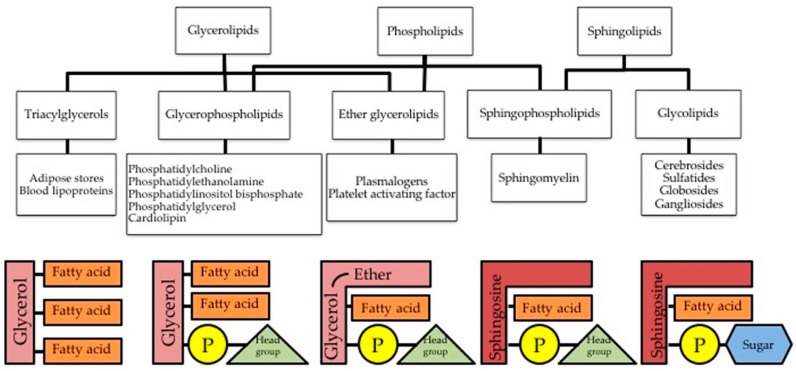
Figure 1
Figure 1
Several forms of triglycerides and phospholipids found in the cell. The left-most scheme is a triglyceride formed by a three-carbon glycerol backbone with a FA tail bound to each carbon. Second left-most scheme is a phospholipid bearing two FA tails with the third carbon of glycerol bound to a phosphate group. The middle scheme is an ether glycerolipid, who shares with the two previous structures the three-carbon glycerol backbone and is slightly modified with an ether group. In second right-most scheme, a sphingosine is shown as backbone instead of glycerol and first fatty acid tail of glycerol is modified slightly. This is a sphingophospholipid since it bears a phosphate group, it is called sphingomyelin. Right-most scheme shows the scheme of sphingolipids called glycolipids, since the phosphate group is replaced with a sugar (carbohydrate group).
Figure 2
Figure 2
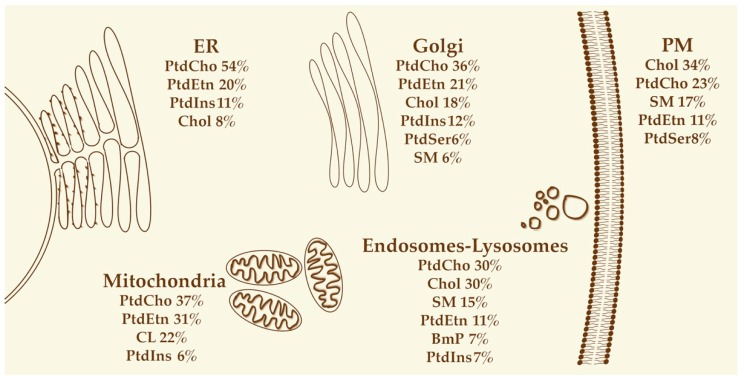
Lipids in organelle identity. For each organelle, the main lipid components are listed according to their contribution to the total lipid content of the organelle (in percentage, from the most abundant to the least abundant). Only lipids representing at least 5% of the total lipids for each organelle are shown. BmP: bis(monoacylglycero)phosphate; Chol: cholesterol; CL: cardiolipin; PtdCho: phosphatidylcholine; PtdEtn: phosphatidylethanolamine; PtdIns: phosphatidylinositol; PtdSer: phosphatidylserine; SM: sphingomyelin. Not to scale. Adapted from [19].
Figure 3
Figure 3
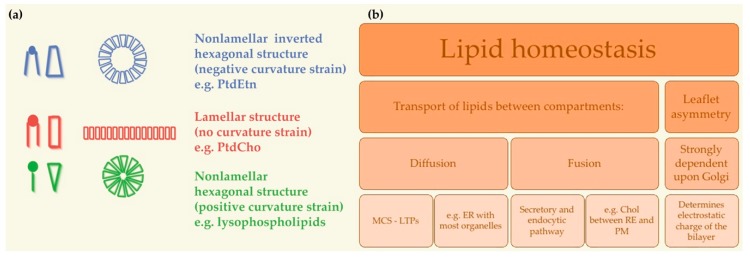
Membrane homeostasis and circuits of lipids between organelles. (a) Lipid bilayers can form a number of different structures upon their composition in PL species. Some examples of lipid shapes and their influence on membrane structure are shown. Lipids with a small polar head (blue), such as PtdEtn, have a molecular shape that resembles a truncated cone. They induce a negative curvature strain. Lipids with a bulky polar head and only one acyl chain (e.g., lysophospholipids, green) have a molecular shape similar to an inverted cone and induce a positive curvature strain in membranes. Lipids such as PtdCho have similar cross-sectional areas for the polar head and hydrophobic region and resemble cylinders (red). They form lamellar phases, with no curvature strain. Not to scale. Adapted from [113]. (b) Mechanisms of lipid homeostasis maintenance between cell compartments. Chol: cholesterol; ER: endoplasmic reticulum; MCS: membrane contact sites; LTPs: lipid transfer proteins; PM: plasma membrane; PtdCho: phosphatidylcholine; PtdEtn: phosphatidylethanolamine.
Figure 4
Figure 4
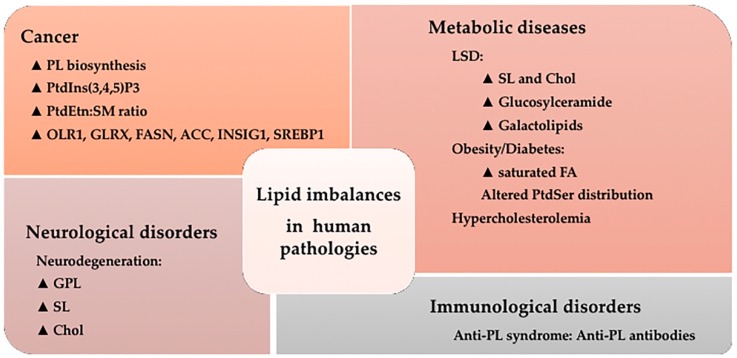
Lipid imbalances and human pathologies. Snapshot of the alterations in the lipidome which have been described in a variety of pathological situations. ▲, increased levels or pathway activity; PL: phospholipid; PtdIns(3,4,5)P3: phosphatidylinositol 3,4,5-trisphosphate; PtdEtn: phosphatidylethanolamine; SM: sphingomyelin; OLR1: Oxidized Low Density Lipoprotein Receptor 1; GLRX: Glutaredoxin; FASN: FA Synthase; ACC: acetyl-CoA carboxylase; INSIG1: Insulin induced gene 1; SREBP1: sterol regulatory element-binding protein 1; LSD: Lysosomal disorder; SL: sphingolipid; Chol: cholesterol; FA: fatty acid; PtdSer: phosphatidylserine; GPL: Glycerophospholipids.
Figure 5
Figure 5
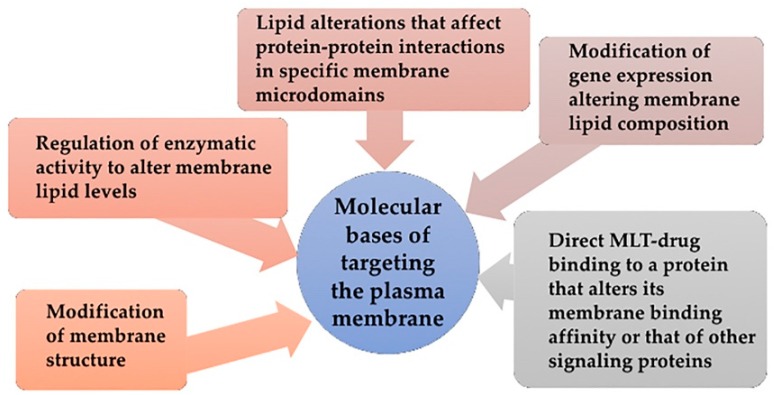
Molecular bases of Membrane-Lipid Therapy. Snapshot of the rationale behind targeting membrane composition or structure i.e., the drug-induced regulation of membrane lipid composition and structure.
Figure 6
Figure 6
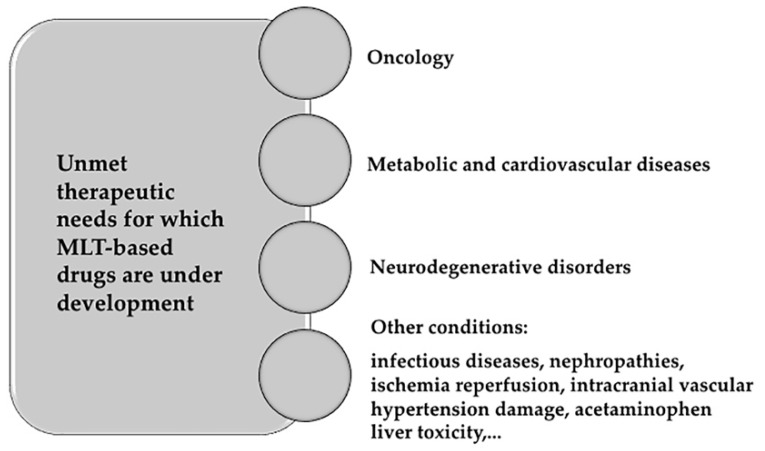
Membrane-Lipid Therapy molecules are currently being developed for several medical conditions.

References

    1. Gould S.B. Membranes and evolution. Curr. Biol. 2018;28:R381–R385. doi: 10.1016/j.cub.2018.01.086. - DOI - PubMed
    1. Singer S.J., Nicolson G.L. The Fluid Mosaic Model of the Structure of Cell Membranes. Science. 1972;175:720–731. doi: 10.1126/science.175.4023.720. - DOI - PubMed
    1. Bloom M., Evans E., Mouritsen O.G. Physical properties of the fluid lipid-bilayer component of cell membranes: a perspective. Q. Rev. Biophys. 1991;24:293. doi: 10.1017/S0033583500003735. - DOI - PubMed
    1. Bloom M., Mouritsen O.G. Handbook of Biological Physics. Vol. 1. Elsevier BV; Amsterdam, The Netherlands: 1995. The Evolution of Membranes; pp. 65–95.
    1. Karnovsky M.J. The concept of lipid domains in membranes. J. Cell Biol. 1982;94:1–6. doi: 10.1083/jcb.94.1.1. - DOI - PMC - PubMed

MeSH terms