. 2019 May 3;18(1):77.
doi: 10.1186/s12934-019-1127-8.

Boosting the biosynthesis of betulinic acid and related triterpenoids in Yarrowia lipolytica via multimodular metabolic engineering

Affiliations

Boosting the biosynthesis of betulinic acid and related triterpenoids in Yarrowia lipolytica via multimodular metabolic engineering

Cong-Cong Jin et al. Microb Cell Fact. .

Abstract

Background: Betulinic acid is a pentacyclic lupane-type triterpenoid and a potential antiviral and antitumor drug, but the amount of betulinic acid in plants is low and cannot meet the demand for this compound. Yarrowia lipolytica, as an oleaginous yeast, is a promising microbial cell factory for the production of highly hydrophobic compounds due to the ability of this organism to accumulate large amounts of lipids that can store hydrophobic products and supply sufficient precursors for terpene synthesis. However, engineering for the heterologous production of betulinic acid and related triterpenoids has not developed as systematically as that for the production of other terpenoids, thus the production of betulinic acid in microbes remains unsatisfactory.

Results: In this study, we applied a multimodular strategy to systematically improve the biosynthesis of betulinic acid and related triterpenoids in Y. lipolytica by engineering four functional modules, namely, the heterogenous CYP/CPR, MVA, acetyl-CoA generation, and redox cofactor supply modules. First, by screening 25 combinations of cytochrome P450 monooxygenases (CYPs) and NADPH-cytochrome P450 reductases (CPRs), each of which originated from 5 different sources, we selected two optimal betulinic acid-producing strains. Then, ERG1, ERG9, and HMG1 in the MVA module were overexpressed in the two strains, which dramatically increased betulinic acid production and resulted in a strain (YLJCC56) that exhibited the highest betulinic acid yield of 51.87 ± 2.77 mg/L. Then, we engineered the redox cofactor supply module by introducing NADPH- or NADH-generating enzymes and the acetyl-CoA generation module by directly overexpressing acetyl-CoA synthases or reinforcing the β-oxidation pathway, which further increased the total triterpenoid yield (the sum of the betulin, betulinic acid, betulinic aldehyde yields). Finally, we engineered these modules in combination, and the total triterpenoid yield reached 204.89 ± 11.56 mg/L (composed of 65.44% betulin, 23.71% betulinic acid and 10.85% betulinic aldehyde) in shake flask cultures.

Conclusions: Here, we systematically engineered Y. lipolytica and achieved, to the best of our knowledge, the highest betulinic acid and total triterpenoid yields reported in microbes. Our study provides a suitable reference for studies on heterologous exploitation of P450 enzymes and manipulation of triterpenoid production in Y. lipolytica.

Keywords: Betulinic acid; Multimodular metabolic engineering; P450; Triterpenoids; Yarrowia lipolytica.


Conflict of interest statement

The authors declare that they have no competing interests.

Figures
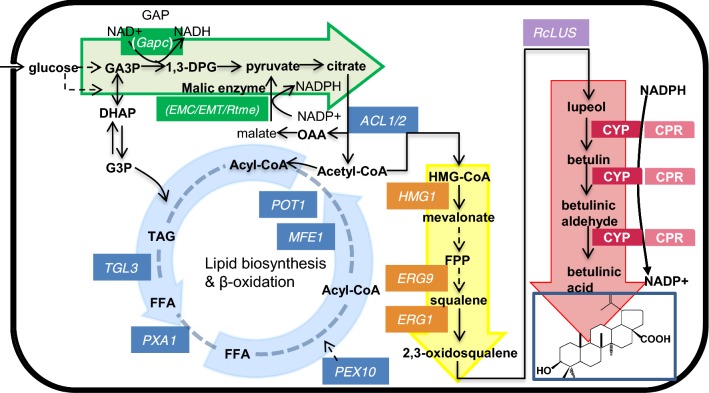
Fig. 1
Fig. 1
Overview of the multimodular strategy for betulinic acid-related triterpenoid production in Y. lipolytica. All the genes that were engineered in this study are presented, and the betulinic acid biosynthesis pathway was divided into four modules: the red arrow represents the heterogenous CYP/CPR module (CYP is lupeol C-28 oxidase and CPR is NADPH-cytochrome P450 reductase. Both originate from the five sources). The yellow arrow represents the MVA module with 3 genes (ERG1/ERG9/HMG1) that are overexpressed separately or simultaneously. The green arrow represents the redox cofactor supply module with four introduced genes, namely, EMC, EMT, Rtme (encoding malic enzyme, which is responsible for NADPH generation) and Gapc (encoding glyceraldehyde-3-phosphate dehydrogenase, which is responsible for NADH generation). The blue arrow represents the acetyl-CoA generation module with seven endogenous genes overexpressed (ACL1 and ACL2, encoding ATP citrate lyase, which can directly increase acetyl-CoA levels; PXA1, MFE1, PEX10, POT1 and TGL3 in the β-oxidation pathway, which are responsible for the catabolism of fatty acids to generate acetyl-CoA)
Fig. 2
Fig. 2
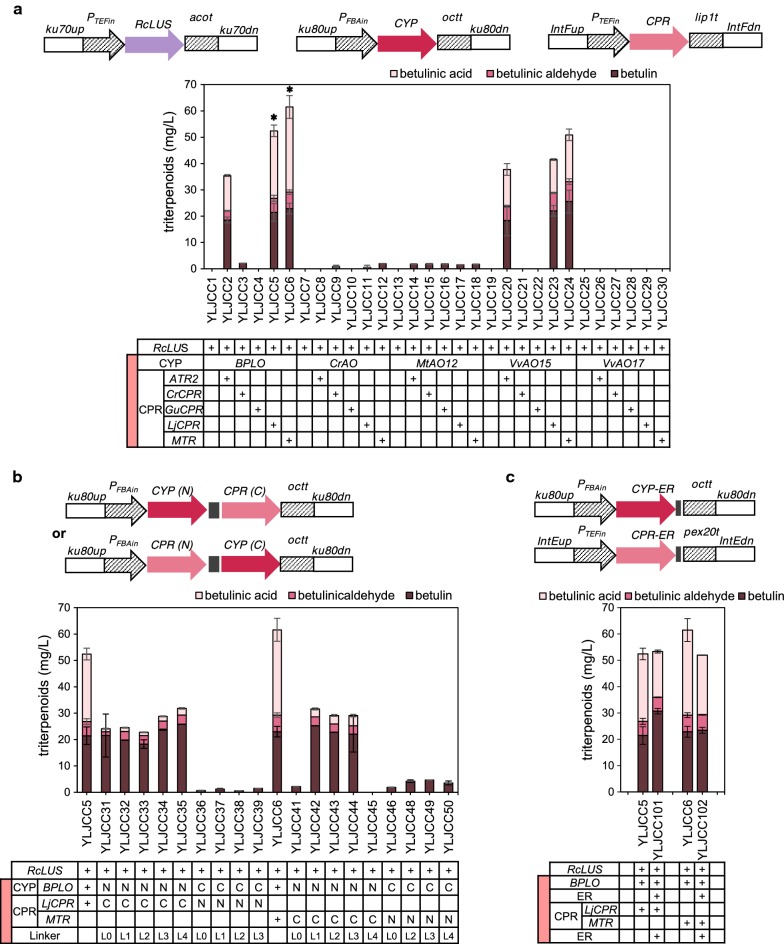
Screening of CYP/CPR for betulinic acid production. a Triterpenoid production by 30 strains that coexpressed LUS with CYP or LUS with CYP and CPR (both CYPs and CPRs originated from 5 different sources). b Triterpenoid production by strains that coexpressed LUS and fused CYP with CPR. N indicates that the encoded protein was located at the N-terminus of the fusion protein; C indicates that the encoded protein was located at the C-terminus of the fusion protein. L0 indicates that the two proteins were fused without any linker. L1, L2, L3 and L4 represent four different linkers, with amino acid sequences GGGS, GSG, GGGGS, and EAAAK, respectively. c Triterpenoid production of strains that coexpressed LUS and endoplasmic reticulum (ER)-targeted CYP and CPR. The ER-targeting sequence was fused to the C-terminus of both CYP and CPR. The red block in the first column of the gene forms represents the CYP/CPR module. Asterisk represents the strains used for subsequent optimization
Fig. 3
Fig. 3
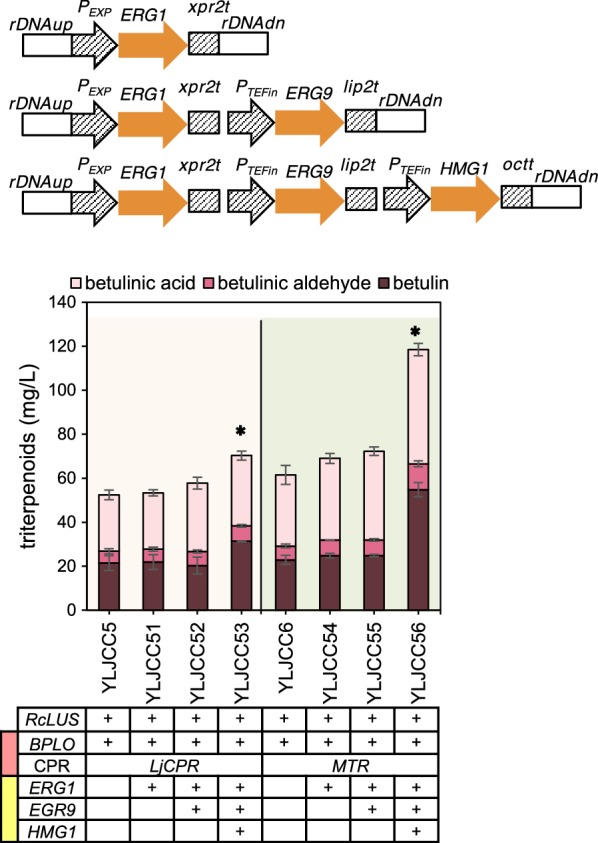
Engineering of the MVA module to enhance betulinic acid production. The genes ERG1, ERG9 and HMG1 in the MVA module were overexpressed individually or in combination. The light orange background represents strains generated from YLJCC5, and the reseda background represents strains generated from YLJCC6. Red and yellow blocks in the first column of the gene form represent the CYP/CPR and MVA modules, respectively. Asterisk represents the strains used in the final multimodular optimization
Fig. 4
Fig. 4
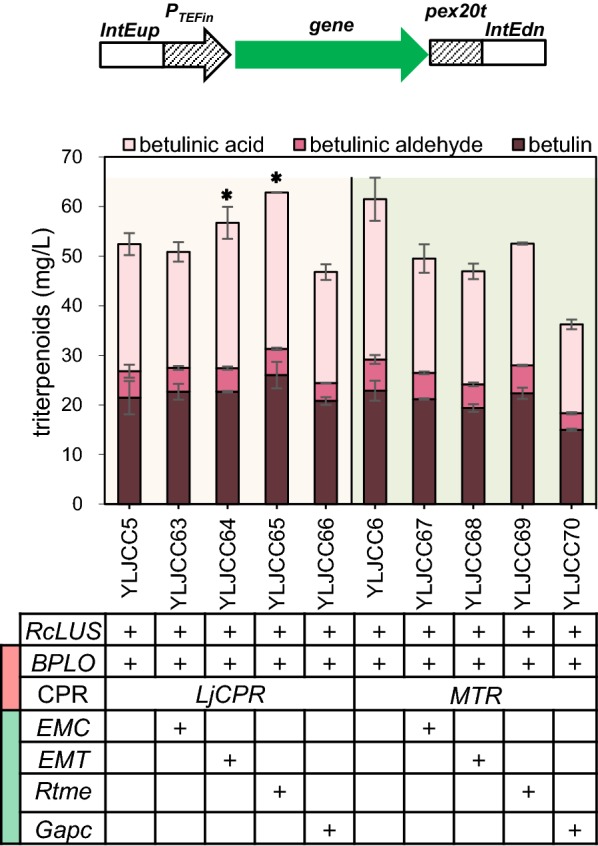
Engineering of the redox cofactor supply module to improve triterpenoid production. The EMC, EMT and Rtme genes that encode malic enzymes are responsible for NADPH generation. The gene Gapc, encoding glyceraldehyde-3-phosphate dehydrogenase, is responsible for NADH generation. The light orange background represents strains generated from YLJCC5, and the reseda background represents strains generated from YLJCC6. Red and green blocks in the first column of the gene form represent the CYP/CPR and redox cofactor supply modules, respectively. Asterisk represents the strains that exhibited increased triterpenoid production, and similar engineering was used in the final multimodular optimization
Fig. 5
Fig. 5
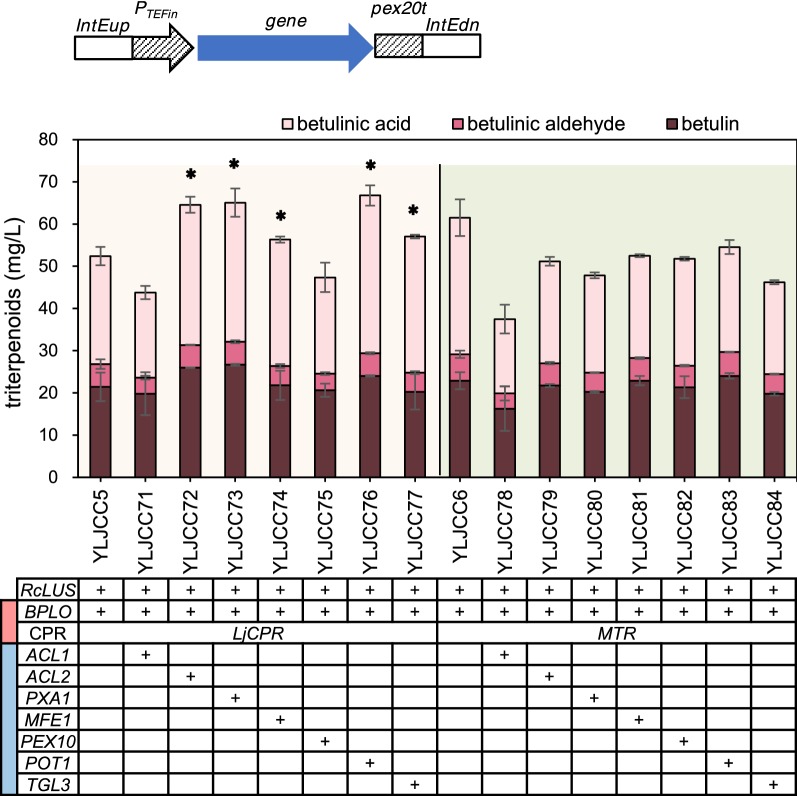
Engineering of the acetyl-CoA generation module to increase triterpenoid production. ACL1 and ACL2 encode ATP citrate lyase, which can directly increase acetyl-CoA levels; PXA1, MFE1, PEX10, POT1, and TGL3 in the β-oxidation pathway are responsible for the catabolism of fatty acids to acetyl-CoA. The light orange background represents strains generated from YLJCC5, and the reseda background represents strains generated from YLJCC6. Red and blue blocks in the first column of gene form represent the CYP/CPR and acetyl-CoA generation modules, respectively. Asterisk represents the strains that exhibited increased triterpenoid production, and similar engineering was used in the final multimodular optimization
Fig. 6
Fig. 6
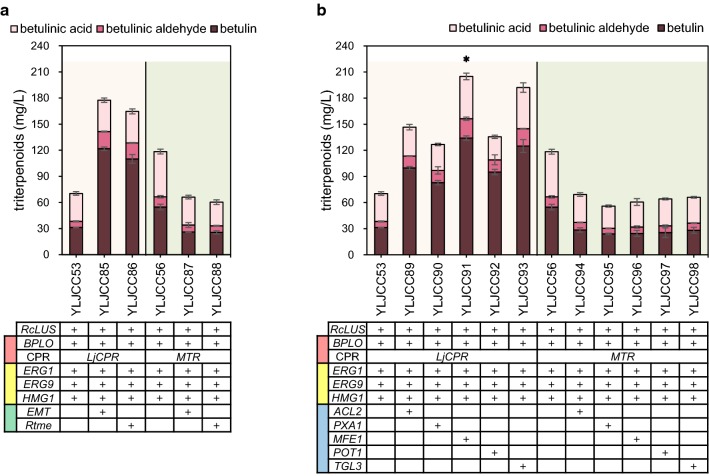
Multimodular optimization to further improve triterpenoid production. a Triterpenoid production by strains in which the CYP/CRP, MVA and redox cofactor supply modules were optimized in combination. b Triterpenoid production by strains in which the CYP/CPR, MVA and acetyl-CoA generation modules were optimized in combination. The light orange background represents strains generated from YLJCC53, and the reseda background represents strains generated from YLJCC56. Red, yellow, green and blue blocks in the first column of the gene forms represent the CYP/CPR, MVA, redox cofactor supply, and acetyl-CoA generation modules, respectively. Asterisk represents the strain exhibiting the highest total triterpenoid production in this study
Fig. 7
Fig. 7
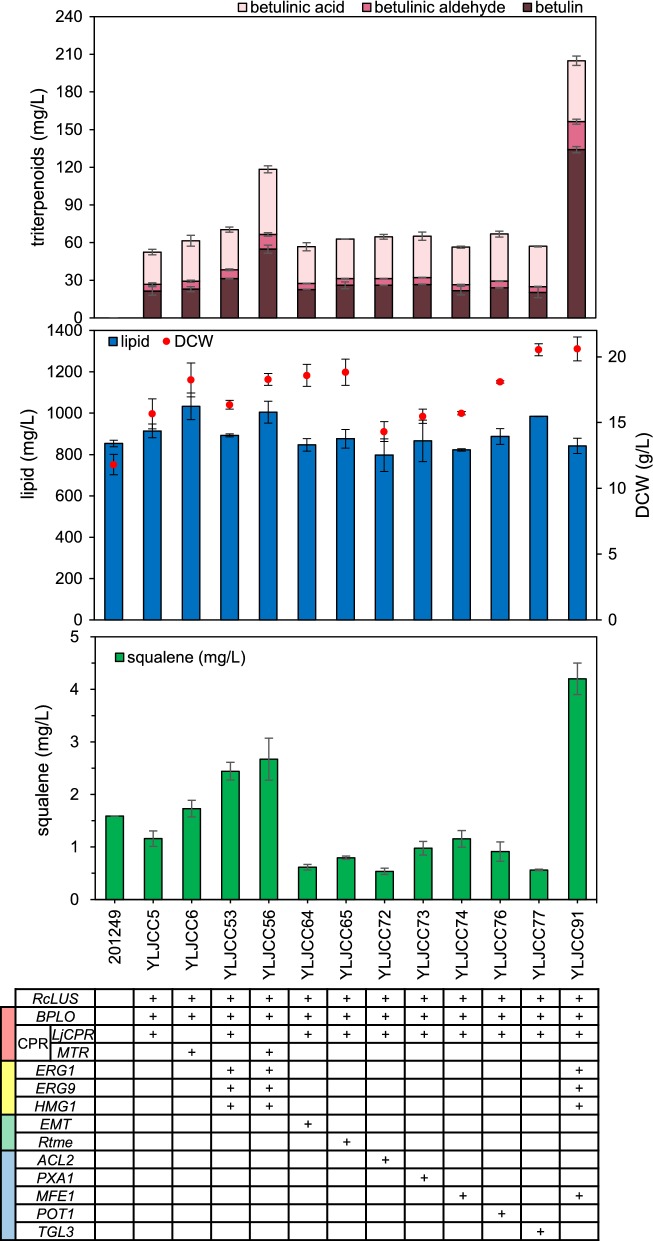
Triterpenoid, lipid, DCW, and squalene production in the parent strain and engineered strains marked with Asterisk. Red, yellow, green and blue blocks in the first column of the gene form represent the CYP/CPR, MVA, redox cofactor supply, and acetyl-CoA generation modules, respectively

References

    1. Fujioka T, Kashiwada Y, Kilkuskie RE, Cosentino LM, Ballas LM, Jiang JB, et al. Anti-AIDS agents, 11. betulinic acid and platanic acid as anti-HIV principles from Syzigium claviflorum, and the anti-HIV activity of structurally related triterpenoids. J Nat Prod. 1994;57(2):243–247. - PubMed
    1. Aiken C, Chen CH. Betulinic acid derivatives as HIV-1 antivirals. Trends Mol Med. 2005;11(1):31–36. - PubMed
    1. Pisha E, Chai H, Lee I-S, Chagwedera TE, Farnsworth NR, Cordell GA, et al. Discovery of betulinic acid as a selective inhibitor of human melanoma that functions by induction of apoptosis. Nat Med. 1995;1(10):1046–1051. - PubMed
    1. Cichewicz RH, Kouzi SA. Chemistry, biological activity, and chemotherapeutic potential of betulinic acid for the prevention and treatment of cancer and HIV infection. Med Res Rev. 2004;24(1):90–114. - PubMed
    1. Silva FS, Oliveira PJ, Duarte MF. Oleanolic, ursolic, and betulinic acids as food supplements or pharmaceutical agents for type 2 diabetes: promise or illusion? J Agric Food Chem. 2016;64(15):2991–3008. - PubMed

MeSH terms

LinkOut - more resources