Effects of Two-Week Sleep Extension on Glucose Metabolism in Chronically Sleep-Deprived Individuals
- PMID: 31053213
- PMCID: PMC6510689
- DOI: 10.5664/jcsm.7758
Effects of Two-Week Sleep Extension on Glucose Metabolism in Chronically Sleep-Deprived Individuals
Abstract
Study objectives: Sleep deprivation is known to be associated with insulin resistance and diabetes risk. This study investigated whether 2-week sleep extension in chronically sleep-deprived individuals would improve glucose metabolism.
Methods: A crossover study was conducted in volunteers without diabetes who reported sleeping ≤ 6 h/night. They were randomized to maintain their habitual sleep or extend sleep time for 2 weeks, then crossed over after a washout period. Sleep was monitored by actigraphy. Oral glucose tolerance tests (75 g) with insulin levels was performed at the end of each period. Mixed-effect linear regression analysis, adjusting for sequence and period effects, was applied.
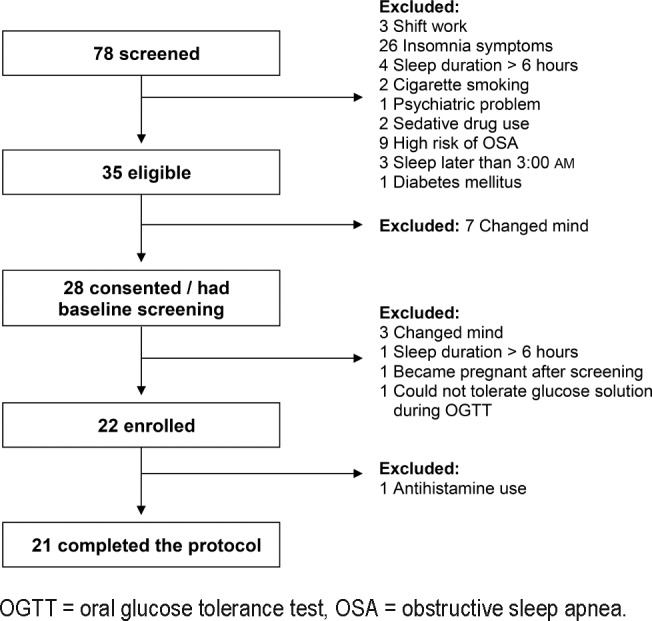
Results: A total of 21 participants (19 females) with mean (standard deviation) age of 33.1 (6.1) years completed the protocol. Mean sleep duration during habitual sleep was 318.7 (44.3) minutes and the participants extended their sleep by 36.0 (45.2) minutes during sleep extension. The average washout period was 21 (11) days. There were no significant effects of sleep extension on any metabolic parameters. The per-protocol analysis included eight participants who could sleep more than 6 hours during sleep extension (mean sleep duration 396 [25] minutes, extended by 60.1 [28.5] minutes). Among these individuals, sleep extension improved Homeostatic Model Assessment of Insulin Resistance (adjusted mean difference -0.50 [95% confidence interval [CI] -0.89, -0.11, P = .013]), early insulin secretion (insulinogenic index; mean difference 0.39 [95% CI 0.15, 0.63, P = .001]), and β-cell function (disposition index, mean difference 1.07 [95% CI 0.17, 1.97, P = .02]).
Conclusions: Sleep extension in chronically sleep-deprived individuals improved glucose metabolism in only those who could objectively extend their sleep to more than 6 h/night. Our findings suggest that a critical amount of sleep is needed to benefit metabolic outcomes.
Keywords: glucose metabolism; insulin resistance; sleep extension.
© 2019 American Academy of Sleep Medicine.
Figures
References
-
- National Diabetes Statistics Report, 2017: Estimates of Diabetes and Its Burden in the United States [PDF] Centers for Disease Control and Prevention website. [Accessed November 20, 2017]. https://www.cdc.gov/diabetes/data/statistics/statistics-report.html. Published 2017.
-
- International Diabetes Federation Diabetes Atlas - 8th Edition. International Diabetes Federation website. [Accessed February 8, 2018]. http://www.diabetesatlas.org/resources/2017-atlas.html. Published 2017.
-
- Anothaisintawee T, Reutrakul S, Van Cauter E, Thakkinstian A. Sleep disturbances compared to traditional risk factors for diabetes development: systematic review and meta-analysis. Sleep Med Rev. 2016;30:11–24. - PubMed
-
- 2009 Sleep in America Poll. National Sleep Foundation website. [Accessed April 5, 2019]. https://www.sleepfoundation.org/professionals/sleep-america-polls/2009-h.... Published 2009.
Publication types
MeSH terms
Substances
LinkOut - more resources
Full Text Sources