Review
. 2019 Dec;27(12):1774-1782.
doi: 10.1038/s41431-019-0415-4. Epub 2019 May 3.

Perspectives in genetic counseling for spinal muscular atrophy in the new therapeutic era: early pre-symptomatic intervention and test in minors

Affiliations
Review

Perspectives in genetic counseling for spinal muscular atrophy in the new therapeutic era: early pre-symptomatic intervention and test in minors

Clara Serra-Juhe et al. Eur J Hum Genet. 2019 Dec.

Abstract

Spinal muscular atrophy (SMA) is an autosomal-recessive neuromuscular disorder representing a continuous spectrum of muscular weakness ranging from compromised neonates to adults with minimal manifestations. Patients show homozygous absence or disease-causing variants of the SMN1 gene (-/- or 0/0) and in carriers only one copy is absent or mutated (1/0). Genetic diagnosis and counseling in SMA present several challenges, including the existence of carriers (2/0) that are undistinguishable of non-carriers (1/1) with current genetic testing methods and the report of patients (0/0) with very mild manifestations and even asymptomatic that are discovered when a full symptomatic case appears in the family. Younger asymptomatic siblings of symptomatic SMA patients are usually never tested until adolescence or adult life. However, following regulatory approval of the first tailored treatment for SMA, the prospects for care of these patients have changed. Early testing, including pre-symptomatic newborn screening and confirmation of diagnosis would change proactive measures and opportunities for therapy based in the actual landscape of new treatments. This review discusses the challenges and new perspectives of genetic counseling in SMA.


Conflict of interest statement

E.F.T. has received grant support to conduct clinical trials on SMA from Ionis/Biogen and serves as a consultant to Biogen, AveXis, Roche, Biologix, and Cytokinetics. The other author declares that she has no conflict of interest.

Figures
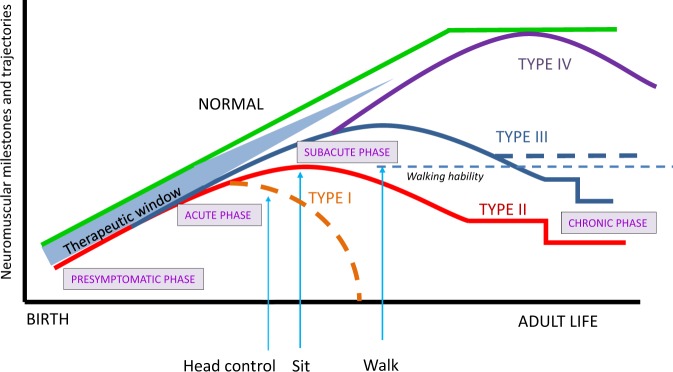
Fig. 1
Fig. 1
Neuromuscular milestones and trajectories from birth to adult life in spinal muscular atrophy (SMA) types. SMA patients present a pre-symptomatic phase, which is considered a therapeutic window to initiate the most effective intervention and treatment before substantial motor neuron loss occurs. Type-I disease has an acute phase with linear decline to death if no invasive respiratory intervention is made (dashed orange line). Type-II and -III SMA have a subacute onset in infancy and a late chronic more stable phase. Some type III patients maintain the walking ability for years (thick dashed blue line). Type-IV disease appears gradually during adult life. All SMA types can be treated early at pre-symptomatic stages according to the length of their respective and different therapeutic windows and is very likely that these patients will closely follow the green normal line. Treatment in already symptomatic patients may change trajectories with the slopes tending to reach the green normal line depending on each case (onset of disease, onset of treatment) and with new emerging phenotypes. Type-0 trajectories are not represented. Based on [, , –16]
Fig. 2
Fig. 2
Epidemiologic evolution and prevention policies in spinal muscular atrophy (SMA). The actual situation of treatment of symptomatic cases when disease is already established (tertiary prevention, with a main effect in standard of care and evolving phenotypes) should change to implement newborn screening to treat patients before symptoms during the therapeutic window (secondary prevention, with a main effect in burden and development of disease). This would allow also detection of other carriers in the family. Public health policies should consider in the near future population carrier testing not only specific to SMA but several other autosomal-recessive conditions (primary prevention). These measures unavoidably will decrease the incidence and the prevalence of the disease in the future
Fig. 3
Fig. 3
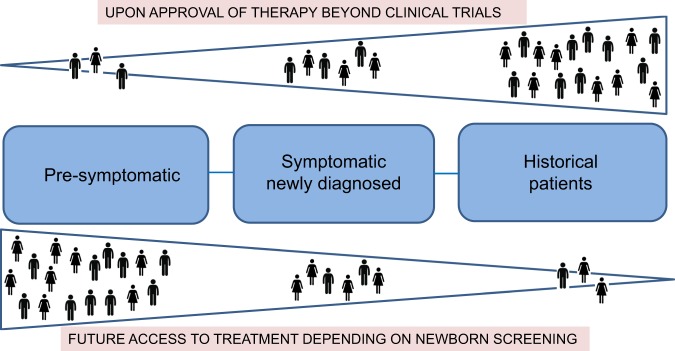
Changing scenario of access to treatment in spinal muscular atrophy. At present (upper triangle), the new treatments reach fewer pre-symptomatic babies, almost all newly symptomatic cases, and an important number of historical patients. The implementation of universal newborn screening (lower triangle) would modify the proportion and most of the patients will be treated at pre-symptomatic stages, fewer will be newly symptomatic (because of false negative in newborn screening, i.e., disease-causing point mutations), and the vast majority of the historical cases will be already under treatment

References

    1. Sugarman EA, Nagan N, Zhu H, Akmaev VR, Zhou Z, Rohlfs EM, et al. Pan-ethic carrier screening and prenatal diagnosis for spinal muscular atrophy: clinical laboratory analysis of >72,400 specimens. Eur J Hum Genet. 2012;20:27–32. - PMC - PubMed
    1. Finkel RS, McDermott MP, Kaufmann P, Darras BT, Chung WK, Sproule DM, et al. Observational study of spinal muscular atrophy type I and implications for clinical trials. Neurology. 2014;83:810–7. - PMC - PubMed
    1. Kolb SJ, Coffey CS, Yankey JW, Krosschell K, Arnold WD, Rutkove SB, et al. Natural history of infantile-onset spinal muscular atrophy. Ann Neurol. 2017;82:883–91. - PMC - PubMed
    1. Talbot K, Tizzano EF. The clinical landscape for SMA in a new therapeutic era. Gene Ther. 2017;24:529–33. - PMC - PubMed
    1. Lefebvre S, Bürglen L, Reboullet S, Clermont O, Burlet P, Viollet L, et al. Identification and characterization of a spinal muscular atrophy- determining gene. Cell. 1995;80:155–65. - PubMed

Publication types

Substances