


Survey of Handlers of 158 Police Dogs in New Zealand: Functional Assessment and Canine Orthopedic Index
- PMID: 31058169
- PMCID: PMC6478039
- DOI: 10.3389/fvets.2019.00085
Survey of Handlers of 158 Police Dogs in New Zealand: Functional Assessment and Canine Orthopedic Index
Abstract
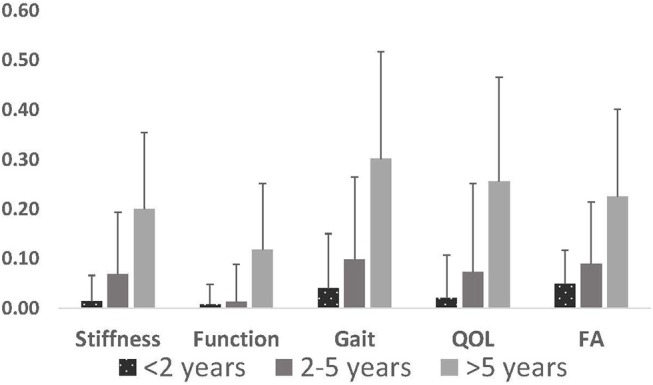
Objectives: To determine the functional assessment (FA) of fitness and Canine Orthopedic Index (COI) scores of 158 police dogs. The hypothesis was the dogs would have excellent fitness and no evidence of orthopedic disease regardless of age as reported by the handlers. Study Design:Observational, prospective study. Sample Population: Handlers of dogs >1 year of age in active duty or breeding/active duty. Methods: COI and FA questionnaires were completed via e-mail. Fisher's Exact test for count data assessed scores by age group (<2 years, 2-5 years, >5 years); Wilcoxon Signed-rank test correlated COI parameters (stiffness, function, gait, quality of life) to FA. Results: The dogs were 3.2 ± 2.4 (mean ± standard deviation) years-old, 96% were German Shepherds and 111 were male. 32% of dogs could hold the "Hup" position for no longer than 4 s and 8% frequently had difficulty with this task. Difficulty jumping into vehicles occurred in 1/3 of the dogs. Overall FA was impaired in 20% (score >8), abnormal in 15% (score = 5-7), and reduced (score = 1-4) in 36% of dogs. Only 29% had normal function (FA score = 0) and these were significantly younger (2.8 ± 1.7 years, p < 0.05) than impaired dogs (6.6 ± 2.2 years). COI stiffness score was abnormal in 37% (3.3 ± 2.2) and gait was abnormal in 41% (5.4 ± 4.0). Quality of life (QOL) was excellent in 69% of dogs. Stiffness for the <2 year-old group was 0.2 ± 0.8, for the 2-5 year-old group was 1.1 ± 2.0 and for the >5 year-old group was 3.2 ± 2.4. Gait score for the <2 year group was 0.8 ± 2.2, and for the 2-5 year group was 1.9 ± 3.2 and for the >5 year group was 6.0 ± 4.3. Quality of life was close to excellent for the <2 year-olds (0.3 ± 1.1) and 2-5 year-olds (0.8 ± 2.0) but the >5 year-olds scored higher (3.0 ± 2.5). Only the COI gait score correlated with the FA score (p = 0.30). Conclusions and Clinical Relevance: Police dogs were reported by handlers to have good to excellent QOL, however, increasing age was associated with declining FA and COI scores.
Keywords: canine orthopedic index; functional assessment; gait; musculoskeletal disease; police working dog.
Figures
References
-
- Fox PR, Puschner B, Ebel JG. Assessment of acute injuries, exposure to environmental toxins, and five-year health surveillance of New York Police Department working dogs following the September 11, 2001, World Trade Center terrorist attack. J Am Vet Med Assoc. (2008) 233:48–59. 10.2460/javma.233.1.48 - DOI - PubMed
LinkOut - more resources
Full Text Sources
