


The Spectrum of Bladder Health: The Relationship Between Lower Urinary Tract Symptoms and Interference with Activities
- PMID: 31058573
- PMCID: PMC6590721
- DOI: 10.1089/jwh.2018.7364
The Spectrum of Bladder Health: The Relationship Between Lower Urinary Tract Symptoms and Interference with Activities
Abstract
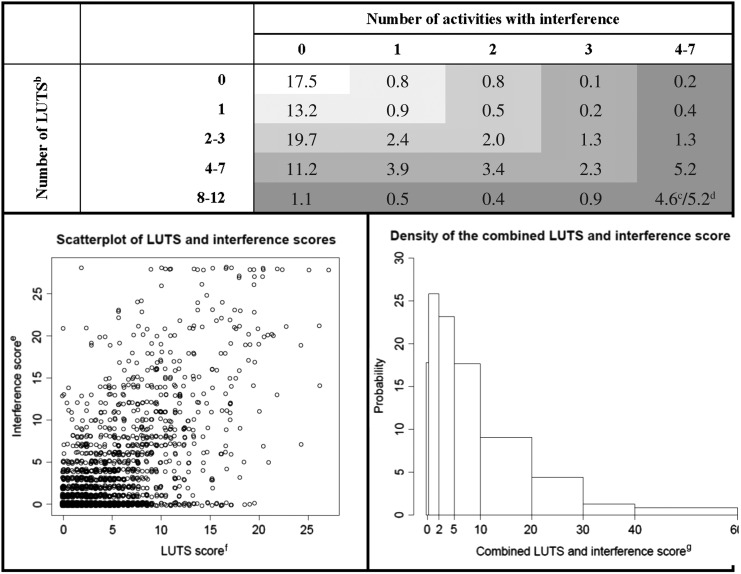
Background: Little research to date has focused on lower urinary tract symptom (LUTS) prevention and bladder health promotion in women. To address this gap, the Prevention of LUTS Research Consortium developed the following working bladder health definition: "A complete state of physical, mental, and social well-being related to bladder function [that] permits daily activities [and] allows optimal well-being." To begin to inform and quantify this definition, we used data from the Boston Area Community Health Survey, drawing upon its rare collection of information on LUTS and LUTS-specific interference with activities. Methods: At baseline, participants reported their frequency of 15 LUTS and interference with 7 activities. Prevalence ratios (PRs) were calculated by generalized linear models with robust variance estimation, adjusting for LUTS risk factors and individual LUTS. Results: Of the 3169 eligible participants, 17.5% reported no LUTS or interference, whereas the remaining 82.5% reported some frequency of LUTS/interference: 15.1% rarely; 21.7% a few times; 22.6% fairly often/usually; and 22.9% almost always. LUTS independently associated with interference were urgency incontinence, any incontinence, urgency, nocturia, perceived frequency, and urinating again after <2 hours (PRs = 1.2-1.5, all p < 0.05). Conclusions: Our findings suggest that bladder health exists on a continuum, with approximately one in five women considered to have optimal bladder health (no LUTS/interference), the majority to have intermediate health (LUTS/interference rarely to usually), and a further one in five to have worse or poor health (LUTS/interference almost always). These findings underscore the need for LUTS prevention and bladder health promotion.
Keywords: health promotion; incontinence; prevention; public health.
Conflict of interest statement
No competing financial interests exist.
Figures
References
-
- Haylen BT, de Ridder D, Freeman RM, et al. An International Urogynecological Association (IUGA)/International Continence Society (ICS) joint report on the terminology for female pelvic floor dysfunction. Int Urogynecol J 2010;21:5–26 - PubMed
-
- Coyne KS, Sexton CC, Thompson CL, et al. The prevalence of lower urinary tract symptoms (LUTS) in the USA, the UK and Sweden: Results from the Epidemiology of LUTS (EpiLUTS) study. BJU Int 2009;104:352–360 - PubMed
-
- Kupelian V, Wei JT, O'Leary MP, et al. Prevalence of lower urinary tract symptoms and effect on quality of life in a racially and ethnically diverse random sample: The Boston Area Community Health (BACH) Survey. Arch Intern Med 2006;166:2381–2387 - PubMed
-
- Irwin DE, Milsom I, Hunskaar S, et al. Population-based survey of urinary incontinence, overactive bladder, and other lower urinary tract symptoms in five countries: Results of the EPIC study. Eur Urol 2006;50:1306–1314; discussion 1314–1305. - PubMed
-
- Litwin MS, Saigal CS, Yano EM, et al. Urologic diseases in America Project: Analytical methods and principal findings. J Urol 2005;173:933–937 - PubMed
Publication types
MeSH terms
Grants and funding
LinkOut - more resources
Full Text Sources
Medical
Miscellaneous
