


New Drug Discovery Paradigms for Retinal Diseases: A Focus on Retinal Organoids
- PMID: 31059378
- PMCID: PMC6985764
- DOI: 10.1089/jop.2018.0140
New Drug Discovery Paradigms for Retinal Diseases: A Focus on Retinal Organoids
Abstract
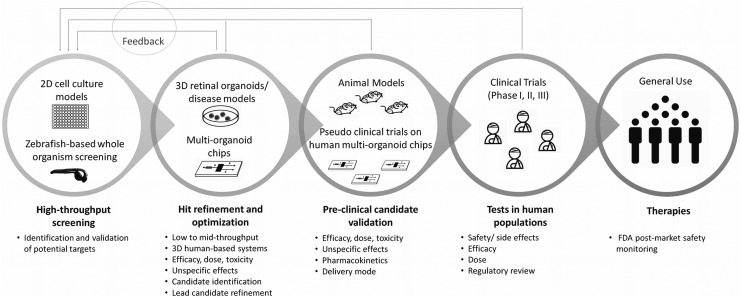
Retinal disease represents a growing global problem, both in terms of quality of life and economic impact, yet new therapies are not being developed at a sufficient rate to meet this mounting need. In this context, retinal organoids derived from human induced pluripotent stem cells hold significant promise for improving upon the current drug development process, increasing the speed and efficiency of moving potential therapeutic agents from bench to bedside. These organoid systems display the cell-cell and cell-matrix interactions, cellular heterogeneity, and physiological responses reflective of human biology and, thus, have the ability to replicate retinal disease pathology in a way that 2-dimensional cell cultures and animal models have been heretofore unable to achieve. However, organoid technology is not yet mature enough to meet the high-throughput demands of the first stages of drug screening. Hence, the augmentation of the existing drug development pipeline with retinal organoids, rather than the replacement of existing pathway components, may provide a way to harness the benefits of this improved pathological modeling. In this study, we outline the possible benefits of such a symbiosis, discuss other potential uses, and highlight barriers that remain to be overcome.
Keywords: cell culture models; drug screening; hiPSC; organoids; retina.
Conflict of interest statement
No competing financial interests exist.
Figures
References
-
- Flaxman S.R., Bourne R.R.A., Resnikoff S., et al. . Global causes of blindness and distance vision impairment 1990–2020: a systematic review and meta-analysis. Lancet Glob. Health. 5:e1221–e1234, 2017 - PubMed
-
- Herper M. The Cost Of Creating A New Drug Now $5 Billion, Pushing Big Pharma To Change, 2013: https://www.forbes.com/sites/matthewherper/2013/08/11/how-the-staggering... Last accessed April25, 2019
Publication types
MeSH terms
LinkOut - more resources
Full Text Sources
Medical
