. 2019 May 5;11(5):417.
doi: 10.3390/v11050417.

Targeting Human Parainfluenza Virus Type-1 Haemagglutinin-Neuraminidase with Mechanism-Based Inhibitors

Affiliations

Targeting Human Parainfluenza Virus Type-1 Haemagglutinin-Neuraminidase with Mechanism-Based Inhibitors

Tanguy Eveno et al. Viruses. .

Abstract

Human parainfluenza virus (hPIV) infections are a major cause of respiratory tract illnesses in children, with currently no available vaccine or drug treatment. The surface glycoprotein haemagglutinin-neuraminidase (HN) of hPIV has a central role in the viral life cycle, including neuraminic acid-recognising receptor binding activity (early stage) and receptor-destroying activity (late stage), which makes it an ideal target for antiviral drug disovery. In this study, we showed that targeting the catalytic mechanism of hPIV-1 HN by a 2α,3β-difluoro derivative of the known hPIV-1 inhibitor, BCX 2798, produced more potent inhibition of the neuraminidase function which is reflected by a stronger inhibition of viral replication. The difluorosialic acid-based inhibitor efficiently blocked the neuraminidase activity of HN for a prolonged period of time relative to its unsaturated neuraminic acid (Neu2en) analogue, BCX 2798 and produced a more efficient inhibition of the HN neuraminidase activity as well as in vitro viral replication. This prolonged inhibition of the hPIV-1 HN protein suggests covalent binding of the inhibitor to a key catalytic amino acid, making this compound a new lead for a novel class of more potent hPIV-1 mechanism-based inhibitors.

Keywords: difluorosialic acid; glycohydrolase; haemagglutinin; inhibitor; neuraminidase; parainfluenza; sialidase.


Conflict of interest statement

The authors declare no conflict of interest.

Figures
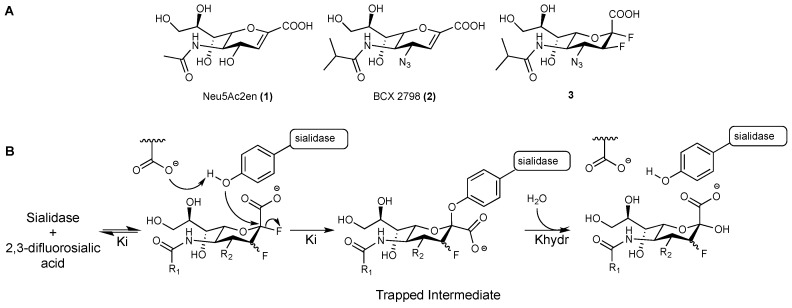
Figure 1
Figure 1
(A). Structures of Neu5Ac2en (1), BCX 2798 (2), and the difluoro analogue of BCX 2798 (3); (B). Proposed catalytic mechanism for all of the studied sialidases confirmed by the X-ray crystal structures of the trapped neuraminosyl–enzyme intermediate.
Figure 2
Figure 2
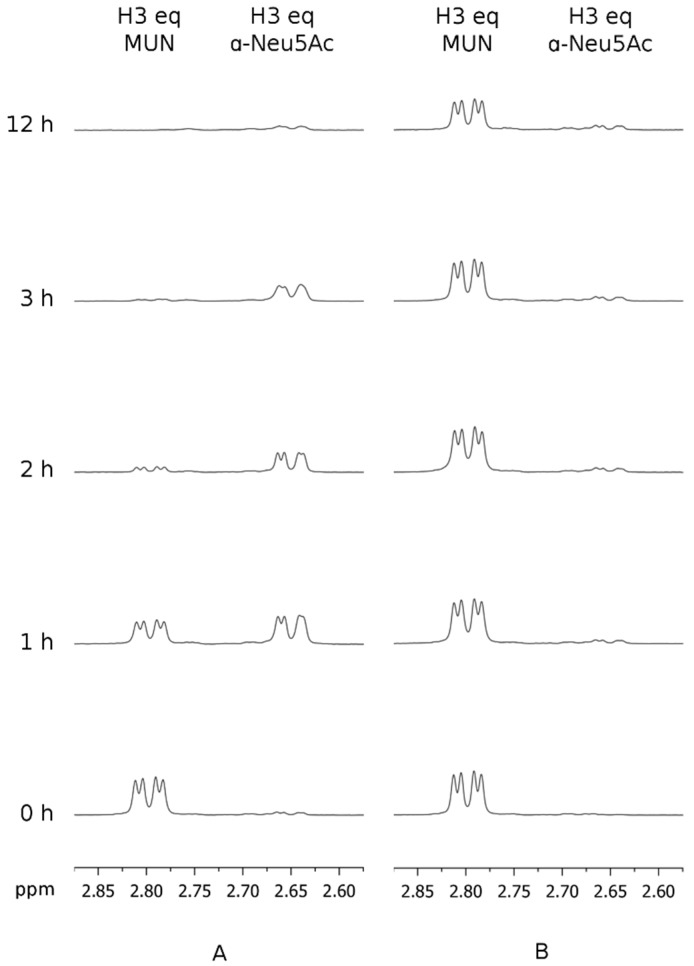
Time course study of the blockade of human parainfluenza virus-1 haemagglutinin-neuraminidase (hPIV-1 HN) neuraminidase activity by compounds 2 and 3. The hydrolysis of 4-methylumbelliferyl α-d-N-acetylneuraminide (MUN) by hPIV-1 HN, pre-incubated with either compound 2 or 3 (50 μM), was monitored by 1H NMR spectroscopy over 12 h at 37 °C. (A) 5 μg of HN preincubated with 2, in the presence of 5 mM of MUN. (B) 5 μg of HN preincubated with 3, in the presence of 5 mM of MUN. eq: equatorial.
Figure 3
Figure 3
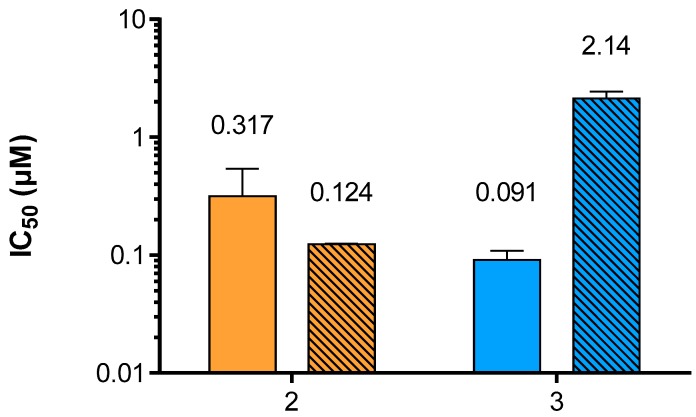
Evaluation of compounds 2 and 3 potencies to inhibit hPIV-1 HN neuraminidase and haemagglutinin functions. Inhibition of hPIV-1 HN neuraminidase (plain) and haemagglutinin (stripes) functions by inhibitors 2 and 3. The values presented are the mean of 3 independent experiments; the calculated standard deviation (SD) is represented by the error bars.
Figure 4
Figure 4
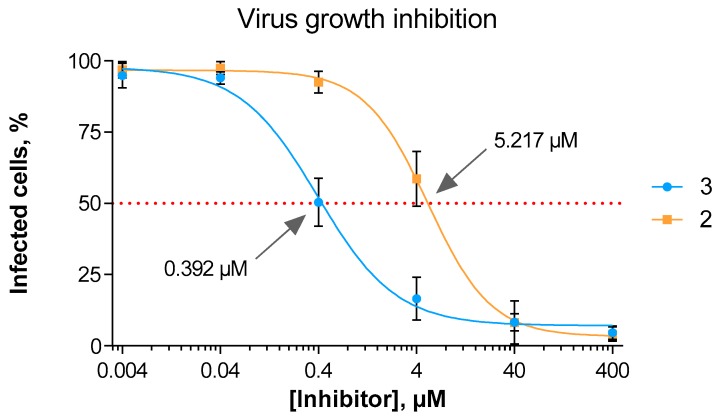
hPIV-1 growth inhibition by compounds 2 and 3. The data represents the mean of three independent experiments; the error bars represent the calculated standard deviation (SD).
Figure 5
Figure 5
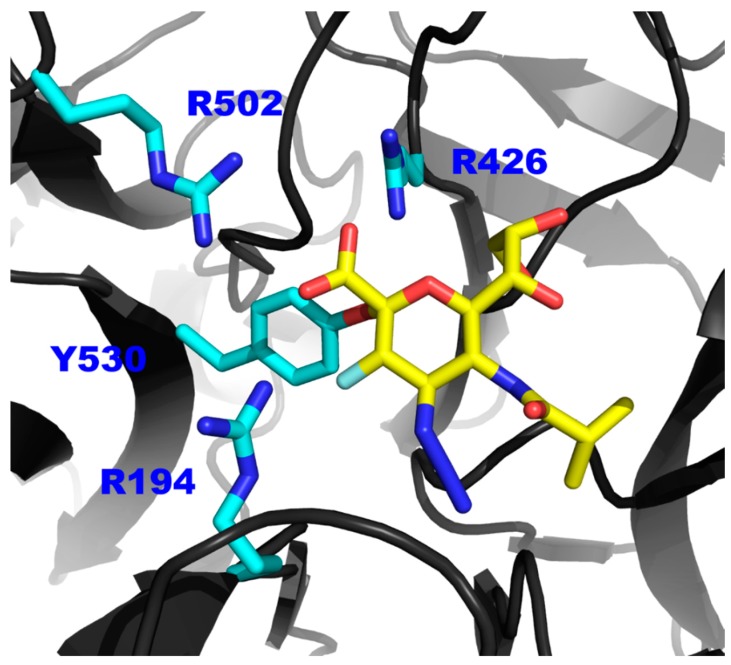
The proposed model of the interaction between inhibitor 3 and the Tyr530 of hPIV-1 HN. Representation of a hPIV-1 homology model (based on hPIV-3 co-crystal structure in complex with 3, PDB ID: 4XJR) [13] in complex with inhibitor 3 (yellow sticks). Side chains of the tri-arginyl cluster (R194, R426 and R502) and the key catalytic amino acid Tyr530 are shown in blue sticks.

References

    1. Pavia A.T. Viral Infections of the Lower Respiratory Tract: Old Viruses, New Viruses, and the Role of Diagnosis. Clin. Infect. Dis. 2011;52:S284–S289. doi: 10.1093/cid/cir043. - DOI - PMC - PubMed
    1. Karron R.A., Collins P.L. Fields Virology: Sixth Edition. Volume 1 Lippincott Williams & Wilkins; Philadelphia, PA, USA: 2013. Parainfluenza viruses.
    1. Schomacker H., Schaap-Nutt A., Collins P.L., Schmidt A.C. Pathogenesis of acute respiratory illness caused by human parainfluenza viruses. Curr. Opin. Virol. 2012;2:294–299. doi: 10.1016/j.coviro.2012.02.001. - DOI - PMC - PubMed
    1. Abedi G.R., Prill M.M., Langley G.E., Wikswo M.E., Weinberg G.A., Curns A.T., Schneider E. Estimates of Parainfluenza Virus-Associated Hospitalizations and Cost Among Children Aged Less Than 5 Years in the United States, 1998–2010. J. Pediatr. Infect. Dis. Soc. 2016;5:7–13. doi: 10.1093/jpids/piu047. - DOI - PMC - PubMed
    1. Bayon J.-C.L., Lina B., Rosa-Calatrava M., Boivin G. Recent developments with live-attenuated recombinant paramyxovirus vaccines. Rev. Med. Virol. 2013;23:15–34. doi: 10.1002/rmv.1717. - DOI - PubMed

Publication types

MeSH terms

Substances

LinkOut - more resources