. 2019 May 21;116(21):10510-10517.
doi: 10.1073/pnas.1818009116. Epub 2019 May 6.

Chemical disarming of isoniazid resistance in Mycobacterium tuberculosis

Affiliations

Chemical disarming of isoniazid resistance in Mycobacterium tuberculosis

Kelly Flentie et al. Proc Natl Acad Sci U S A. .

Abstract

Mycobacterium tuberculosis (Mtb) killed more people in 2017 than any other single infectious agent. This dangerous pathogen is able to withstand stresses imposed by the immune system and tolerate exposure to antibiotics, resulting in persistent infection. The global tuberculosis (TB) epidemic has been exacerbated by the emergence of mutant strains of Mtb that are resistant to frontline antibiotics. Thus, both phenotypic drug tolerance and genetic drug resistance are major obstacles to successful TB therapy. Using a chemical approach to identify compounds that block stress and drug tolerance, as opposed to traditional screens for compounds that kill Mtb, we identified a small molecule, C10, that blocks tolerance to oxidative stress, acid stress, and the frontline antibiotic isoniazid (INH). In addition, we found that C10 prevents the selection for INH-resistant mutants and restores INH sensitivity in otherwise INH-resistant Mtb strains harboring mutations in the katG gene, which encodes the enzyme that converts the prodrug INH to its active form. Through mechanistic studies, we discovered that C10 inhibits Mtb respiration, revealing a link between respiration homeostasis and INH sensitivity. Therefore, by using C10 to dissect Mtb persistence, we discovered that INH resistance is not absolute and can be reversed.

Keywords: Mycobacterium tuberculosis; antibiotic resistance; drug tolerance; isoniazid; respiration.


Conflict of interest statement

Conflict of interest statement: C.L.S., S.J.H., and F.A. have ownership interests in Quretech Bio AB, which licenses C10.

Figures
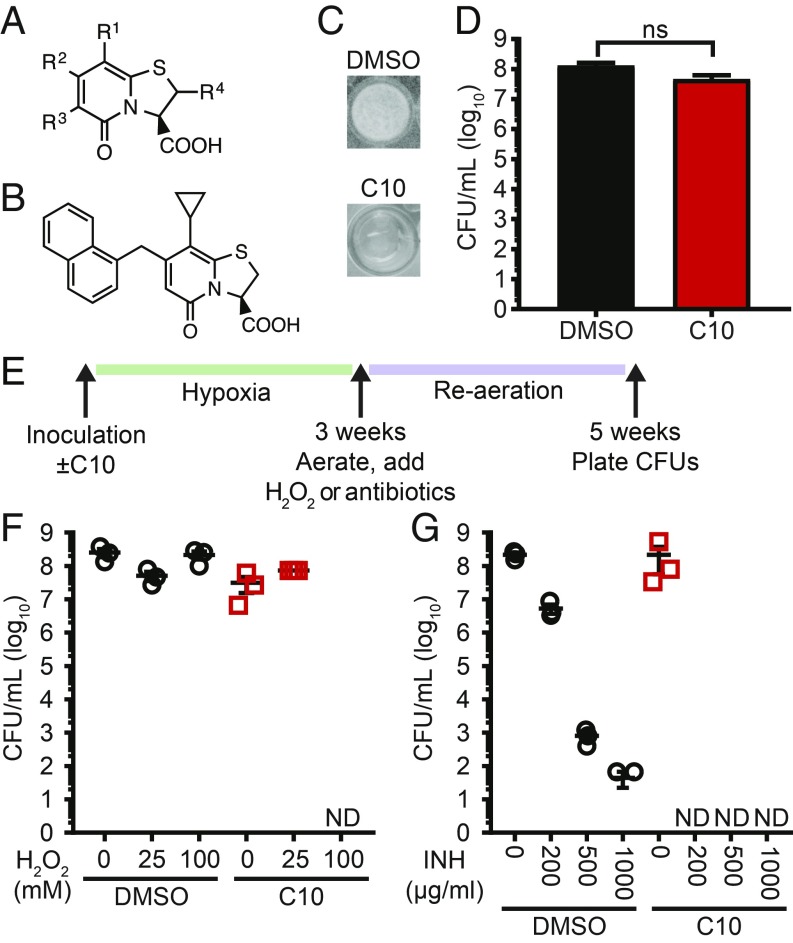
Fig. 1.
Fig. 1.
C10 blocks hypoxia-induced tolerance to H2O2 and INH. (A) The bicyclic 2-pyridone scaffold shared by all compounds in the screening library in which compounds contained different substituents at each of the “R” groups. (B) The chemical structure of C10. (C) Mtb was incubated in low oxygen in Sauton’s medium in the presence of DMSO or 50 μM C10 for 3 wk, then reaerated and incubated for an additional 2 wk. Representative pictures from three independent experiments are shown. (D) Mtb ± 50 μM C10 was treated the same as the cultures in C, and viable cfu/mL were enumerated at 5 wk. n = 3. ns, not significant by unpaired t test. (E) Schematic of stress assays. (F and G) Mtb was cultured in low oxygen conditions ± 50 μM C10 for 3 wk, then reaerated and treated with H2O2 (F) or INH (G) for an additional 2 wk before cfu/mL were enumerated. Mean ± SEM between biological triplicates is graphed for each sample. ND, not detected; limit of detection, 67 cfu/mL. Complete statistical comparisons for all data are provided in SI Appendix, Table S1.
Fig. 2.
Fig. 2.
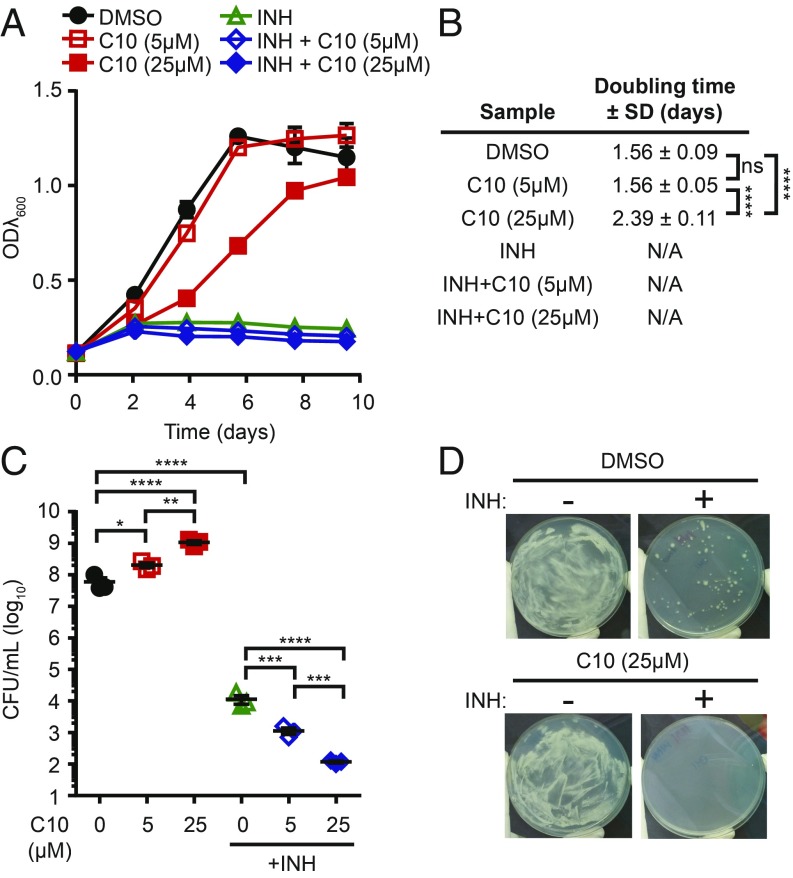
C10 potentiates killing by INH and prevents the selection of INH-resistant mutants. (A) WT Mtb was grown in aerated planktonic conditions in Sauton’s medium with 5 μM or 25 μM C10 ± 0.25 μg/mL INH, and ODλ600 was measured over 10 d. Mean ± SEM is graphed; n = 3. (B) The doubling time ± SD of cultures in A was calculated between day 0 and day 4. This time frame was chosen because the DMSO cultures were in the exponential growth phase. N/A indicates that growth was inhibited, and the calculation of doubling time did not accurately represent the data, as determined by R2 value (R2 <0.98). (C) After 10 d of treatment, cfu/mL were enumerated from cultures in A. Mean ± SEM values are graphed. n = 3. (D) WT Mtb was plated onto Sauton’s agar containing 0.5 μg/mL INH ± 25 μM C10. Representative pictures from three independent experiments are shown. *P < 0.05; **P < 0.01; ***P < 0.001; ****P < 0.0001 by one-way ANOVA with Tukey’s test. Complete statistical comparisons for all data are provided in SI Appendix, Table S1.
Fig. 3.
Fig. 3.
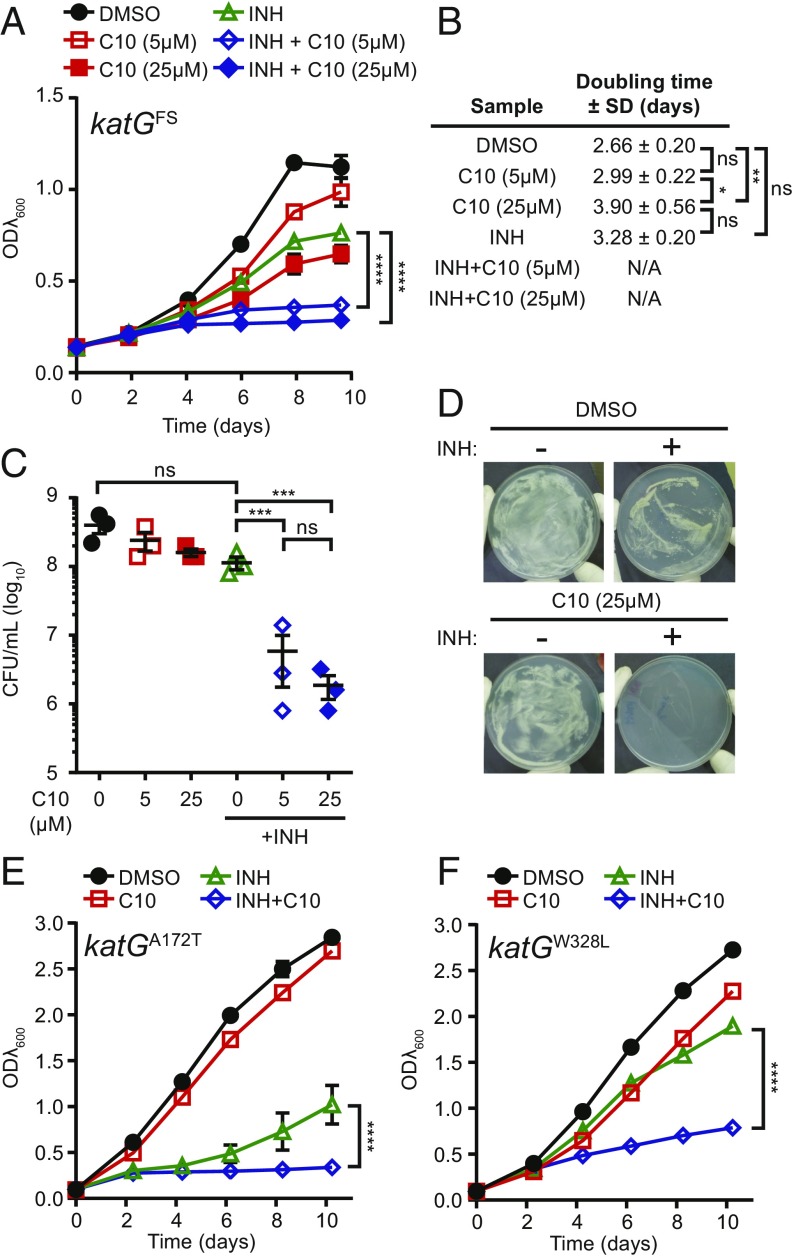
C10 resensitizes katG mutants to inhibition by INH. (A) katGFS Mtb was grown in Sauton’s medium with 5 μM or 25 μM C10 ± 0.25 μg/mL INH, and ODλ600 was measured over 10 d. Mean ± SEM is graphed. n = 3. (B) The doubling time of cultures in A was calculated between day 0 and day 4. This time frame was chosen to be consistent with that used in Fig. 2; however, the doubling time was similar when calculated over days 0–8. N/A indicates that growth was inhibited, and the calculation of doubling time did not accurately represent the data, as determined by R2 value (R2 <0.98). (C) After 10 d of treatment, cfu/mL were enumerated. Mean ± SEM values are graphed. n = 3. (D) katGFS Mtb was plated onto Sauton’s agar containing 0.5 μg/mL INH and/or 25 μM C10. Representative pictures from three independent experiments are shown. (E and F) Either katGA172T (E) or katGW328L (F) mutant Mtb was grown in Sauton’s medium with 5 μM C10 ± 0.25 μg/mL INH, and ODλ600 was measured over 10 d. n = 2. *P < 0.05; **P < 0.01; ***P < 0.001; ****P < 0.0001; ns, not significant by two-way ANOVA (A, E, and F) or one-way ANOVA (B and C) with Tukey’s test. Complete statistical comparisons for all data are provided in SI Appendix, Table S1.
Fig. 4.
Fig. 4.
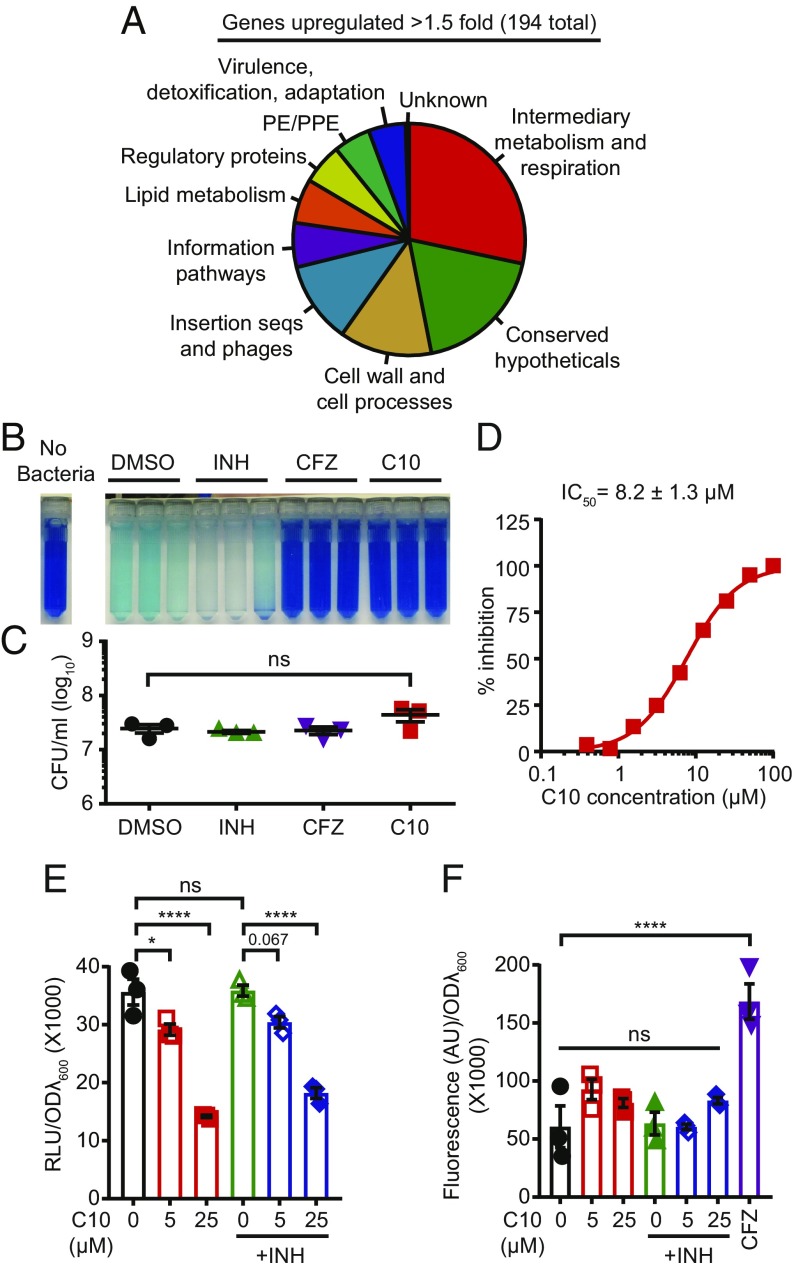
C10 inhibits respiration in Mtb. (A) RNA-seq was performed on Mtb treated with 25 μM C10 for 48 h in aerobic conditions. The functional categories based on gene annotations in Mycobrowser for the genes significantly (Padj < 0.05) up-regulated by >1.5-fold are presented in a pie chart. (B) Mtb was pretreated for 4 h with DMSO, 2.5 μg/mL INH, 1 μg/mL CFZ, or 50 μM C10, followed by the addition of methylene blue for an additional 16 h. n = 3. (C) The viable bacteria from B were enumerated. (D) Mtb was treated with increasing concentrations of C10 and monitored for respiration in the MABA, and the IC50 ± SD was calculated with GraphPad Prism. n = 3. (E and F) WT Mtb was incubated with 5 or 25 μM C10 ± 0.25 μg/mL INH for 24 h, and either ATP levels were measured in relative luminescence units (RLU) using BacTiter Glo (E), or ROS levels were quantified by CellROX Green fluorescence in arbitrary units (AU) (F). In F, 1 μg/mL CFZ was included as a positive control. In CF, values are mean ± SEM. *P < 0.05; ****P < 0.0001; ns, not significant by one-way ANOVA with Tukey’s test. Relevant comparisons are indicated. Complete statistics are provided in SI Appendix, Table S1.
Fig. 5.
Fig. 5.
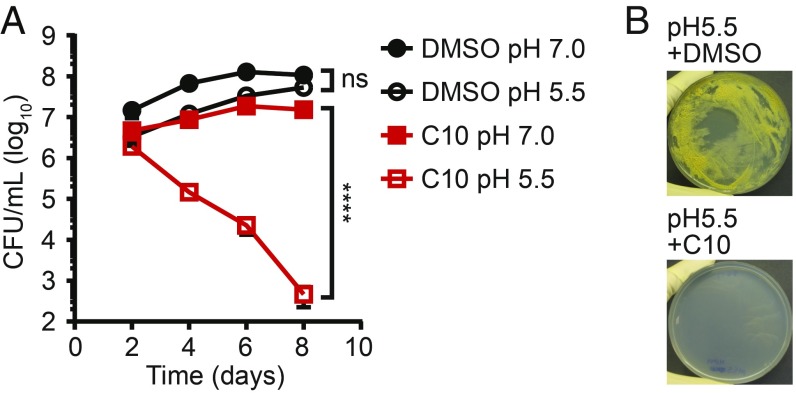
C10 sensitizes Mtb to acid stress. (A) WT Mtb was cultured in Sauton’s media at pH 7.0 or 5.5 in the presence of DMSO or 50 μM C10, and viable bacteria were enumerated over time. n = 3. Mean ± SEM values are graphed. ****P < 0.0001; ns, not significant by two-way ANOVA with Tukey’s test. Relevant comparisons are indicated. Complete statistics are provided in SI Appendix, Table S1. (B) WT Mtb was cultured on Sauton’s agar, pH 5.5, with 25 μM C10 or DMSO, and pictures were taken at 43 d. Growth on pH 7.0 agar is shown in Fig. 2D.
Fig. 6.
Fig. 6.
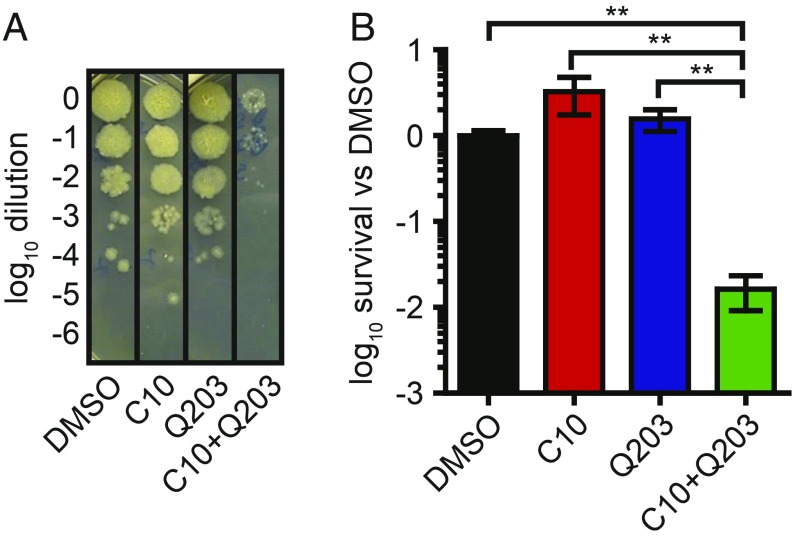
C10 potentiates killing by Q203. WT Mtb was cultured with 25 μM C10 ± 400 nM Q203 for 15 d, followed by enumeration of surviving cfu. (A) A representative image of the culture dilutions plated to enumerate cfu is shown. (B) Bacterial survival was quantified relative to DMSO-treated samples. n = 6. Values are mean ± SEM. **P < 0.01, one-way ANOVA with Tukey’s test. Relevant comparisons are indicated. Complete statistics are provided in SI Appendix, Table S1.

Comment in

References

    1. World Health Organization 2018 Global tuberculosis report. Available at https://apps.who.int/iris/bitstream/handle/10665/274453/9789241565646-en.... Accessed October 4, 2018.
    1. Mehta M, Rajmani RS, Singh A. Mycobacterium tuberculosis WhiB3 responds to vacuolar pH-induced changes in mycothiol redox potential to modulate phagosomal maturation and virulence. J Biol Chem. 2016;291:2888–2903. - PMC - PubMed
    1. Jain P, et al. Dual-reporter mycobacteriophages (Φ2DRMs) reveal preexisting Mycobacterium tuberculosis-persistent cells in human sputum. MBio. 2016;7:e01023-16. - PMC - PubMed
    1. McCune RM, Jr, Tompsett R. Fate of Mycobacterium tuberculosis in mouse tissues as determined by the microbial enumeration technique, I: The persistence of drug-susceptible tubercle bacilli in the tissues despite prolonged antimicrobial therapy. J Exp Med. 1956;104:737–762. - PMC - PubMed
    1. Deb C, et al. A novel in vitro multiple-stress dormancy model for Mycobacterium tuberculosis generates a lipid-loaded, drug-tolerant, dormant pathogen. PLoS One. 2009;4:e6077. - PMC - PubMed

Publication types

MeSH terms