. 2019 Jun 21;201(14):e00231-19.
doi: 10.1128/JB.00231-19. Print 2019 Jul 15.

Properties of Aged Spores of Bacillus subtilis

Affiliations

Properties of Aged Spores of Bacillus subtilis

Emily Camilleri et al. J Bacteriol. .

Abstract

Bacillus spores incubated on plates for 2 to 98 days at 37°C had identical Ca-dipicolinic acid contents, exhibited identical viability on rich- or poor-medium plates, germinated identically in liquid with all germinants tested, identically returned to vegetative growth in rich or minimal medium, and exhibited essentially identical resistance to dry heat and similar resistance to UV radiation. However, the oldest spores had a lower core water content and significantly higher wet heat and NaOCl resistance. In addition, 47- and 98-day spores had lost >98% of intact 16S and 23S rRNA and 97 to 99% of almost all mRNAs, although minimal amounts of mononucleotides were generated in 91 days. Levels of 3-phosphoglyceric acid (3PGA) also fell 30 to 60% in the oldest spores, but how the 3PGA was lost is not clear. These results indicate that (i) translation of dormant spore mRNA is not essential for completion of spore germination, nor is protein synthesis from any mRNA; (ii) in sporulation for up to 91 days at 37°C, the RNA broken down generates minimal levels of mononucleotides; and (iii) the lengths of time that spores are incubated in sporulation medium should be considered when determining conditions for spore inactivation by wet heat, in particular, in using spores to test for the efficacy of sterilization regimens.IMPORTANCE We show that spores incubated at 37°C on sporulation plates for up to 98 days have lost almost all mRNAs and rRNAs, yet the aged spores germinated and outgrew as well as 2-day spores, and all these spores had identical viability. Thus, it is unlikely that spore mRNA, rRNA, or protein synthesis is important in spore germination. Spores incubated for 47 to 98 days also had much higher wet heat resistance than 2-day spores, suggesting that spore "age" should be considered in generating spores for tests of sterilization assurance. These data are the first to show complete survival of hydrated spores for ∼100 days, complementing published data showing dry-spore survival for years.

Keywords: Bacillus; endospores; germination; heat resistance.


Figures

FIG 1
FIG 1
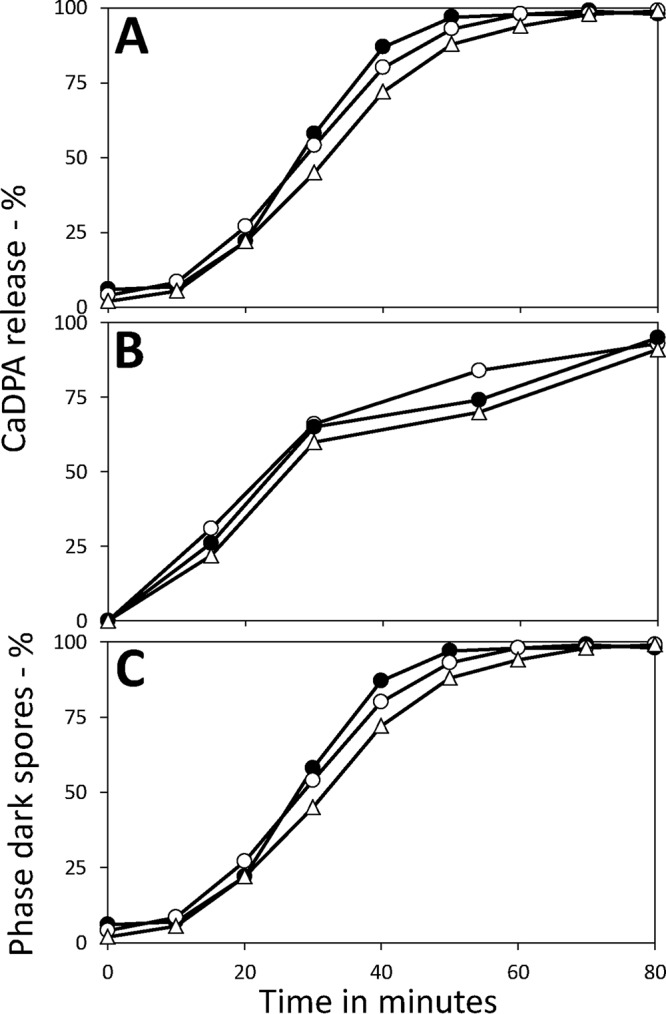
Germination of B. subtilis 2-, 47-, and 98-day spores with various germinants. Spores were harvested from sporulation plates incubated for 2, 47, or 98 days, highly purified as described in Materials and Methods, and germinated with either l-valine (A), dodecylamine (B), or Ca-DPA (C). Spore germination was monitored by measuring either Ca-DPA release by fluorometry (A and B) or generation of dark spores in phase-contrast microscopy (C), with 100 spores examined at all time points for each spore preparation. The symbols used are as follows: ○, 2-day spores; ●, 47-day spores; and ▵, 98-day spores. This experiment was carried out twice, with essentially identical results.
FIG 2
FIG 2
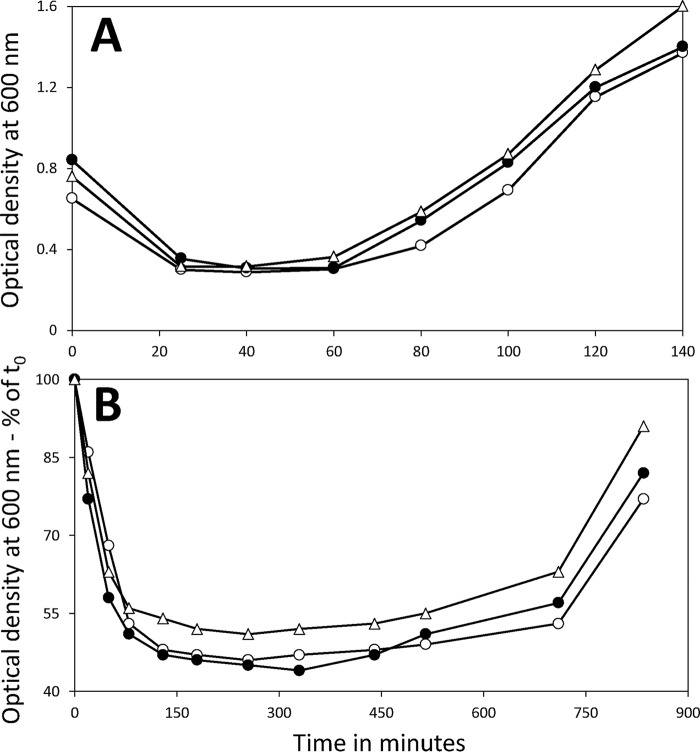
Germination and outgrowth of B. subtilis 2-, 47-, and 98-day spores in rich or minimal medium. Spores harvested from sporulation plates after 2, 47, or 98 days were purified as described in Materials and Methods. Spores were then incubated at 37°C in either L broth plus l-valine (A) or Spizizen’s minimal medium plus l-alanine (B) as described in Materials and Methods, and spore germination, outgrowth, and vegetative growth were followed by measuring the OD600 of the cultures. The symbols used are as follows: ○, 2-day spores; ●, 47-day spores; and ▵, 98-day spores. This experiment was carried out twice, with essentially identical results.
FIG 3
FIG 3
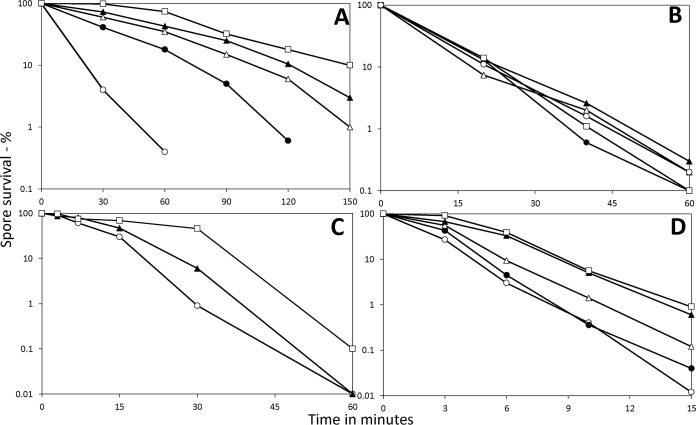
Resistance properties of B. subtilis spores incubated for 2, 47, or 98 days. Spores harvested from sporulation plates incubated for 2, 6, 15, 47, or 98 days were purified as described in Materials and Methods. The purified spores’ survival when exposed to wet heat (A), dry heat (B), hypochlorite (C), or UV radiation (D) was then measured as described in Materials and Methods, and essentially identical results were obtained in duplicate experiments. The symbols for the ages of the spores used are as follows: ○, 2 days; ●, 6 days; ▵, 15 days; ▲, 47 days; and ☐, 98 days.
FIG 4
FIG 4
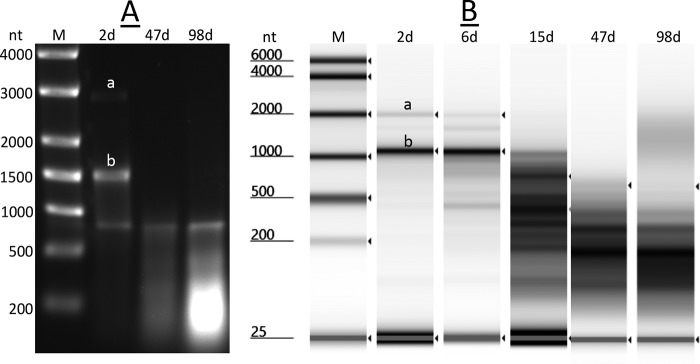
Electrophoretic analysis of RNA in B. subtilis spores incubated for 2 to 98 days (d). Spores were harvested from plates incubated for 2 to 98 days and were purified as described in Materials and Methods. RNA was extracted from the purified spores and analyzed either by agarose gel electrophoresis with coelectrophoresed nucleotide size markers (A) or on an Agilent TapeStation 4200 automated gel electrophoresis system (high-sensitivity RNA assay) using in silico size markers (B), as described in Materials and Methods. Bands labeled “a” and “b” in panels A and B denote the migration positions of intact 23S and 16S rRNA, respectively; note the software sizing of detected rRNA peaks in panel B is not accurate compared to the expected size of the bands detected in panel A. Samples run were from separate experiments and had RNA from two separate spore preparations harvested after 2 days. (B) The 47- and 98-day RNA lanes were from a different TapeStation run than the 2-day, 6-day, and 15-day RNA lanes.
FIG 5
FIG 5
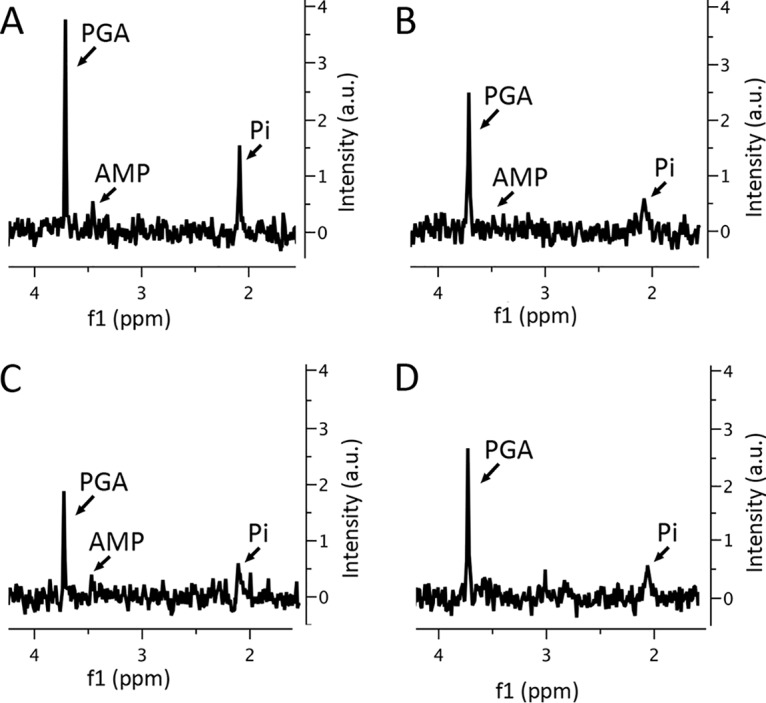
31P NMR spectra of small molecules extracted from 2-day (A), 6-day (B), 51-day (C), and 91-day (D) spores. Small molecules were extracted from spores of various ages, and extracts were processed and examined by 31P NMR, as described in Materials and Methods. Labeled peaks are from 3PGA, AMP, and Pi, and all spectra are shown at the same scale. There appear to be slightly broader peaks for Pi and 3PGA in spectra from 6- and 51-day spores, perhaps because of less efficient Mn2+ removal from these samples, and this could contribute to lower peak heights in these samples. a.u., arbitrary units.
FIG 6
FIG 6
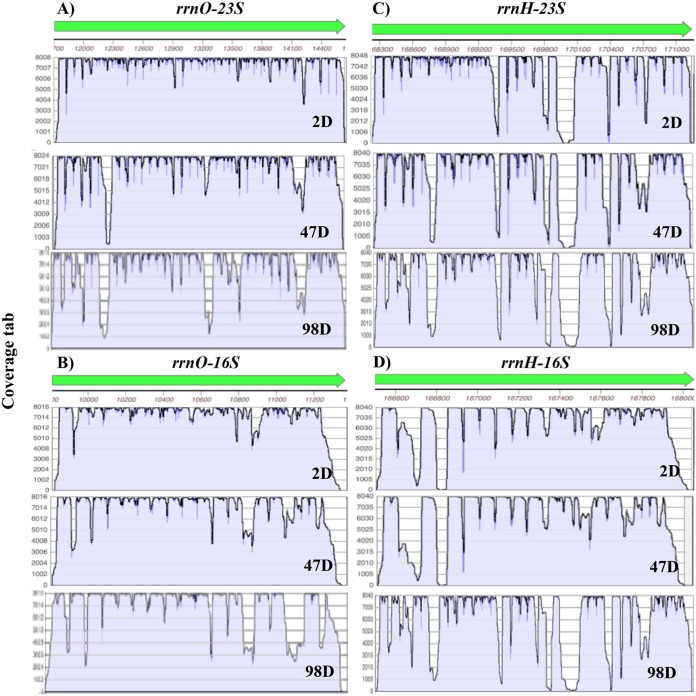
Coverage of RNA-seq reads from 16S and 23S rRNAs from 2-, 47-, and 98-day spores. RNA-seq data for two sets of rRNA genes, rrnO and rrnH, which exhibited lower (rrnO) and higher (rrnH), respectively, loss of reads in regions of 47- and 98-day spore rRNA are shown, and coverage of reads was determined as described in Materials and Methods. The vertical axes are coverage in arbitrary units (a.u.). Note that the scales of the vertical axes are identical for 2-, 47-, and 98-day spore rRNA.
FIG 7
FIG 7
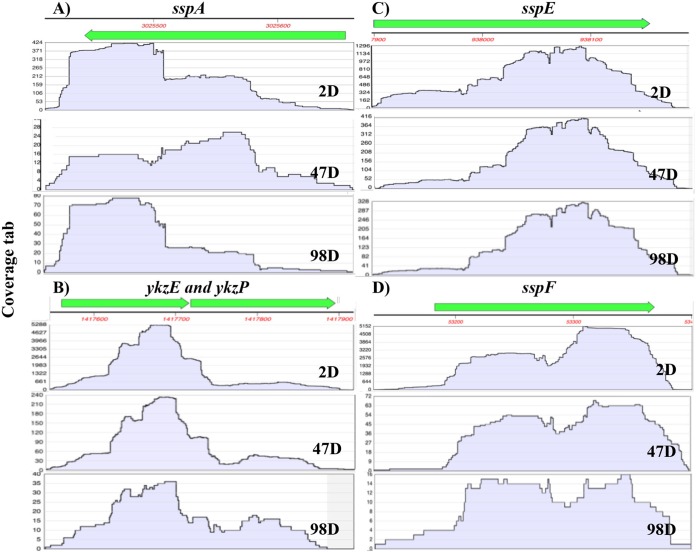
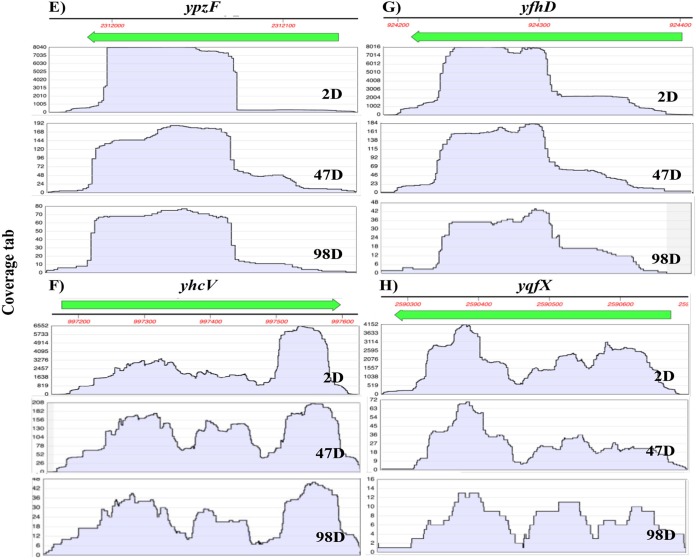
Coverage of RNA-seq reads from 8 abundant mRNAs from 2-, 47-, and 98-day spores. RNA-seq data using RNA that was not ribo-depleted for 8 abundant mRNAs in 2-day spores, as well as in 47-day and 98-day spores, were obtained, and coverage of reads was determined as described in Materials and Methods. The vertical axes are coverage in arbitrary units (a.u.). Note the large differences in the scales of the vertical axes in the 2- to 98-day samples.
FIG 7
FIG 7
Coverage of RNA-seq reads from 8 abundant mRNAs from 2-, 47-, and 98-day spores. RNA-seq data using RNA that was not ribo-depleted for 8 abundant mRNAs in 2-day spores, as well as in 47-day and 98-day spores, were obtained, and coverage of reads was determined as described in Materials and Methods. The vertical axes are coverage in arbitrary units (a.u.). Note the large differences in the scales of the vertical axes in the 2- to 98-day samples.
FIG 8
FIG 8
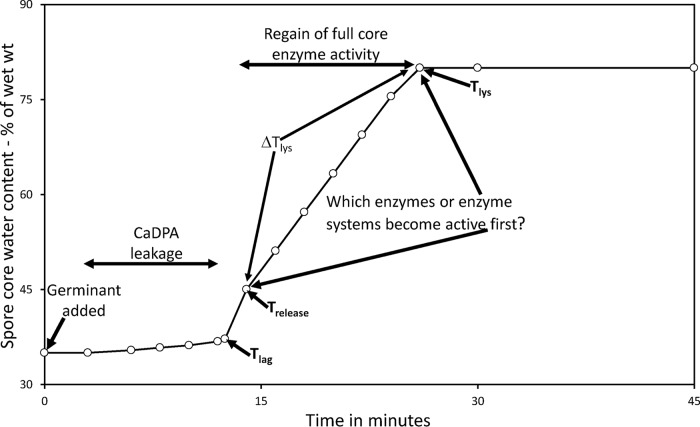
Model showing changes in spore core water content in the early minutes of germination of an individual wild-type B. subtilis spore. Data from references and were used to generate the times for the various events shown in this model. wt, weight; Tlag, time when rapid Ca-DPA release begins; Trelease, time when all Ca-DPA has been released.

References

    1. Setlow P. 2006. Spores of Bacillus subtilis: their resistance to and killing by radiation, heat and chemicals. J Appl Microbiol 101:514–525. doi:10.1111/j.1365-2672.2005.02736.x. - DOI - PubMed
    1. Setlow P. 2016. Spore resistance properties, p 201–215. In Eichenberger P, Driks A (ed), The bacterial spore: from molecules to systems. ASM Press, Washington, DC.
    1. Setlow P, Johnson EA. 2012. Spores and their significance, p 45–79. In Doyle MP, Buchanan R (ed), Food microbiology, fundamentals and frontiers, 4th ed ASM Press, Washington, DC.
    1. Kennedy MJ, Reader SL, Swierczynski LM. 1994. Preservation records of microorganisms: evidence of the tenacity of life. Microbiology 140:2513–2529. doi:10.1099/00221287-140-10-2513. - DOI - PubMed
    1. Vreeland RH, Rosenzweig WD, Powers DW. 2000. Isolation of a 250 million-year-old halotolerant bacterium from a primary salt crystal. Nature 407:897–900. doi:10.1038/35038060. - DOI - PubMed

Publication types

MeSH terms

LinkOut - more resources