


Looking Into the Crystal Ball: Predicting the Future Challenges of Fibrotic NASH Treatment
- PMID: 31061949
- PMCID: PMC6492475
- DOI: 10.1002/hep4.1342
Looking Into the Crystal Ball: Predicting the Future Challenges of Fibrotic NASH Treatment
Abstract
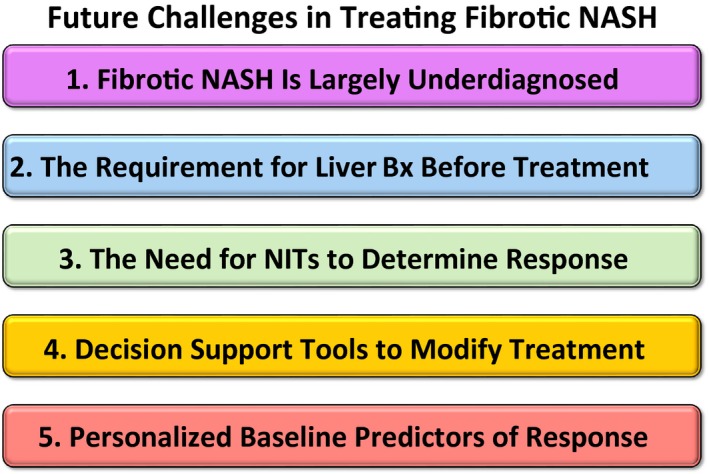
Nonalcoholic fatty liver disease (NAFLD) is the most common form of chronic liver disease worldwide, and its aggressive form of nonalcoholic steatohepatitis (NASH) is becoming a leading cause for end-stage liver disease and liver transplantation in the United States. In patients with NASH, the presence of advanced fibrosis is considered the most important prognostic factor in predicting liver-related morbidity and mortality. Unfortunately, there are no US Food and Drug Administration (FDA)-approved medications to treat patients with NASH-induced advanced fibrosis. However, the field of drug development to treat NASH and fibrosis has witnessed major advances over the past 5 years with several medications in phase III trials. Results from some of these trials are expected in 2019 with potential FDA approval in 2020. Clinicians who treat patients with NAFLD are likely to face several challenges over the next few years related to identifying patients with advanced fibrosis who may derive most benefit from pharmacologic treatment, the requirement for liver biopsy to assess histologic severity and response to treatment, and the urgent need to validate noninvasive tests to replace liver biopsy-to determine treatment initiation, response, futility, and the need for combination therapy with multiple drugs. Conclusion: In this review, we aim to dissect each of these challenges and attempt to provide suggested solutions while fully realizing that knowledge gaps still exist where future research is likely to provide urgently needed answers.
Figures
References
-
- Younossi ZM, Koenig AB, Abdelatif D, Fazel Y, Henry L, Wymer M. Global epidemiology of nonalcoholic fatty liver disease—meta‐analytic assessment of prevalence, incidence, and outcomes. Hepatology 2016;64:73‐84. - PubMed
-
- Ekstedt M, Hagstrom H, Nasr P, Fredrikson M, Stal P, Kechagias S, et al. Fibrosis stage is the strongest predictor for disease‐specific mortality in NAFLD after up to 33 years of follow‐up. Hepatology 2015;61:1547‐1554. - PubMed
Publication types
LinkOut - more resources
Full Text Sources
Other Literature Sources
Miscellaneous
