


The relationship between sleep duration, cognition and dementia: a Mendelian randomization study
- PMID: 31062029
- PMCID: PMC6659373
- DOI: 10.1093/ije/dyz071
The relationship between sleep duration, cognition and dementia: a Mendelian randomization study
Abstract
Background: Short and long sleep duration have been linked with poorer cognitive outcomes, but it remains unclear whether these associations are causal.
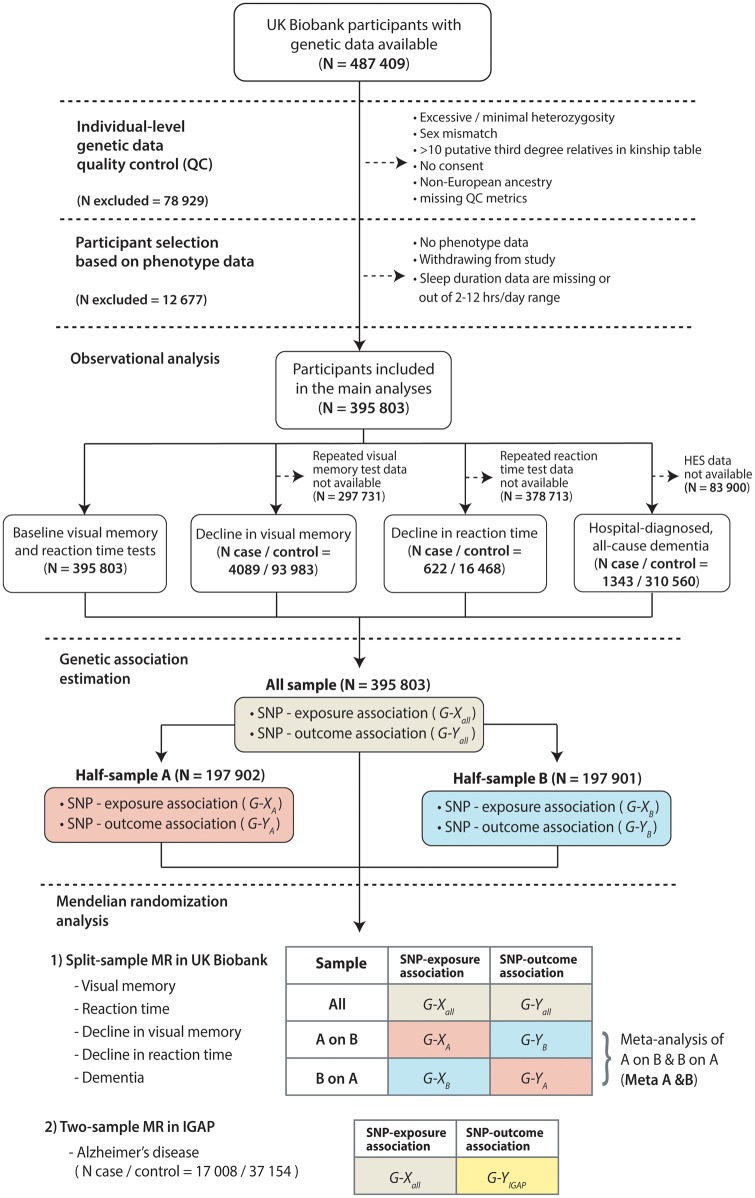
Methods: We conducted the first Mendelian randomization (MR) study with 77 single-nucleotide polymorphisms (SNPs) for sleep duration using individual-participant data from the UK Biobank cohort (N = 395 803) and summary statistics from the International Genomics of Alzheimer's Project (N cases/controls = 17 008/37 154) to investigate the potential impact of sleep duration on cognitive outcomes.
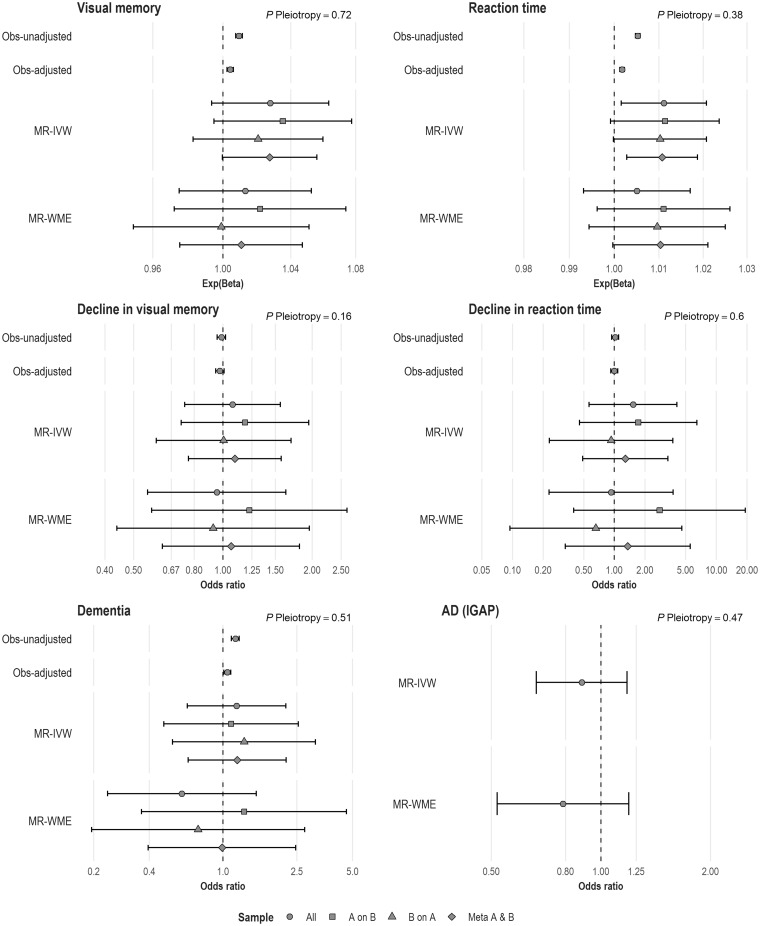
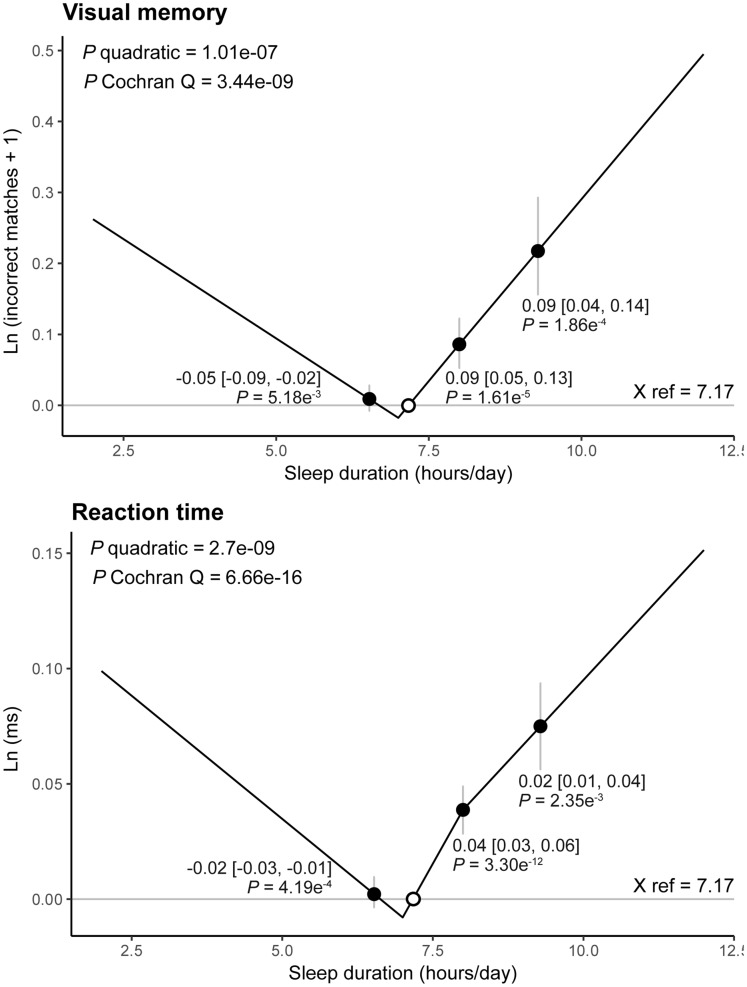
Results: Linear MR suggested that each additional hour/day of sleep was associated with 1% [95% confidence interval (CI) = 0-2%; P = 0.008] slower reaction time and 3% more errors in visual-memory test (95% CI = 0-6%; P = 0.05). There was little evidence to support associations of increased sleep duration with decline in visual memory [odds ratio (OR) per additional hour/day of sleep = 1.10 (95% CI = 0.76-1.57); P = 0.62], decline in reaction time [OR = 1.28 (95% CI = 0.49-3.35); P = 0.61], all-cause dementia [OR = 1.19 (95% CI = 0.65-2.19); P = 0.57] or Alzheimer's disease risk [OR = 0.89 (95% CI = 0.67-1.18); P = 0.41]. Non-linear MR suggested that both short and long sleep duration were associated with poorer visual memory (P for non-linearity = 3.44e-9) and reaction time (P for non-linearity = 6.66e-16).
Conclusions: Linear increase in sleep duration has a small negative effect on reaction time and visual memory, but the true association might be non-linear, with evidence of associations for both short and long sleep duration. These findings suggest that sleep duration may represent a potential causal pathway for cognition.
Keywords: Mendelian randomization; Sleep duration; cognition; dementia.
© The Author(s) 2019. Published by Oxford University Press on behalf of the International Epidemiological Association.
Figures
References
-
- Brayne C. The elephant in the room—healthy brains in later life, epidemiology and public health. Nat Rev Neurosci 2007;8:233–9. - PubMed
-
- Devore EE, Grodstein F, Schernhammer ES.. Sleep duration in relation to cognitive function among older adults: a systematic review of observational studies. Neuroepidemiology 2016;46:57–78. - PubMed
-
- Lo JC, Groeger JA, Cheng GH, Dijk D-J, Chee M.. Self-reported sleep duration and cognitive performance in older adults: a systematic review and meta-analysis. Sleep Med [Internet]. 2016;17:87–98. http://linkinghub.elsevier.com/retrieve/pii/S1389945715019796 (31 May 2017, date last accessed). - PubMed
-
- Mander BA, Marks SM, Vogel JW.. β-amyloid disrupts human NREM slow waves and related hippocampus-dependent memory consolidation. Nat Neurosci [Internet] 2015;18:1051–7. http://www.nature.com/doifinder/10.1038/nn.4035 (28 July 2017, date last accessed). - DOI - PMC - PubMed
Publication types
MeSH terms
Grants and funding
LinkOut - more resources
Full Text Sources
Medical
