


Pre- and Early Pregnancy Onset Depression and Subsequent Rate of Gestational Weight Gain
- PMID: 31063018
- PMCID: PMC6743087
- DOI: 10.1089/jwh.2018.7497
Pre- and Early Pregnancy Onset Depression and Subsequent Rate of Gestational Weight Gain
Abstract
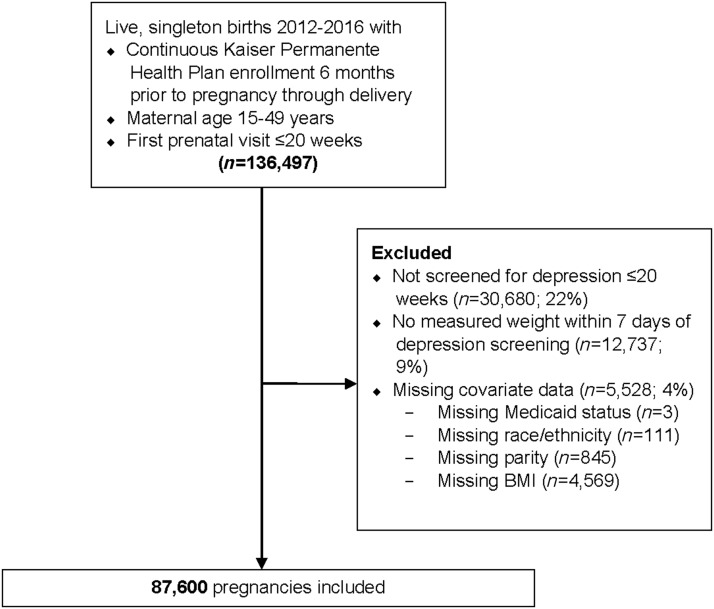
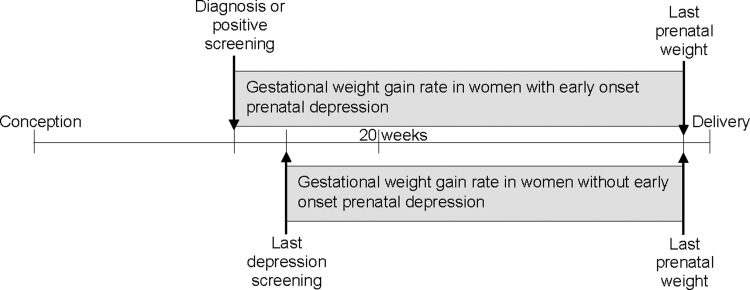
Background: Depression is associated with weight change outside of pregnancy. We assessed associations of prepregnancy or early pregnancy onset depression with gestational weight gain (GWG) rate overall and according to Institute of Medicine (IOM) recommendations. Materials and Methods: Depression from 6 months prepregnancy through 20 weeks gestation was identified in a health care system in northern California with perinatal depression screening (2011-2016; n = 87,600). GWG rate (lbs/week) was calculated using weight at delivery and at diagnosis or depression screening ≤20 weeks. Results: Compared to women without prepregnancy or early pregnancy depression, women with prepregnancy onset depression had 11% greater risk of GWG rate <IOM recommendations (95% confidence intervals [CI]: 1.07-1.15) and 3% greater risk of GWG rate >IOM recommendations (95% CI: 1.01-1.05), with a stronger association for >IOM in normal weight women. Early pregnancy onset depression was associated with 0.04 lbs/week greater GWG rate (95% CI: 0.02-0.07) and 4% greater risk of GWG rate >IOM recommendations (95% CI: 1.02-1.07) compared to no prepregnancy or early pregnancy depression, with stronger associations in obese women. Conclusions: Women with prepregnancy onset depression may be at higher risk for GWG both below and above recommendations. Women with early onset prenatal depression may be at slightly higher risk for GWG rate above recommendations. Our results suggest that the relationship between depression and GWG may vary based on timing of depression onset, prepregnancy body mass index category, and antidepressant use. Additional research should identify factors that predict how a woman's lifestyle behaviors and weight change after depression diagnosis.
Keywords: depression; gestational weight gain; perinatal depression; pregnancy.
Conflict of interest statement
No competing financial interests exist.
Figures
References
-
- ACOG Committee opinion no. 548: Weight gain during pregnancy. Obstet Gynecol 2013;121:210–212 - PubMed
-
- Committee on Obstetric Practice. Weight gain during pregnancy: reexamining the guidelines. Washington, DC: National Academies Press, 2009 - PubMed
-
- Burt VK, Stein K. Epidemiology of depression throughout the female life cycle. J Clin Psychiatry 2002;63 Suppl 7:9–15 - PubMed
-
- Farr SL, Bitsko RH, Hayes DK, Dietz PM. Mental health and access to services among US women of reproductive age. Am J Obstet Gynecol 2010;203:542.e541–e549 - PubMed
Publication types
MeSH terms
Grants and funding
LinkOut - more resources
Full Text Sources
Medical
