


The Quality and Outcomes of Care Provided to Patients with Cirrhosis by Advanced Practice Providers
- PMID: 31063262
- PMCID: PMC6834870
- DOI: 10.1002/hep.30695
The Quality and Outcomes of Care Provided to Patients with Cirrhosis by Advanced Practice Providers
Abstract
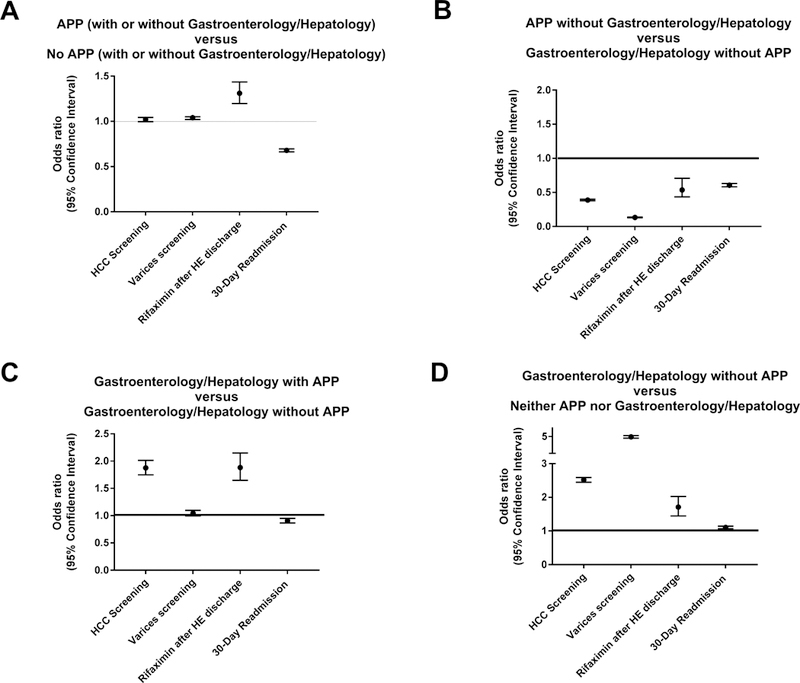
Cirrhosis is morbid and increasingly prevalent, yet the U.S. health care system lacks enough physicians and specialists to adequately manage patients with cirrhosis. Although advanced practice providers (APPs) can expand access to cirrhosis-related care, their impact on the quality of care remains unknown. We sought to determine the effect on care quality and outcomes for patients managed by APPs using a retrospective analysis of a nationally representative American commercial claims database (Optum), which included 389,257 unique adults with cirrhosis. We evaluated a complication of process measures (i.e., rates of hepatocellular carcinoma [HCC] screening, endoscopic varices screening, and use of rifaximin after hospitalization for hepatic encephalopathy) and outcomes (30-day readmissions and survival). Compared with patients without APP care, patients with APP care had higher rates of HCC screening (adjusted odds ratio [OR] 1.23, 95% confidence interval 1.19, 1.27), varices screening (OR 1.20 [1.13, 1.27]), use of rifaximin after a discharge for hepatic encephalopathy (OR 2.09 [1.80, 2.43]), and reduced risk of 30-day readmission (OR 0.68 [0.66, 0.70]). Gastroenterology/hepatology consultation was also associated with improved quality metric performance compared with primary care; however, shared visits between gastroenterologists/hepatologists and APPs were associated with the best performance and lower 30-day readmissions compared with subspecialty consultation without an APP (OR 0.91 [0.87, 0.95]. Multivariate analysis adjusting for comorbidities, liver disease severity, and other factors including gastroenterology/hepatology consultation showed that patients seen by APPs were more likely to receive consistent HCC and varices screening over time, less likely to experience 30-day readmissions, and had lower mortality (adjusted hazard ratio 0.57, 95% confidence interval 0.55, 0.60). Conclusion: APPs, particularly when working with gastroenterologists/hepatologists, are associated with improved quality of care and outcomes for patients with cirrhosis.
© 2019 by the American Association for the Study of Liver Diseases.
Conflict of interest statement
Conflicts of interest. No other author has relevant conflicts of interest.
Figures
Comment in
-
Advanced Practice Providers: Raising Our Defenses Against the Rising Tide of Cirrhosis.Hepatology. 2020 Jan;71(1):11-13. doi: 10.1002/hep.30987. Hepatology. 2020. PMID: 31605626 No abstract available.
References
-
- Wong R, Liu B, Bhuket T. Significant burden of nonalcoholic fatty liver disease with advanced fibrosis in the US: a cross-sectional analysis of 2011–2014 National Health and Nutrition Examination Survey. Alimentary pharmacology & therapeutics 2017;46:974–980. - PubMed
-
- Beste LA, Leipertz SL, Green PK, Dominitz JA, Ross D, Ioannou GN. Trends in burden of cirrhosis and hepatocellular carcinoma by underlying liver disease in US veterans, 2001–2013. Gastroenterology 2015;149:1471–1482. e1475. - PubMed
-
- Mellinger JL, Shedden K, Winder GS, Tapper E, Adams M, Fontana RJ, Volk ML, et al. The High Burden of Alcoholic Cirrhosis in Privately Insured Persons in the United States. Hepatology 2018. - PubMed
