


Assessment of the analytical performances and sample stability on ST Genesia system using the STG-DrugScreen application
- PMID: 31063645
- PMCID: PMC6852561
- DOI: 10.1111/jth.14470
Assessment of the analytical performances and sample stability on ST Genesia system using the STG-DrugScreen application
Abstract
Background: Thrombin generation testing has been used to provide information on the coagulation phenotype of patients. The most used technique is the calibrated automated thrombogram (CAT) but it suffers from a lack of standardization, preventing its implementation in routine. The ST Genesia is a new analyzer designed to assess thrombin generation based on the same principle as the CAT. Unlike the CAT system, the ST Genesia is a benchtop, fully automated analyzer, able to perform the analyses individually and not by batch, with strict control of variables such as temperature and volumes, ensuring, theoretically, maximal reproducibility.
Objectives: This study aimed at assessing the performance of the STG-DrugScreen application on the ST Genesia analyzer. We also aimed at exploring stability of plasma samples after freezing and defining a reference normal range.
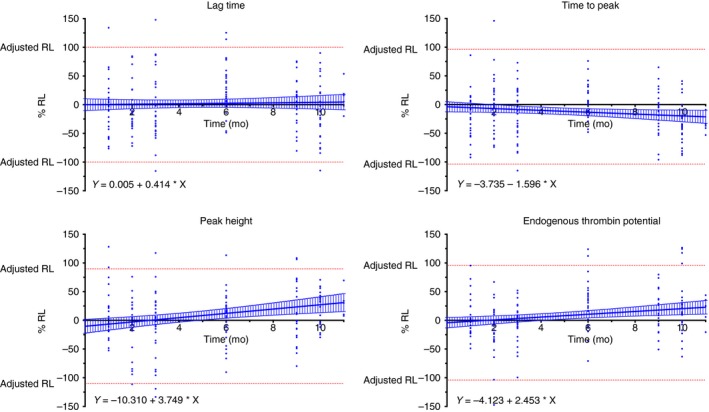
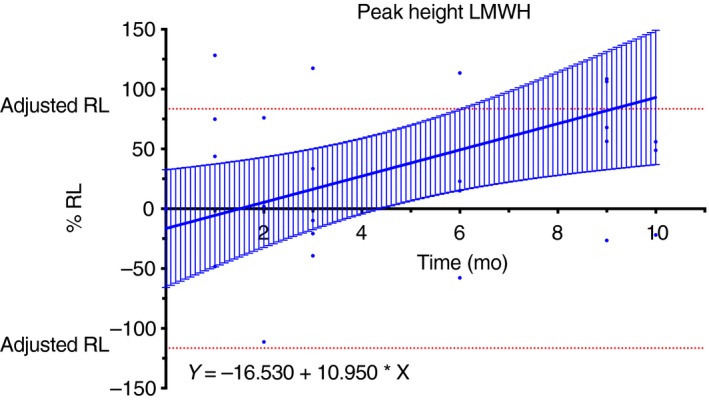
Results: Results demonstrated the excellent interexperiment precision of the ST Genesia and confirmed that the use of a reference plasma helps reducing the inter-experiments variability. Stability revealed that plasma samples are stable for at least 11 months at -70°C or lower, except for those containing low molecular weight heparins which have to be tested within 6 months. Freezing had no effect on the majority of thrombin generation parameters except on time to peak.
Conclusions: Our results suggest an easy implementation of thrombin generation with the use of ST Genesia in the routine laboratory. This will facilitate the design of multicentric studies and enable the establishment of reliable and evidence-based thresholds, which may improve the management of patients treated with anticoagulants.
Keywords: anticoagulants; blood coagulation tests; clinical laboratory techniques; normal range; reproducibility.
© 2019 The Authors. Journal of Thrombosis and Haemostasis published by Wiley Periodicals, Inc. on behalf of International Society on Thrombosis and Haemostasis.
Conflict of interest statement
The study was financed by Diagnostica Stago group. Among the authors, J. Douxfils is chief executive officer and founder of QUALIblood s.a. and reports personal fees from Diagnostica Stago, Roche, Roche Diagnostics, and Daiichi‐Sankyo, outside the submitted work. F. Mullier reports institutional fees from Diagnostica Stago, Werfen, Nodia, Sysmex, and Bayer. He also reports speaker fees from Boehringer Ingelheim, Bayer Healthcare, and Bristol‐Myers Squibb‐Pfizer, all outside the submitted work. The other authors have no conflicts of interest to disclose.
Figures
References
-
- Tripodi A. Thrombin generation assay and its application in the clinical laboratory. Clin Chem. 2016;62:699–707. - PubMed
-
- Hemker HC, Willems GM, Beguin S. A computer assisted method to obtain the prothrombin activation velocity in whole plasma independent of thrombin decay processes. Thromb Haemost. 1986;56:9–17. - PubMed
-
- Hemker HC, Giesen P, Al Dieri R, Regnault V, de Smedt E, Wagenvoord R, et al. Calibrated automated thrombin generation measurement in clotting plasma. Pathophysiol Haemost Thromb. 2003;33:4–15. - PubMed
Publication types
MeSH terms
Substances
LinkOut - more resources
Full Text Sources
Medical
Miscellaneous
