


Clinical Implications of Discordant Early Molecular Responses in CML Patients Treated with Imatinib
- PMID: 31064152
- PMCID: PMC6539817
- DOI: 10.3390/ijms20092226
Clinical Implications of Discordant Early Molecular Responses in CML Patients Treated with Imatinib
Abstract
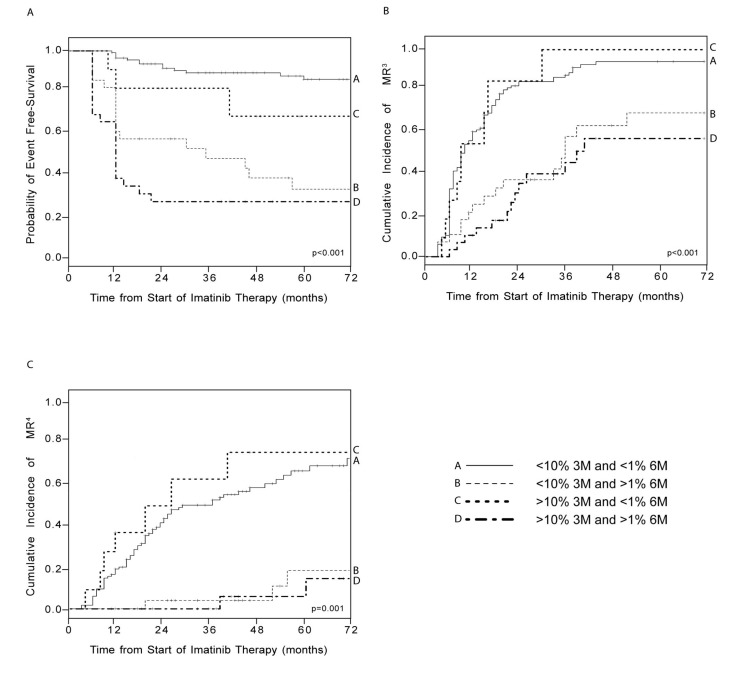
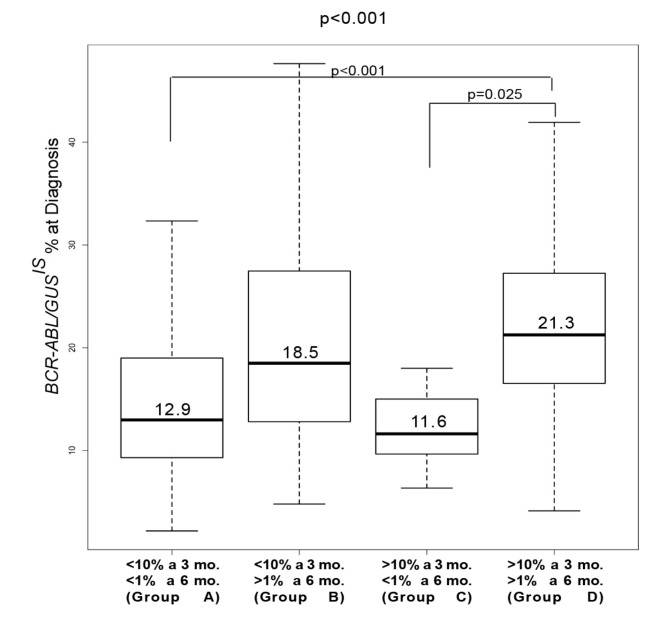
A reduction in BCR-ABL1/ABL1IS transcript levels to <10% after 3 months or <1% after 6 months of tyrosine kinase inhibitor therapy are associated with superior clinical outcomes in chronic myeloid leukemia (CML) patients. In this study, we investigated the reliability of multiple BCR-ABL1 thresholds in predicting treatment outcomes for 184 subjects diagnosed with CML and treated with standard-dose imatinib mesylate (IM). With a median follow-up of 61 months, patients with concordant BCR-ABL1/ABL1IS transcripts below the defined thresholds (10% at 3 months and 1% at 6 months) displayed significantly superior rates of event-free survival (86.1% vs. 26.6%) and deep molecular response (≥ MR4; 71.5% vs. 16.1%) compared to individuals with BCR-ABL1/ABL1IS levels above these defined thresholds. We then analyzed the outcomes of subjects displaying discordant molecular transcripts at 3- and 6-month time points. Among these patients, those with BCR-ABL1/ABL1IS values >10% at 3 months but <1% at 6 months fared significantly better than individuals with BCR-ABL1/ABL1IS <10% at 3 months but >1% at 6 months (event-free survival 68.2% vs. 32.7%; p < 0.001). Likewise, subjects with BCR-ABL1/ABL1IS at 3 months >10% but <1% at 6 months showed a higher cumulative incidence of MR4 compared to patients with BCR-ABL1/ABL1IS <10% at 3 months but >1% at 6 months (75% vs. 18.2%; p < 0.001). Finally, lower BCR-ABL1/GUSIS transcripts at diagnosis were associated with BCR-ABL1/ABL1IS values <1% at 6 months (p < 0.001). Our data suggest that when assessing early molecular responses to therapy, the 6-month BCR-ABL1/ABL1IS level displays a superior prognostic value compared to the 3-month measurement in patients with discordant oncogenic transcripts at these two pivotal time points.
Keywords: BCR-ABL1; European Leukemia Net; chronic myeloid leukemia; early molecular response; imatinib mesylate.
Conflict of interest statement
Fabio Stagno: honoraria from BMS, Incyte, Novartis, Pfizer. Francesco Di Raimondo: research funding from BMS, honoraria from Novartis, Incyte, BMS, and Pfizer. Paolo Vigneri: research funding from Novartis, honoraria from Astra-Zeneca, Celgene, Incyte, Novartis, and Pfizer. The other authors declare no conflict of interest.
Figures
References
MeSH terms
Substances
LinkOut - more resources
Full Text Sources
Medical
Molecular Biology Databases
Miscellaneous
