Review
. 2019 Jun;15(6):340-354.
doi: 10.1038/s41584-019-0220-z.

Single-cell technologies - studying rheumatic diseases one cell at a time

Affiliations
Review

Single-cell technologies - studying rheumatic diseases one cell at a time

Peggie Cheung et al. Nat Rev Rheumatol. 2019 Jun.

Abstract

Cells, the basic units of life, have striking differences at transcriptomic, proteomic and epigenomic levels across tissues, organs, organ systems and organisms. The coordination of individual immune cells is essential for the generation of effective immune responses to pathogens while immune tolerance is maintained to protect the host. In rheumatic diseases, when immune responses are dysregulated, pathologically important cells might represent only a small fraction of the immune system. Interrogation of the contributions of individual immune cells to pathogenesis and disease progression should therefore reveal important insights into the complicated aetiology of rheumatic diseases. Technological advances are enabling the high-dimensional dissection of single cells at multiple omics levels, which could facilitate the identification of dysregulated molecular mechanisms in patients with rheumatic diseases and the discovery of new therapeutic targets and biomarkers. The single-cell technologies that have been developed over the past decade and the experimental platforms that enable multi-omics integrative analyses have already made inroads into immunology-related fields of study and have potential for use in rheumatology. Layers of omics data derived from single cells are likely to fundamentally change our understanding of the molecular pathways that underpin the pathogenesis of rheumatic diseases.


Conflict of interest statement

Competing interests

The authors declare no competing interests.

Figures
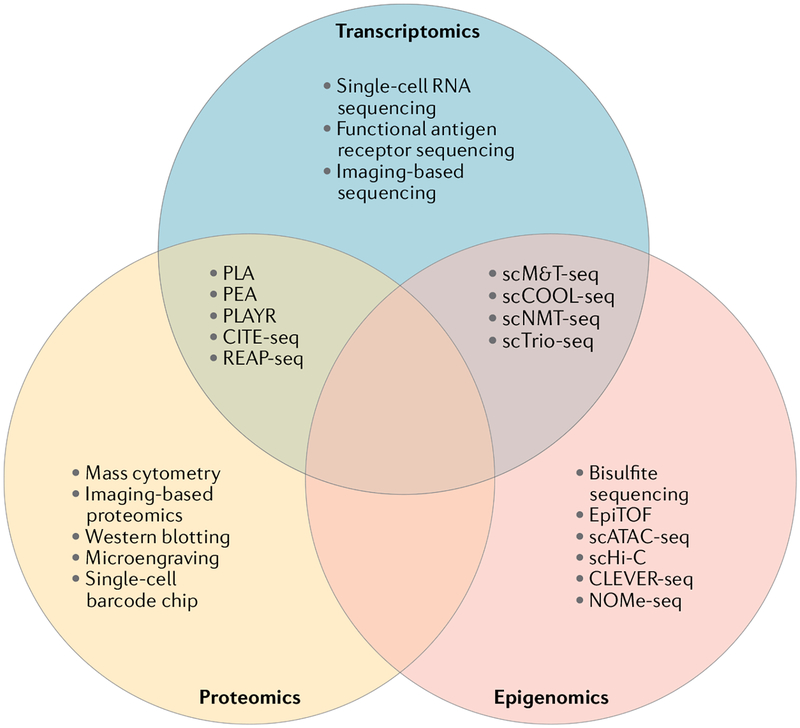
Fig. 1 |
Fig. 1 |. Single-cell experimental platforms for omics analysis.
Venn diagram depicting single-cell technologies that can be used to interrogate the transcriptome, epigenome and proteome. Overlapping regions contain technologies that enable the integrative analysis of multiple omics in the same cells. CITE-seq, cellular indexing of transcriptomes and epitopes by sequencing; CLEVER-seq, chemical-labelling-enabled C-to-T conversion sequencing; EpiTOF, epigenetic landscape profiling using cytometry by time of flight; NOMe-seq, nucleosome occupancy and methylome sequencing; PEA, proximity extension assay; PLA, proximity ligation assay; PLAYR, proximity ligation assay for RNA; REAP-seq, RNA expression and protein sequencing; scATAC-seq, single-cell resolution in assay for transposase-accessible chromatin using sequencing; scCOOL-seq, single-cell chromatin overall omic-scale landscape sequencing; scHi-C, high-throughput variant of chromosome conforation capture performed on single cells; scM&T-seq, single-cell methylome and transcriptome sequencing; scNMT-seq, single-cell nucleosome, methylation and transcription sequencing; scTrio-seq; single-cell triple omics sequencing.
Fig. 2 |
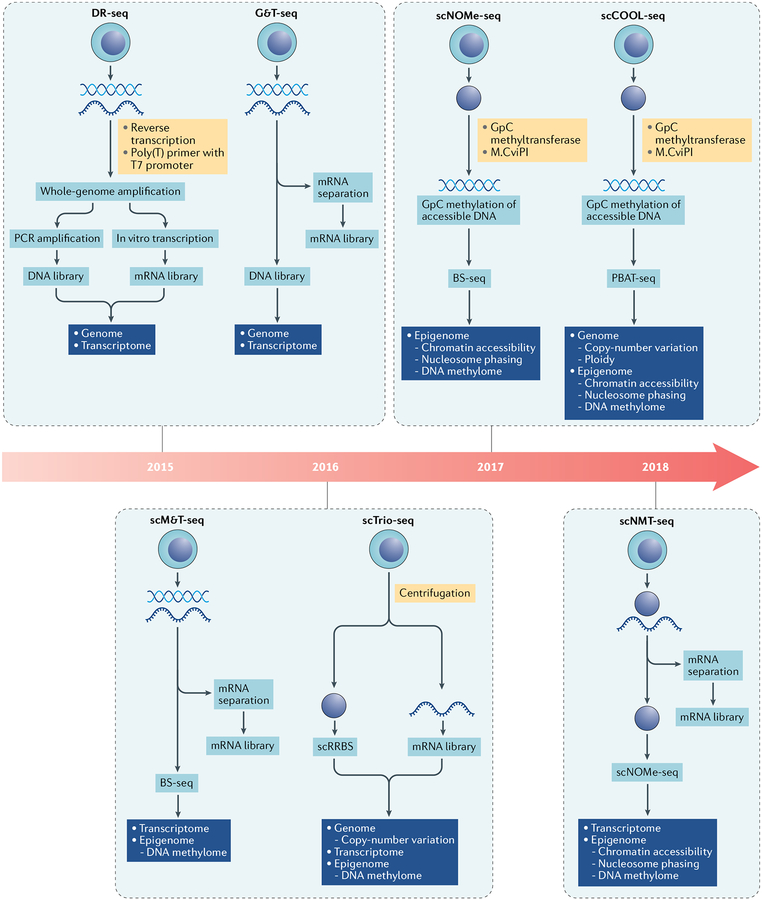
Fig. 2 |. Methods to simultaneously perform genomic, transcriptomic and epigenomic analysis.
Timeline of sequencing-based single-cell technologies for simultaneous analysis of combinations of the genome, transcriptome and epigenome, showing the basic methods for individual technologies and the biological info rmation that can be obtained using these platforms. BS-seq, bisulfite sequencing; DR-seq, DNA and mRNA sequencing; G&T-seq, genom e and transcriptome sequencing; PBAT-seq, post-bisulfite adaptor tagging sequencing; scCOOL-seq, single-cell chromatin overall omic-scale landscape sequencing; scM&T-seq, single-cell methylome and transcriptome sequencing; scNMT-seq, single-cell nucleosome, methylation and transcription sequencing; scNOMe-seq, single-cell nucleosome occupancy and methylome sequencing; scRRBS, single-cell reduced representation bisulfite sequencing; scTrio-seq; single-cell triple omics sequencing.
Fig. 3 |
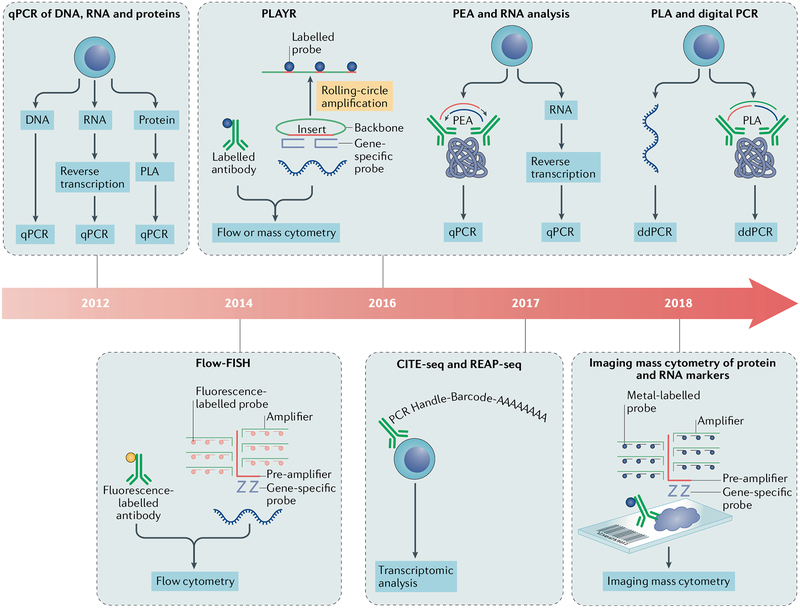
Fig. 3 |. Methods to simultaneously perform nucleic acid and protein marker analysis.
Timeline of single-cell technologies that enable thesim ultaneous analysis of nucleic acid and protein markers, showing the basic methods for individual technologies and the readouts of these platforms. CITE-seq, cellular indexing of transcriptomes and epitopes by sequencing; ddPCR, droplet digital PCR; FISH, fluorescence in situ hybridization; PEA, proxim ity extension assay; PLA, proximity ligation assay; PLAYR, proximity ligation assay for RNA; qPCR, quantitative PCR; REAP-seq, RNA expression and protein sequencing.

References

    1. Mardis ER The impact of next-generation sequencing technology on genetics. Trends Genet. 24, 133–141 (2008). - PubMed
    1. Metzker ML Sequencing technologies — the next generation. Nat. Rev Genet 11, 31–46 (2010). - PubMed
    1. Bendall SC et al. Single-cell mass cytometry of differential immune and drug responses across a human hematopoietic continuum. Science 332, 687–696 (2011). - PMC - PubMed
    1. Helmick CG et al. Estimates of the prevalence of arthritis and other rheumatic conditions in the United States, part I. Arthritis Rheum. 58, 15–25 (2008). - PubMed
    1. Lawrence RC et al. Estimates of the prevalence of arthritis and other rheumatic conditions in the United States, part II. Arthritis Rheum. 58, 26–35 (2008). - PMC - PubMed

Publication types