. 2019 Apr 18:9:112.
doi: 10.3389/fcimb.2019.00112. eCollection 2019.

Dysbiosis of the Gut Microbiome in Lung Cancer

Affiliations

Dysbiosis of the Gut Microbiome in Lung Cancer

He Zhuang et al. Front Cell Infect Microbiol. .

Abstract

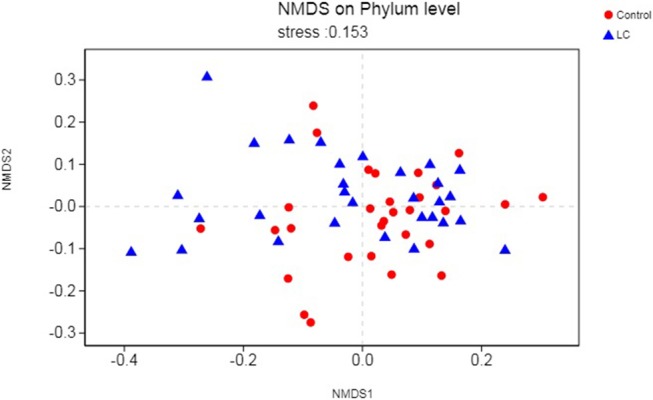
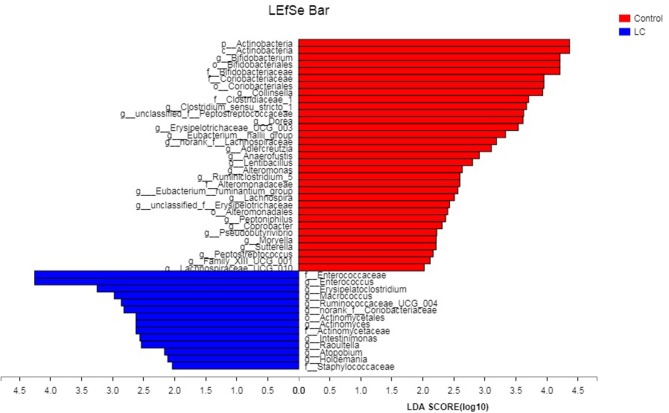
Lung cancer (LC) is one of the most serious malignant tumors, which has the fastest growing morbidity and mortality worldwide. A role of the lung microbiota in LC pathogenesis has been analyzed, but a comparable role of the gut microbiota has not yet been investigated. In this study, the gut microbiota of 30 LC patients and 30 healthy controls were examined via next-generation sequencing of 16S rRNA and analyzed for diversity and biomarkers. We found that there was no decrease in significant microbial diversity (alpha diversity) in LC patients compared to controls (P observed = 0.1422), while the composition (beta diversity) differed significantly between patients and controls (phylum [stress = 0.153], class [stress = 0.16], order [stress = 0.146], family [stress = 0.153]). Controls had a higher abundance of the bacterial phylum Actinobacteria and genus Bifidobacterium, while patients with LC showed elevated levels of Enterococcus. These bacteria were found as possible biomarkers for LC. A decline of normal function of the gut microbiome in LC patients was also observed. These results provide the basic guidance for a systematic, multilayered assessment of the role of the gut microbiome in LC, which has a promising potential for early prevention and targeted intervention.

Keywords: 16S rRNA; biomarkers; gut microbiota; lung cancer; microbial diversity; next generation sequencing.


Figures
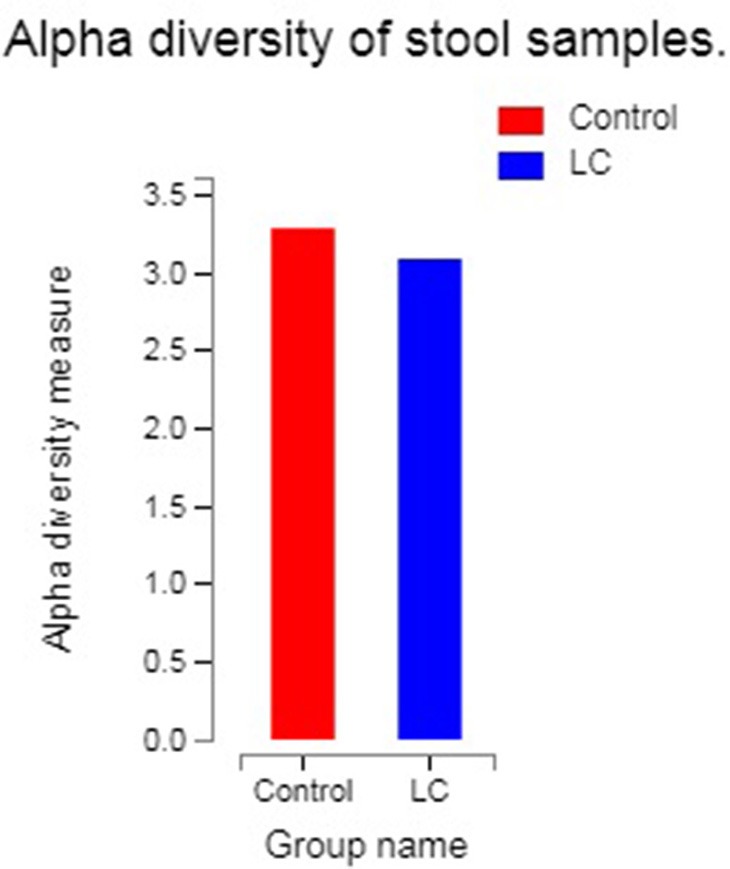
Figure 1
Figure 1
The abscissa is the group name, and the ordinate is the exponential average of each group (0.01 < P ≤ 0.05 marked as *, 0.001 < P ≤ 0.01 marked as **P ≤ 0.001 marked as***). LC: lung cancer.
Figure 2
Figure 2
Points of blue colors or shapes represent LC samples; red colors or shapes represent samples of control. The closer the two sample points are, the more similar the composition of the two sample species is. The horizontal and vertical coordinates represent relative distances and have no practical significance. It is generally considered that stress <0.2 can be expressed by the two-dimensional dot pattern of NMDS, and its graph has a certain explanatory meaning. LC, lung cancer.
Figure 3
Figure 3
The LDA score obtained by linear regression analysis (LDA), the larger the LDA score, the greater the influence of species abundance on the difference effect. LC, lung cancer.

References

    1. Addario B. J. (2014). Larger studies of multiple families will help us better understand inherited risk of lung cancer. J. Thorac. Oncol. 9, e65–66. 10.1097/JTO.0000000000000223 - DOI - PubMed
    1. Allali I., Boukhatem N., Bouguenouch L., Hardi H., Boudouaya H. A., Cadenas M. B., et al. (2018). Gut microbiome of moroccan colorectal cancer patients. Med. Microbiol. Immunol. 207, 211–225. 10.1007/s00430-018-0542-5 - DOI - PMC - PubMed
    1. Allison J. P. (2015). Immune checkpoint blockade in cancer therapy: the 2015 lasker-debakey clinical medical research award. J. Am. Med. Assoc. 314, 1113–1114. 10.1001/jama.2015.11929 - DOI - PubMed
    1. Amarnani R., Rapose A. (2017). Colon cancer and enterococcus bacteremia co-affection: a dangerous alliance. J. Infect. Public. Health. 10, 681–684. 10.1016/j.jiph.2016.09.009 - DOI - PubMed
    1. Belcheva A., Irrazabal T., Martin A. (2015). Gut microbial metabolism and colon cancer: can manipulations of the microbiota be useful in the management of gastrointestinal health? Bioessays 37, 403–412. 10.1002/bies.201400204 - DOI - PubMed

MeSH terms