An mHealth SMS intervention on Postpartum Contraceptive Use Among Women and Couples in Kenya: A Randomized Controlled Trial
- PMID: 31067089
- PMCID: PMC6507993
- DOI: 10.2105/AJPH.2019.305051
An mHealth SMS intervention on Postpartum Contraceptive Use Among Women and Couples in Kenya: A Randomized Controlled Trial
Abstract
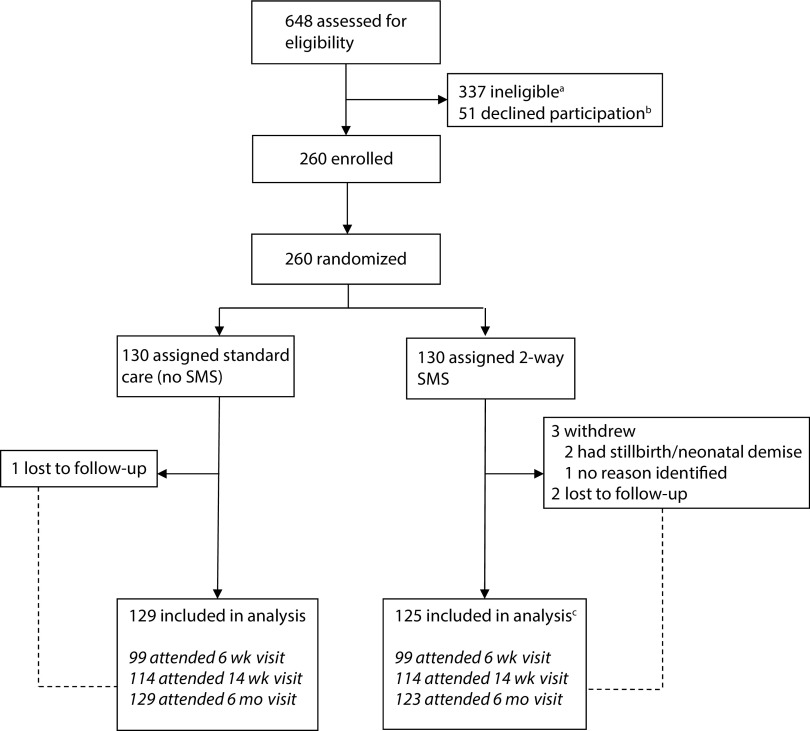
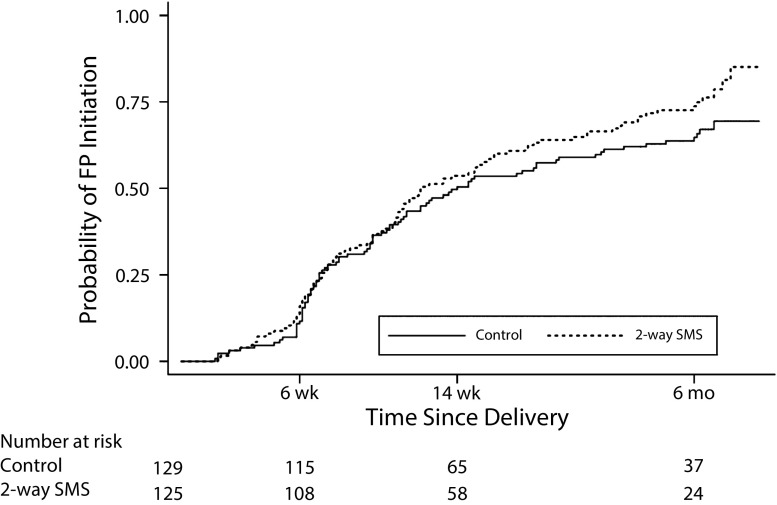
Objectives. To assess the effect of 2-way short message service (SMS) with a nurse on postpartum contraceptive use among individual women and couples. Methods. From 2016 to 2017, we conducted a randomized controlled trial at 2 public hospitals in western Kenya. We assigned eligible pregnant women to receive 2-way SMS with a nurse or no SMS, with the option to include male partners. We delivered automated family planning-focused SMS messages weekly until 6 months postpartum. Women and men receiving SMS could interact with nurses via SMS. In intention-to-treat analysis, we compared highly effective contraceptive (HEC) use at 6 months postpartum between groups using the χ2 test. We used Poisson regression in adjusted analysis. Results. We randomized 260 women to 2-way SMS or control, and we enrolled 103 male partners. At 6 months postpartum, 69.9% women receiving SMS reported HEC use, compared with 57.4% in control (relative risk = 1.22; 95% confidence interval [CI] = 1.01, 1.47; P = .04). In analysis adjusted for baseline demographic differences, the adjusted relative risk for HEC use in the SMS group was 1.26 (95% CI = 1.04, 1.52; P = .02). Conclusions. Two-way SMS with a nurse, including optional male participation, increased postpartum contraceptive use. Trial Registration. ClinicalTrials.gov; identifier: NCT02781714.
Figures
Comment in
-
Mobile Technology for Sexual and Reproductive Health Interventions in Low- and Middle-Income Countries.Am J Public Health. 2019 Jun;109(6):836-837. doi: 10.2105/AJPH.2019.305094. Am J Public Health. 2019. PMID: 31067087 Free PMC article. No abstract available.
References
-
- World Health Organization. Statement for collective action for postpartum family planning. 2012. Available at: https://www.mchip.net/sites/default/files/PPFP%20Statement%20for%20Actio.... Accessed March 28, 2019.
-
- Cleland J, Shah IH, Daniele M. Interventions to improve postpartum family planning in low- and middle-income countries: program implications and research priorities. Stud Fam Plann. 2015;46(4):423–441. - PubMed
-
- Rossier C, Bradley SEK, Ross J, Winfrey W. Reassessing unmet need for family planning in the postpartum period. Stud Fam Plann. 2015;46(4):355–367. - PubMed
-
- Moore Z, Pfitzer A, Gubin R, Charurat E, Elliott L, Croft T. Missed opportunities for family planning: an analysis of pregnancy risk and contraceptive method use among postpartum women in 21 low-and middle-income countries. Contraception. 2015;92(1):31–39. - PubMed
Publication types
MeSH terms
Associated data
Grants and funding
LinkOut - more resources
Full Text Sources
Medical