


Relation of Blood Pressure in Childhood to Self-Reported Hypertension in Adulthood
- PMID: 31067199
- PMCID: PMC6510248
- DOI: 10.1161/HYPERTENSIONAHA.118.12334
Relation of Blood Pressure in Childhood to Self-Reported Hypertension in Adulthood
Abstract
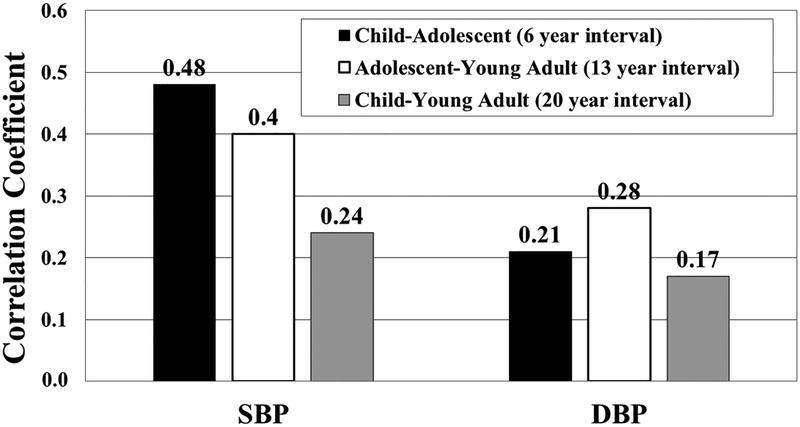
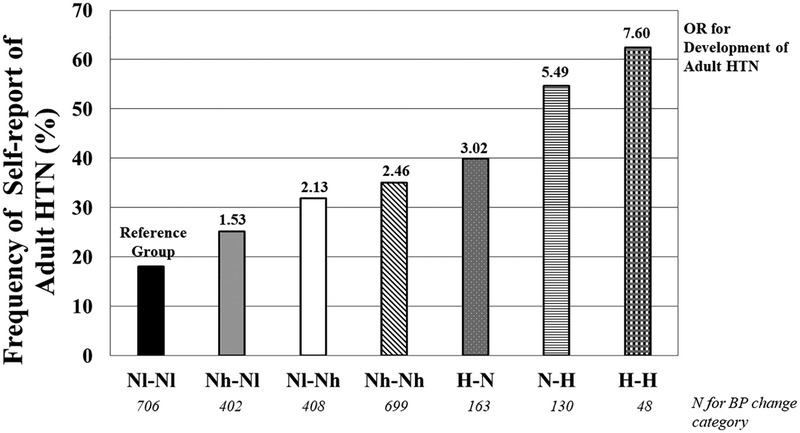
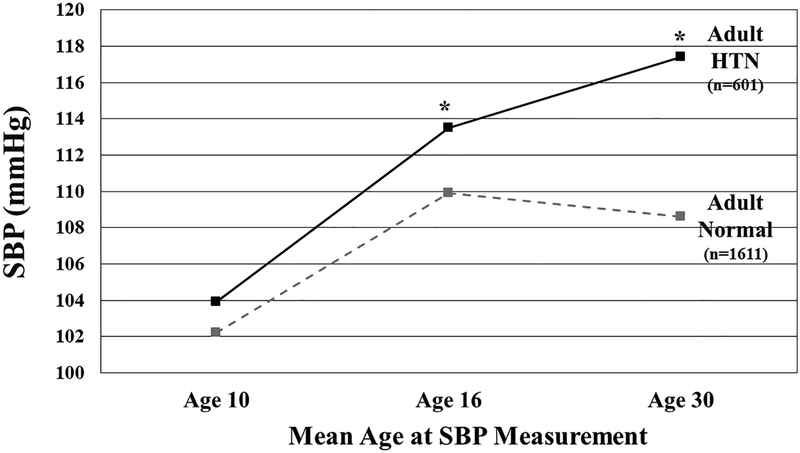
Blood pressure (BP) tracking (maintaining a BP percentile) across life is not well defined but is important in predicting which children will become hypertensive adults. We computed BP tracking in subjects with BP measured in childhood and adulthood and performed logistic regression to determine the ability of childhood BP to predict adult hypertension (N=5035, 46.7 years, 74.2% white, 17.7% black; 39.6% male). Prevalence of hypertension was 29%. Correlations between systolic BP for child and adolescent were r=0.48; for adolescent and young adult were r=0.40, and for child and young adult were r=0.24 (all P<0.0001). Participants self-reporting adult hypertension were less likely to be white (38.7% black, 27.6% white, 20.9% other; P<0.0001) and female (26.4% females, 32.9% male, P<0.0001). Participants with adult hypertension were more likely to have higher BP and adiposity by age 10 years and abnormal lipids and glucose by age 16 years. There was a graded increase in the frequency of self-reported adult hypertension across the BP change groups, even within the persistently normotensive group (X2<0.0001) from 19% in children with a systolic BP% persistently below the median to 80% for individuals with elevated BP in both childhood and adolescence. Although our precision to predict which individual child is at risk of adult BP-related cardiovascular disease is weak, an increase in systolic BP and body mass index percentile from childhood to adolescence should signal a need for lifestyle intervention to prevent future sustained hypertension-related cardiovascular disease.
Keywords: adiposity; blood pressure; hypertension; obesity; risk factor.
Conflict of interest statement
Figures
References
-
- Blumenthal S, Epps RP, Heavenrich R, Lauer RM, Lieberman E, Mirkin B, Mitchell SC, Boyar Naito V, O’Hare D, McFate Smith W, Tarazi RC and Upson D. Report of the task force on blood pressure control in children. Pediatrics. 1977;59:I-ii, 797–820 - PubMed
-
- Flynn JT, Kaelber DC, Baker-Smith CM, Blowey D, Carroll AE, Daniels SR, de Ferranti SD, Dionne JM, Falkner B, Flinn SK, Gidding SS, Goodwin C, Leu MG, Powers ME, Rea C, Samuels J, Simasek M, Thaker VV and Urbina EM. Clinical Practice Guideline for Screening and Management of High Blood Pressure in Children and Adolescents. Pediatrics. 2017;140:e20171904. - PubMed
-
- Vos LE, Oren A, Uiterwaal C, Gorissen WH, Grobbee DE and Bots ML. Adolescent blood pressure and blood pressure tracking into young adulthood are related to subclinical atherosclerosis: the Atherosclerosis Risk in Young Adults (ARYA) study. Am J Hypertens. 2003;16:549–55 - PubMed
-
- Juhola J, Magnussen CG, Viikari JS, Kahonen M, Hutri-Kahonen N, Jula A, Lehtimaki T, Akerblom HK, Pietikainen M, Laitinen T, Jokinen E, Taittonen L, Raitakari OT and Juonala M. Tracking of serum lipid levels, blood pressure, and body mass index from childhood to adulthood: the Cardiovascular Risk in Young Finns Study. J Pediatr. 2011;159:584–90 - PubMed
