


Femoral fracture classification in the Swedish Fracture Register - a validity study
- PMID: 31068172
- PMCID: PMC6506935
- DOI: 10.1186/s12891-019-2579-z
Femoral fracture classification in the Swedish Fracture Register - a validity study
Abstract
Background: A total of more than 270,000 fractures are registered in the Swedish Fracture Register (SFR), a national quality register. Fractures are classified following the AO/OTA classification, commonly by a junior doctor. As a step in the process of validating the data in the SFR, several studies of the accuracy of the fracture classification have already been published. The aim of this study was to evaluate the accuracy of femoral fracture classification in the SFR.
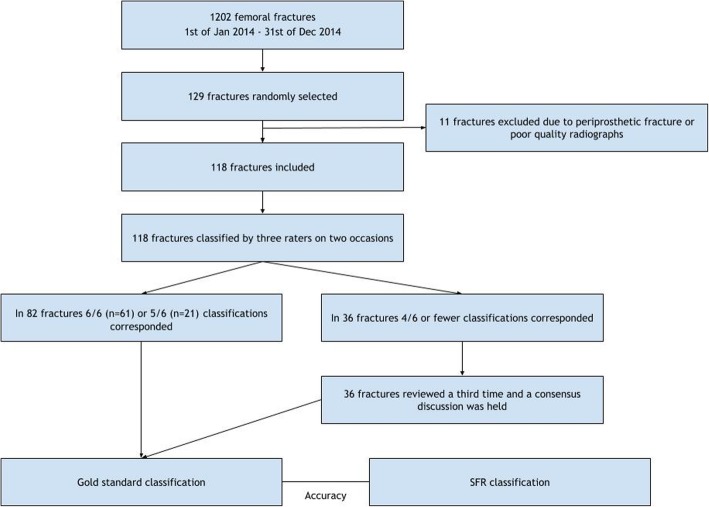
Methods: One hundred and eighteen femur fractures were randomly selected from the SFR. Three experienced orthopaedic surgeons individually classified these fractures on two separate occasions and a gold standard classification was established. This classification was compared with the original classification in the SFR. Inter- and intraobserver agreement was calculated.
Results: The agreement between the classification in the SFR and the gold standard classification was kappa = 0.65 for the AO/OTA group and kappa = 0.83 for the AO/OTA type. This corresponds to substantial and almost perfect agreement, according to Landis and Koch. The kappa values for interobserver agreement ranged from 0.64-0.76 for the AO/OTA group and 0.76-0.85 for the AO/OTA type. The kappa values for intraobserver agreement ranged from 0.79-0.81 for the AO/OTA group and 0.91-0.93 for the AO/OTA type.
Conclusions: The classification of femoral fractures in the Swedish Fracture Register is substantial (AO/OTA group) to almost perfect (AO/OTA type) and as accurate as in previous studies. The present study also shows that the agreement between the SFR classification and a gold standard classification is in the same range of agreement as between experienced raters. In contrast to previous studies, the classifications in the SFR are made by an unselected group of mostly inexperienced classifiers. The results indicate that the fracture classification in a national quality register can be accurate enough to permit the evaluation of fracture treatment in specific groups of fractures.
Keywords: Femoral fractures; Fracture classification; Fracture register; Validity.
Conflict of interest statement
Ethics approval and consent to participate
The study was approved by The Regional ethical review board in Gothenburg. Reference number 174–16.
Consent for publication
Not applicable.
Competing interests
The authors declare that they have no competing interests.
Publisher’s Note
Springer Nature remains neutral with regard to jurisdictional claims in published maps and institutional affiliations.
References
Publication types
MeSH terms
LinkOut - more resources
Full Text Sources
Medical
Research Materials
