. 2019 Apr 24:9:122.
doi: 10.3389/fcimb.2019.00122. eCollection 2019.

Molecular Characterization of Fructose-1,6-bisphosphate Aldolase From Trichinella spiralis and Its Potential in Inducing Immune Protection

Affiliations

Molecular Characterization of Fructose-1,6-bisphosphate Aldolase From Trichinella spiralis and Its Potential in Inducing Immune Protection

Yong Yang et al. Front Cell Infect Microbiol. .

Abstract

Trichinella spiralis is a major food-borne parasite worldwide. Trichinellosis caused by T. spiralis is not only a public health problem, but also an economic hazard in food safety. The development of effective vaccines to prevent Trichinella infection in domestic animals and humans is urgently needed for controlling of this zoonosis. Fructose-1, 6-bisphosphate aldolase (FBPA) is involved in energy production in glycolysis and is also associated with many non-glycolysis functions in the parasite, such as adhesion to host cells, plasminogen binding, and invasion. FBPA has been considered as a potential vaccine candidate or as a target for chemotherapeutic treatment. Here, we report for the first time the characterization of FBPA of T. spiralis and an evaluation of its potential as a vaccine candidate antigen against T. spiralis infection in mice. The results of qPCR and western blot analysis showed that the Ts-FBPA gene was expressed at various developmental stages of T. spiralis and was also detected in excretory-secretory products (ES) of T. spiralis muscle larvae (ML). Immunostaining with anti-Ts-FBPA mouse sera indicated that it localized principally to the surface and embryos of this parasitic nematode. Vaccination of mice with recombinant Ts-FBPA (rTs-FBPA) resulted in a Th1/Th2 mixed humoral and cellular immune response with Th2 predominant, as well as remarkably elevated IgE levels. Moreover, mice vaccinated with rTs-FBPA displayed a 48.7% reduction in adult worm burden and 52.5% reduction in muscle larval burden. These studies indicated that Ts-FBPA is a promising target for developing an effective vaccine to prevent and control Trichinella infection.

Keywords: 6-bisphosphate aldolase; Trichinella spiralis; food-borne parasites; fructose-1; immune protection; vaccine.


Figures
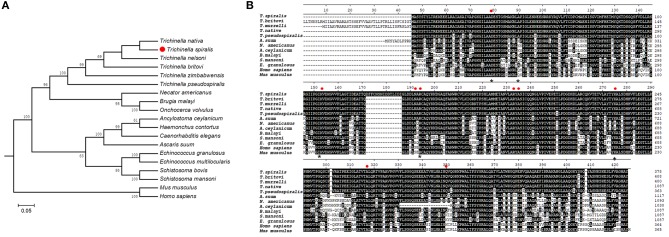
Figure 1
Figure 1
Sequence alignment and phylogenetic tree. (A) Multiple sequence alignment of FBPAs from Trichinella spiralis and homologs from other Trichinella species and other organisms. Active site residues are indicated in the red dot. Asterisks represent actin binding residues. Black shading and dashes represent the amino acid identity and gaps, respectively. (B) A phylogenetic tree of Ts-FBPAs and homologs from other species.
Figure 2
Figure 2
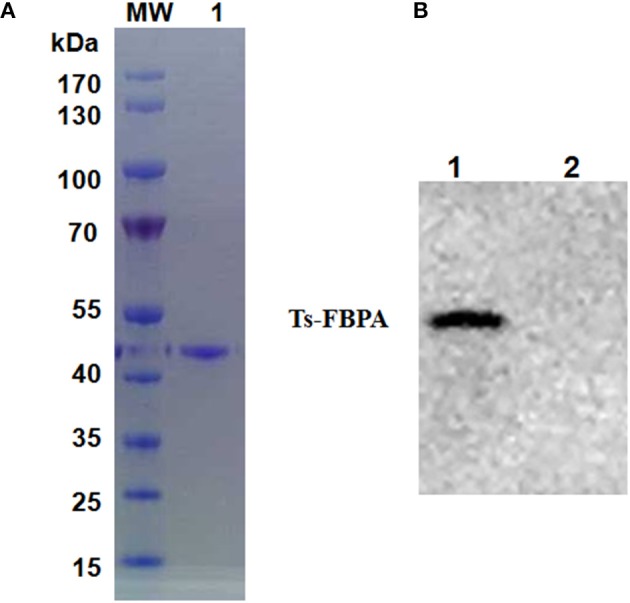
Purification and identification of recombinant Ts-FBPA. (A) Purified rTs-FBPA was analyzed by 12% SDS-PAGE and stained with Coomassie Brilliant blue R. Lane MW: protein molecular weight marker, lane 1: purified rTs-FBPA by Ni-affinity chromatograph. (B) The antigenicity of the rTs-FBPA was analyzed by Western blotting. Lane 1: rTs-FBPA incubated with sera from pigs infected with 20,000 ML of T. spiralis and collected at 60 dpi, Lane 2: rTs-FBPA incubated with the sera from Trichinella–negative pigs.
Figure 3
Figure 3
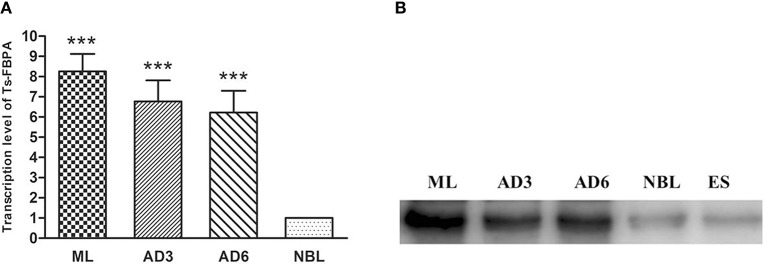
Analysis of the expression pattern of Ts-FBPA at different developmental stages of T. spiralis. (A) Revervse transcription qPCR analysis of the expression of Ts-FBPA at different developmental stages of T. spiralis. After reverse transcription, the cDNA of ML, AD3, AD6, and NBL was used as a template for qPCR using SYBR Green. Each reaction was performed in triplicate. All fold changes were relative to the NBL stage. Significant differences are as follows: ***P < 0.001. (B) Western blot analyses of Ts-FBPA expression levels at different developmental stages of T. spiralis. Expression levels of Ts-FBPA protein (41 kDa) in a crude antigen preparation of diverse T. spiralis growth phases were determined by Western blotting with 1:500 dilutions of anti-rTs-FBPA serum. Line ML: T. spiralis ML crude parasite antigen, Line AD3: T. spiralis AD3 crude parasite antigen, Line AD6: T. spiralis AD6 crude parasite antigen, Line NBL: T. spiralis-NBL crude parasite antigen, Line ES: T. spiralis-ML ESPs.
Figure 4
Figure 4
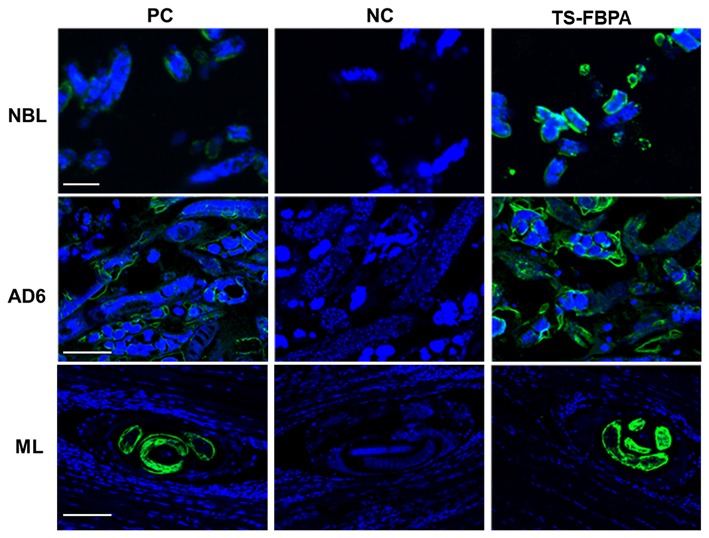
Immunolocalization of Ts-FBPA at different developmental stages of T. spiralis. sections of intact worms (NBL and AD) and skeletal muscles of infected mice (ML) were examined by IFA with anti-rTs-FBPA sera. The obvious green fluorescent staining is observed at the cuticle of the parasites, especially on embryos within the female uterus. NC: pre-immune sera, PC: infection sera. Scale-bars: NBL 10 μm; AD6 and ML 30 μm.
Figure 5
Figure 5
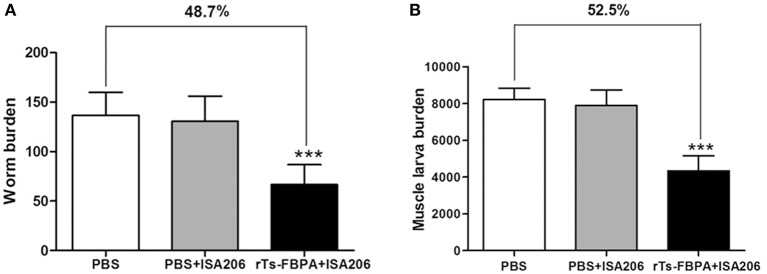
Protective immunity induced by immunizing mice with rTs-FBPA against T. spiralis larval challenge. The number of adults recovered from intestines (A) and muscle larvae per gram (LPG) in skeletal muscles. (B) from immunized mice after challenge with 300 ML of T. spiralis. Results are expressed as the mean ± SD of 10 mice per group. Asterisks indicate significant differences (***P < 0.001) in adults/larvae recovered from the vaccinated group compared to PBS control groups.
Figure 6
Figure 6
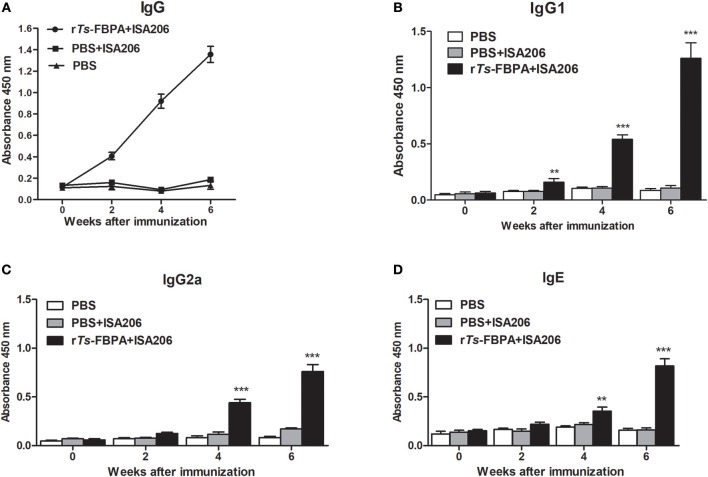
Analysis of humoral immune responses to rTs-FBPA. (A) The levels of anti-rTs-FPBA IgG in the sera of immunized mice or control (ISA006 or PBS) mice were measured by ELISA. (B) The IgG1 subclass responses against rTs-FBPA were detected at different time points. (C) The IgG2a subclass responses against rTs-FBPA were detected at different time points. (D) The levels of specific IgE rTs-FBPA in the sera of immunized mice were measured. The values shown for each group are the mean + SD of the antibody levels (n = 10). Significant differences were as follows: **P < 0.01, ***P < 0.001.
Figure 7
Figure 7
Analysis of cytokine production from splenocytes after rTs-FBPA stimulation in vitro. Splenocytes secreting IL-2, IFN-γ, IL-4 and IL-10 were detected by ELISA one week after the final immunization. The values of (A) IL-2, (B) IFN-γ, (C) IL-4 and (D) IL-10 are presented as the mean ± SD of 5 mice per group. The asterisks (*) indicate that the production of cytokines by immunized mice was significantly different (***P < 0.001) from that of the PBS control group.

References

    1. Agosin M., Aravena L. C. (1959). Anaerobic glycolysis in homogenates of Trichinella spiralis larvae. Exp. Parasitol. 8, 10–30. 10.1016/0014-4894(59)90003-7 - DOI - PubMed
    1. Bai X., Hu X., Liu X., Tang B., Liu M. (2017). Current research of trichinellosis in China. Front. Microbiol. 8:1472. 10.3389/fmicb.2017.01472 - DOI - PMC - PubMed
    1. Bell R. G., Appleton J. A., Negrao-Correa D. A., Adams L. S. (1992). Rapid expulsion of Trichinella spiralis in adult rats mediated by monoclonal antibodies of distinct IgG isotypes. Immunology 75, 520–527. - PMC - PubMed
    1. Bi K., Yang J., Wang L., Gu Y., Zhan B., Zhu X. (2015). Partially protective immunity induced by a 20 kDa protein secreted by Trichinella spiralis stichocytes. PLoS ONE 10:e0136189. 10.1371/journal.pone.0136189 - DOI - PMC - PubMed
    1. Cui J., Wang Z. Q. (2011). An epidemiological overview of swine trichinellosis in China. Vet. J. 190, 323–328. 10.1016/j.tvjl.2010.12.025 - DOI - PubMed

Publication types

MeSH terms

LinkOut - more resources