Review
. 2019 Jul;14(7):667-682.
doi: 10.1080/17460441.2019.1613370. Epub 2019 May 9.

The transcriptional factors HIF-1 and HIF-2 and their novel inhibitors in cancer therapy

Affiliations
Review

The transcriptional factors HIF-1 and HIF-2 and their novel inhibitors in cancer therapy

Najah Albadari et al. Expert Opin Drug Discov. 2019 Jul.

Abstract

Introduction: Hypoxia is one of the intrinsic features of solid tumors, and it is always associated with aggressive phenotypes, including resistance to radiation and chemotherapy, metastasis, and poor patient prognosis. Hypoxia manifests these unfavorable effects through activation of a family of transcription factors, Hypoxia-inducible factors (HIFs) play a pivotal role in the adaptation of tumor cells to hypoxic and nutrient-deprived conditions by upregulating the transcription of several pro-oncogenic genes. Several advanced human cancers share HIFs activation as a final common pathway. Areas covered: This review highlights the role and regulation of the HIF-1/2 in cancers and alludes on the biological complexity and redundancy of HIF-1/2 regulation. Moreover, this review summarizes recent insights into the therapeutic approaches targeting the HIF-1/2 pathway. Expert opinion: More studies are needed to unravel the extensive complexity of HIFs regulation and to develop more precise anticancer treatments. Inclusion of HIF-1/2 inhibitors to the current chemotherapy regimens has been proven advantageous in numerous reported preclinical studies. The combination therapy ideally should be personalized based on the type of mutations involved in the specific cancers, and it might be better to include two drugs that inhibit HIF-1/2 activity by synergistic molecular mechanisms.

Keywords: HIF-1 inhibitors; HIF-1α; HIF-2 inhibitors; HIF-2α; HIF-3α; Hypoxia; angiogenesis; chemoresistance; hypoxia response elements; hypoxia-inducible factors; radioresistance.


Conflict of interest statement

Declaration of Interest:

The authors have no relevant affiliations or financial involvement with any organization or entity with a financial interest in or financial conflict with the subject matter or materials discussed in the manuscript. This includes employment, consultancies, honoraria, stock ownership or options, expert testimony, grants or patents received or pending, or royalties.

Figures
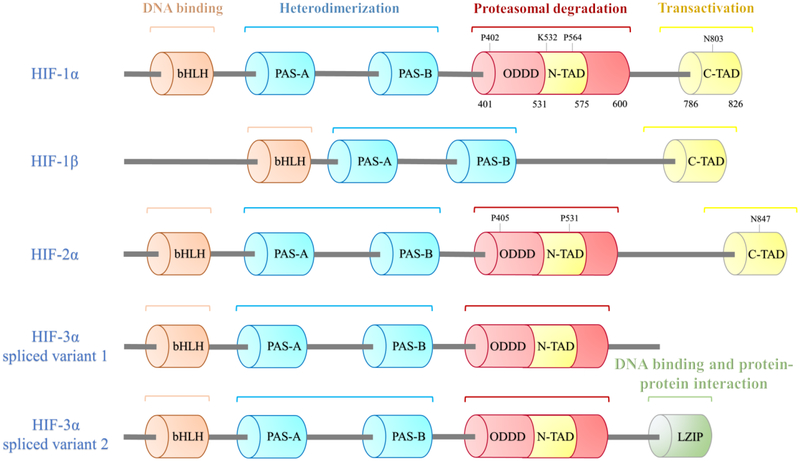
Figure 1.
Figure 1.
Functional domain structures of HIF isoforms and their potential function. Columns represent different function domains. The hydroxylation sites are shown above the domain. HIF isoforms are bHLH–PAS proteins, they all have a bHLH motif, two PAS domains (PAS-A and PAS-B) for the heterodimerization between HIF-α and HIF-1β. Unlike HIF-1β, HIF-α subunits have an ODDD that mediates hydroxylation of two proline (P) residues and the acetylation of a lysine (K) followed by proteasomal degradation, a N-TAD within the ODDD and a C-TAD, which involved in transcriptional activation. The proline residues are conserved in HIF-1/2α subunits. Multiple HIF-3α splice variants exist, such as HIF-3α variant 1 without C-TAD and HIF-3α variant 2 with a LZIP, which mediates DNA binding and protein-protein interaction.
Figure 2.
Figure 2.
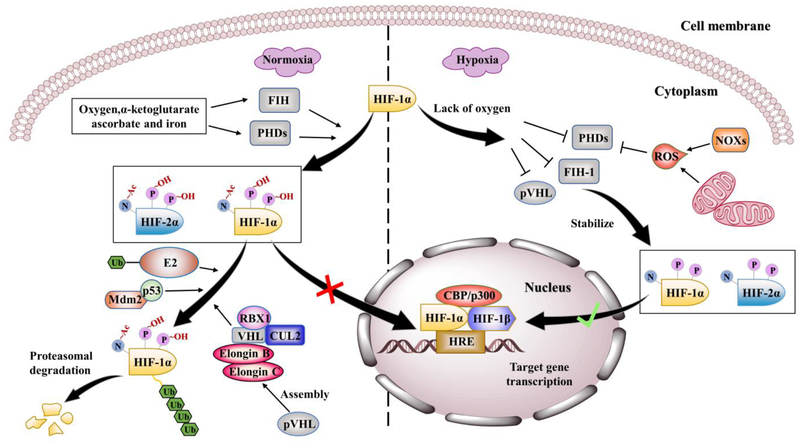
Schematic diagram of canonical mechanisms regulating HIF-1/2. Under normoxic conditions (left panel), PHDs and FIH hydroxylate HIF-1/2α on proline residues and asparagine residue and trigger formation of hydroxylated HIF-1/2α. In the meantime, pVHL mediates the assembly of a complex containing VHL, Elongin B, Elongin C, CUL2 and RBX1, which binds ubiquitin-conjugated E2 component to accomplish ubiquitination of HIF-1/2α proteins. P53 is able to recruit an E3 ubiquitin–protein ligase, Mdm2, to help the proteasomal degradation of HIF-1α mediated by an E2 and E3 ubiquitin ligase–pVHL complex. Besides, hydroxylation of the asparagine residue in the C-TAD of HIF-1/2, FIH blocks the essential interaction between HIF-1α and co-activators such as CBP/p300. However, under hypoxic conditions (right panel), pVHL, PHDs and FIH activities are inhibited by limited oxygen, and ROS generation mechanisms in mitochondria and others such as NADPH oxidases (NOXs), leading to the escape of HIF-1/2α from proteasomal degradation. Thus, the HIF transcriptional complex binds to the HREs motif on the DNA of target genes and activates the target gene transcription.
Figure 3.
Figure 3.
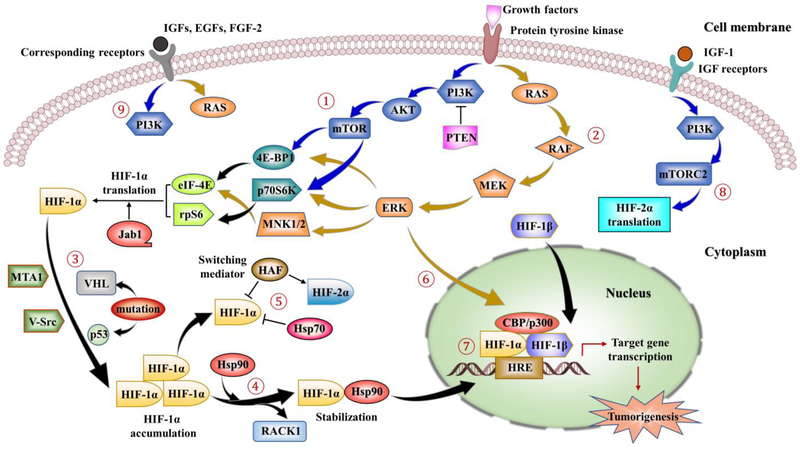
Main signaling involved in non-canonical pathways regulating HIF-1/2. ①-②: HIF-1α regulation could be initiated by growth factors stimulation via activation of protein tyrosine kinases (PTKs). This stimulation leads to downstream signaling activations via the PI3K–AKT–mTOR pathway (indicated by the blue arrows) and MAPK/ERK pathway (indicated by dark yellow arrows). mTOR and ERK signaling further mediate phosphorylation and activation of three downstream effectors, 4E-BP1, p70S6K and MNK1/2, followed by the activation of eIF-4E and rpS6. Finally, these phosphorylation actions result in enhanced translation of HIF-1α mRNA into protein. In addition, Jab1 may promote the transcriptional activity of HIF-1α, while PTEN, a negative regulator of the PI3K, could downregulate the HIF-1α expression. ③: Mutations of VHL, PTEN and p53 result in increased expression of HIF-1α, as well as activations of oncogenes, such as MTA1 and V-Src. ④: Hsp90 competes with the RACK1 for binding to the HIF-1α PAS domain since RACK1 destabilizes HIF-1α via proteasomal degradation pathway. HIF-1α further accumulates in the cytoplasm with the help of Hsp90 which assists the protein folding, prevents the degradation of HIF-1α by the proteasome and contributes its nuclear translocation. ⑤: HIF-1α is also regulated by HAF by inducing the degradation of HIF-1α, while increasing HIF-2α transactivation. Compared with Hsp90, Hsp70 could mediate HIF-1α degradation in the prolonged hypoxia but not HIF-2α. ⑥: ERK phosphorylates the co-activator CBP/p300 and increases HIF-1α/p300 complex formation. ⑦: In the nucleus, the HIF complex binds to the HREs motif on the DNA of target genes and activates the transcription, causing the upregulation of genes involved in cell proliferation, cell survival, angiogenesis and tumorigenesis. ⑧: IGF-1 activation could induce the transcription of HIF-2α via PI3K-mTORC2 system. ⑨: Stimulations of IGFs, EGFs and FGF-2 on corresponding receptors induce HIF-1α expression and protein synthesis through activation of both PI3K/AKT and MAPK pathways.
Figure 4.
Figure 4.
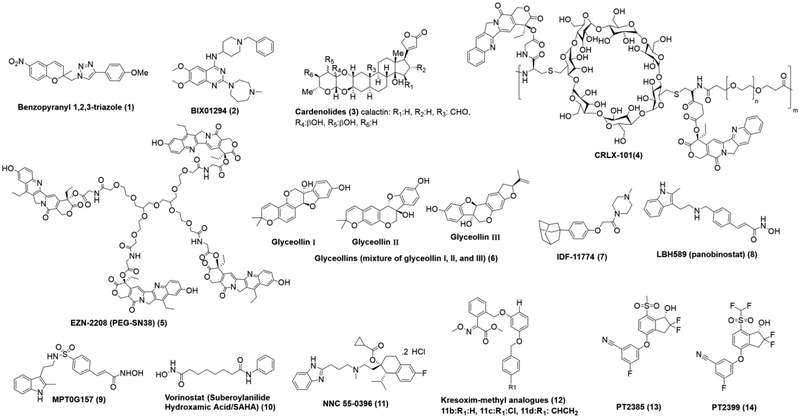
Recently reported chemical structures of molecules inhibiting HIF-1/2.

References

    1. Brown JM. Evidence for acutely hypoxic cells in mouse tumours, and a possible mechanism of reoxygenation. Br J Radiol 1979;52(620):650–6. - PubMed
    1. ckel M, Vaupel P. Tumor Hypoxia: Definitions and Current Clinical, Biologic, and Molecular Aspects. JNCI: Journal of the National Cancer Institute 2001;93(4):266–76. - PubMed
    1. Gray LH, Conger AD, Ebert M, Hornsey S, Scott OCA. The Concentration of Oxygen Dissolved in Tissues at the Time of Irradiation as a Factor in Radiotherapy. 1953;26(312):638–48. - PubMed
    1. Brown JM. Tumor microenvironment and the response to anticancer therapy. Cancer Biol Ther 2002;1(5):453–8. - PubMed
    1. Doktorova H, Hrabeta J, Khalil AM, Eckschlager TJBp. Hypoxia-induced chemoresistance in cancer cells: The role of not only HIF-1. 2015;159(2):166–77. - PubMed

Publication types

MeSH terms

Substances

LinkOut - more resources