. 2019 Jul 12;431(15):2894-2899.
doi: 10.1016/j.jmb.2019.04.041. Epub 2019 May 6.

A Type III CRISPR Ancillary Ribonuclease Degrades Its Cyclic Oligoadenylate Activator

Affiliations

A Type III CRISPR Ancillary Ribonuclease Degrades Its Cyclic Oligoadenylate Activator

Januka S Athukoralage et al. J Mol Biol. .

Abstract

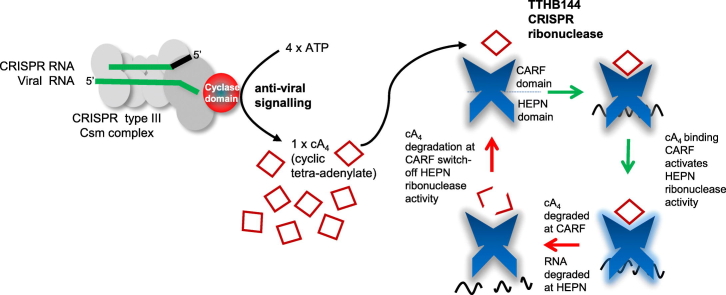
Cyclic oligoadenylate (cOA) secondary messengers are generated by type III CRISPR systems in response to viral infection. cOA allosterically activates the CRISPR ancillary ribonucleases Csx1/Csm6, which degrade RNA non-specifically using a HEPN (Higher Eukaryotes and Prokaryotes, Nucleotide binding) active site. This provides effective immunity but can also lead to growth arrest in infected cells, necessitating a means to deactivate the ribonuclease once viral infection has been cleared. In the crenarchaea, dedicated ring nucleases degrade cA4 (cOA consisting of 4 AMP units), but the equivalent enzyme has not been identified in bacteria. We demonstrate that, in Thermus thermophilus HB8, the uncharacterized protein TTHB144 is a cA4-activated HEPN ribonuclease that also degrades its activator. TTHB144 binds and degrades cA4 at an N-terminal CARF (CRISPR-associated Rossman fold) domain. The two activities can be separated by site-directed mutagenesis. TTHB144 is thus the first example of a self-limiting CRISPR ribonuclease.

Keywords: CRISPR; anti-viral signaling; cyclic oligoadenylate; ring nuclease, Thermus thermophilus.


Figures

Unlabelled Image
Graphical abstract
Fig. 1
Fig. 1
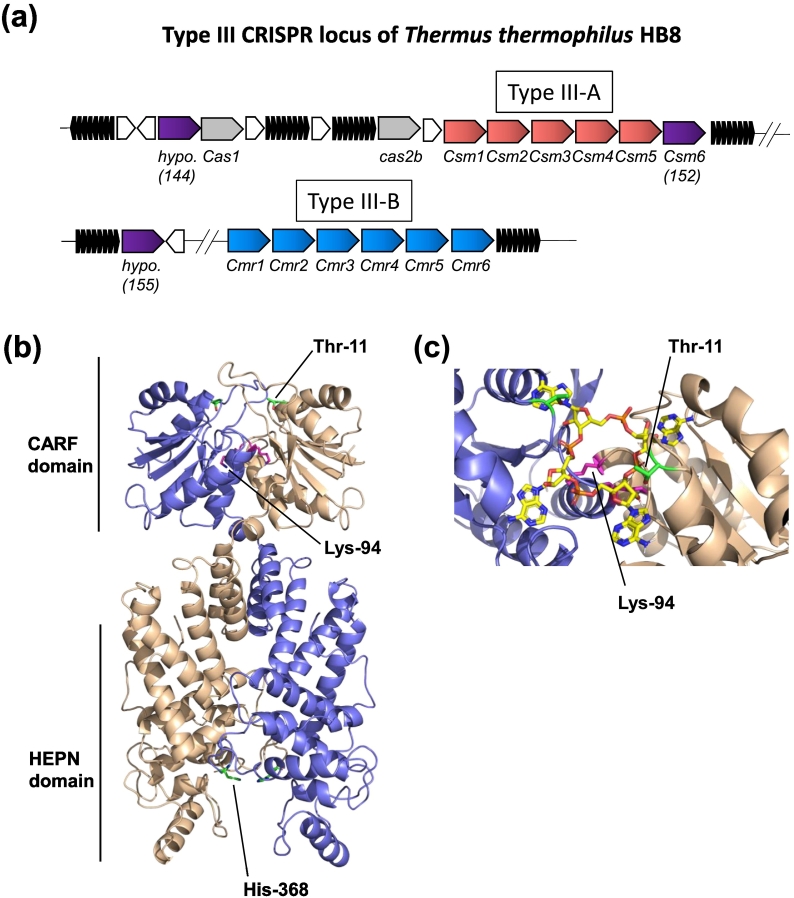
Type III CRISPR locus of T. thermophilus HB8 (TTHB) and model structure of TTHB144 with cA4 bound. (a) Gene neighborhood of TTHB144 encoded on plasmid pTT27. Three genes encoding CARF domain-containing proteins (shown in purple) are present in the type III CRISPR locus of TTHB. TTHB152 is a Csm6 family protein, while TTHB144 and TTHB155 are hypothetical proteins of unknown function. (b) TTHB144 structure modeled using Phyre2. Each subunit of the predicted homodimer is shown by a different color (blue or cream). The highly conserved residues Thr-11, Lys-94 and His-368 are shown. (c) cA4 modeled into the CARF domain of TTHB144. Lys-94 is situated centrally beneath the cA4 molecule, and the side-chain of Thr-11 is suitably positioned to interact with cA4.
Fig. 2
Fig. 2
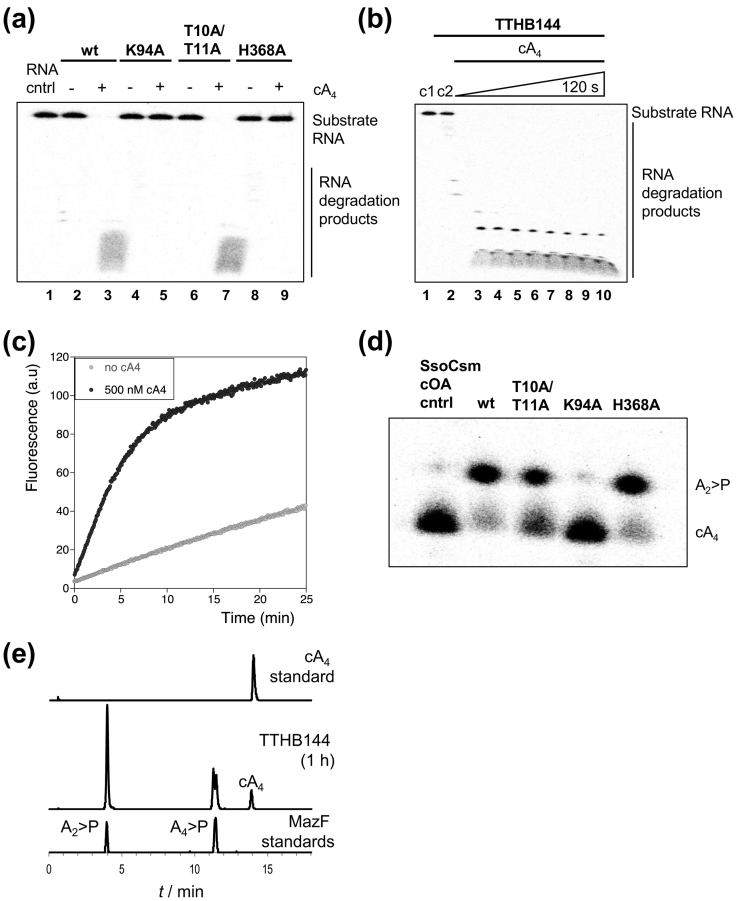
RNA degradation and cA4 cleavage occur in separate domains of TTHB144. (a) Phosphorimage of denaturing PAGE visualizing the degradation of 50 nM radiolabeled A1 RNA, as previously described , by TTHB144 (0.5 μM dimer), its CARF domain variants K94A and T10A/T11A and the HEPN domain variant H368A. The reaction was incubated at 70 °C for 60 min in pH 8.0 buffer containing 20 mM Tris–HCl, 150 mM NaCl, 1 mM EDTA and 3 units SUPERase•In™ inhibitor, before quenching by phenol–chloroform extraction. RNA was cleaved by wild-type (wt) protein and the T10A/T11A variant in the presence of 1 μM cA4, but not by the K94A or H368A variants. (b) Phosphorimage of denaturing PAGE visualizing degradation of 50 nM radiolabeled RNA by TTHB144 (1 μM dimer) when incubated with 20 μM cA4 at 70 °C. Control reactions incubating RNA with buffer (c1) or RNA with protein in the absence of cA4 (c2) are shown. All of the substrate RNA was degraded within 15 s (lane 3). (c) Plot of fluorescence emitted when RNaseAlert™ substrate (1.5 μM; Integrated DNA Technologies) was degraded by 125 nM dimer TTHB144 in the absence or presence of 500 nM cA4 at 50 °C. Fluorimetry was carried out in a Cary Eclipse Fluorescence Spectrophotometer (Agilent Technologies) with excitation and emission wavelengths set to 490 and 520 nm, respectively. (d) Phosphorimage of denaturing PAGE visualizing degradation of 400 nM radiolabeled cA4 generated using SsoCsm complex, as previously described , by TTHB144 (4 μM dimer) and variants at 70 °C for 120 min. cA4 was degraded to a slower migrating product. (e) High-resolution liquid chromatography mass spectrometry of cA4 produced using the SsoCsm complex and cleavage products generated on incubation with TTHB144 (40 μM dimer) at 70 °C. cA4 (~ 16 μM; top panel) was degraded to intermediate and product species (middle panel) with identical retention times to A4 > P and A2 > P, respectively (bottom panel). A4 > P and A2 > P standards were generated using the E. coli MazF toxin as previously described .
Fig. 3
Fig. 3
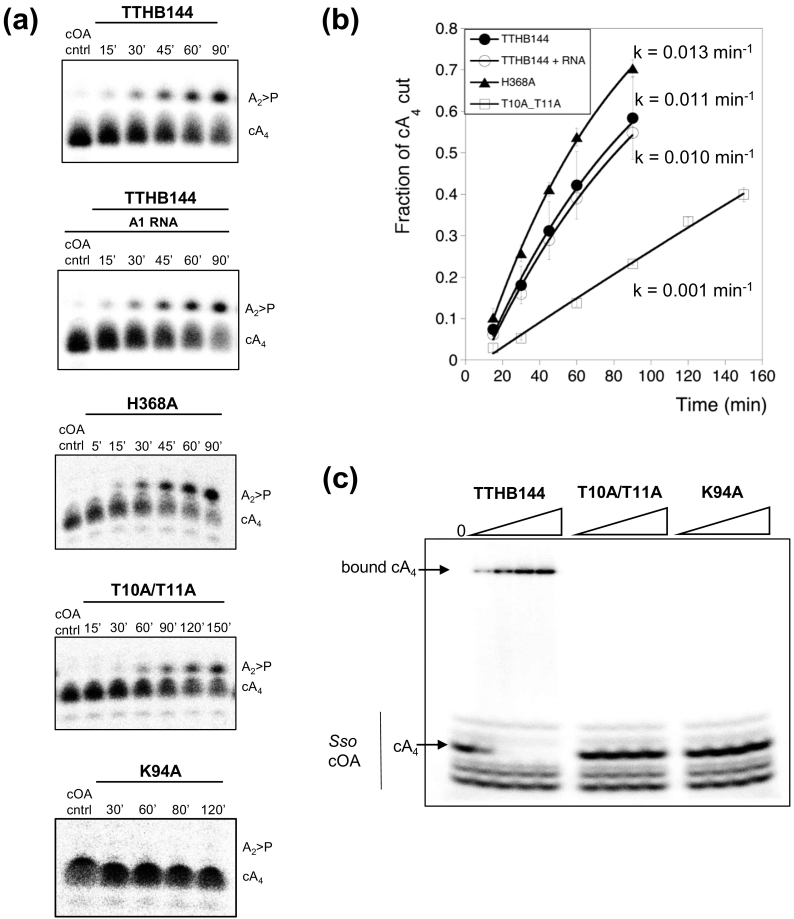
cA4 binding and cleavage by wild-type and variant TTHB144 enzymes. (a) Panels are phosphorimages of denaturing PAGE visualizing degradation of 200 nM radiolabeled cA4 by TTHB144 and variants (8 μM dimer) at 70 °C. cA4 is degraded to A2 > P. Time in minutes is indicated. Protein and radiolabeled cA4 were incubated in pH 8.0 buffer containing 20 mM Tris–HCl, 150 mM NaCl, 1 mM EDTA and 3 units SUPERase•In™ inhibitor, and reactions were quenched at the indicated time-points by phenol–chloroform extraction. A cA4 degradation assay was also carried out in the presence of 1 μM A1 RNA in order to evaluate the effect of RNA binding and cleavage at the HEPN active site on cA4 degradation at the CARF domain. (b) Plot of the fraction of cA4 cut versus time, generated by quantifying the densiometric signals from the phosphorimages depicted in panel a. All data points are the average of at least three technical replicates and are fitted to an exponential rise equation to derive the rate of cA4 degradation, as described previously . Data points for TTHB144 are the average of six replicates encompassing two biological replicates with three technical replicates for each. Error bars show the standard deviation of the mean. (c) Electrophoretic mobility shift assay of radioactively-labeled cOA generated by the S. solfataricus Csm complex. cA4 is indicated; minor bands correspond to linear and cyclic byproducts of the reaction. cA4 (20 nM) was incubated with TTHB144 or variants T10A/T11A or K94A (0.1, 1, 10 or 20 μM protein dimer) in buffer containing 20 mM Tris–HCl (pH 7.5), 150 mM NaCl and 2 mM MgCl2 supplemented with 2 μM Ultrapure Bovine Serum Albumin (Invitrogen) for 10 min at 25 °C. A reaction volume equivalent of 20% (v/v) glycerol was then added prior to loading the samples on a 15% polyacrylamide, 1 × TBE gel. Electrophoresis was carried out at 25 °C and 200 V.

References

    1. Barrangou R., Marraffini L.A. CRISPR–cas systems: prokaryotes upgrade to adaptive immunity. Mol. Cell. 2014;54:234–244. - PMC - PubMed
    2. R. Barrangou, L.A. Marraffini, CRISPR-cas systems: Prokaryotes upgrade to adaptive immunity, Mol. Cell. 54 (2014) 234–244. - PMC - PubMed
    1. Koonin E.V., Makarova K.S. Mobile genetic elements and evolution of CRISPR–Cas systems: all the way there and back. Genome Biol. Evol. 2017;9:2812–2825. - PMC - PubMed
    2. E. V. Koonin, K.S. Makarova, Mobile Genetic Elements and Evolution of CRISPR-Cas Systems: All the Way There and Back, Genome Biol. Evol. 9 (2017) 2812–2825. - PMC - PubMed
    1. Hille F., Richter H., Wong S.P., Bratovič M., Sarah R., Charpentier E. The biology of CRISPR–Cas: backward and forward. Cell. 2018;172:1239–1259. - PubMed
    2. F. Hille, H. Richter, S.P. Wong, M. Bratovič, R. Sarah, E. Charpentier, The Biology of CRISPR-Cas: Backward and Forward, Cell. 172 (2018) 1239–1259. - PubMed
    1. G. Tamulaitis, Č. Venclovas, V. Siksnys, Type III CRISPR–Cas immunity: major differences brushed aside, Trends Microbiol. 25 (2017) 49–61. - PubMed
    1. Pyenson N.C., Marraffini L.A. Type III CRISPR–Cas systems: when DNA cleavage just isn’t enough. Curr. Opin. Microbiol. 2017;37:150–154. - PubMed
    2. N.C. Pyenson, L.A. Marraffini, Type III CRISPR-Cas systems: when DNA cleavage just isn’t enough, Curr. Opin. Microbiol. 37 (2017) 150–154. - PubMed

Publication types

LinkOut - more resources