Review
. 2019 May 8;20(9):2282.
doi: 10.3390/ijms20092282.

Exogenous RNAs for Gene Regulation and Plant Resistance

Affiliations
Review

Exogenous RNAs for Gene Regulation and Plant Resistance

Alexandra S Dubrovina et al. Int J Mol Sci. .

Abstract

Recent investigations documented that plants can uptake and process externally applied double-stranded RNAs (dsRNAs), hairpin RNAs (hpRNAs), and small interfering RNAs (siRNAs) designed to silence important genes of plant pathogenic viruses, fungi, or insects. The exogenously applied RNAs spread locally and systemically, move into the pathogens, and induce RNA interference-mediated plant pathogen resistance. Recent findings also provided examples of plant transgene and endogene post-transcriptional down-regulation by complementary dsRNAs or siRNAs applied onto the plant surfaces. Understanding the plant perception and processing of exogenous RNAs could result in the development of novel biotechnological approaches for crop protection. This review summarizes and discusses the emerging studies reporting on exogenous RNA applications for down-regulation of essential fungal and insect genes, targeting of plant viruses, or suppression of plant transgenes and endogenes for increased resistance and changed phenotypes. We also analyze the current understanding of dsRNA uptake mechanisms and dsRNA stability in plant environments.

Keywords: RNA interference; RNA spraying; dsRNAs, hpRNAs and siRNAs; exogenous RNAs; external application; gene silencing; plant gene regulation; plant resistance.


Conflict of interest statement

The authors declare no conflict of interest.

Figures
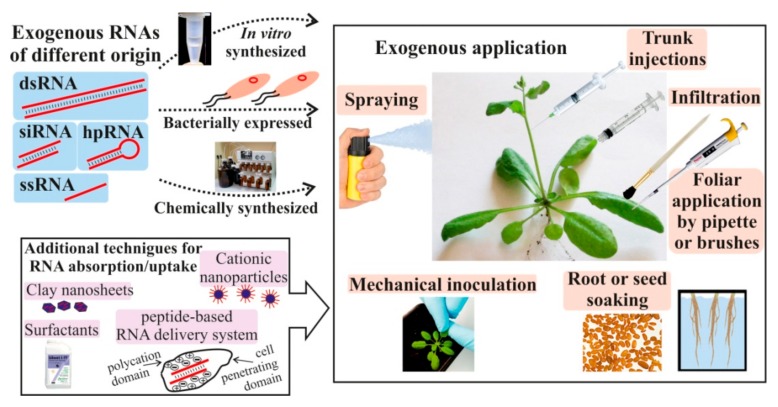
Figure 1
Figure 1
Schematic representation of the type (double-stranded RNA (dsRNA), small interfering RNA (siRNA), hairpin RNA (hpRNA), and single-stranded RNA (ssRNA)) and origin (in vitro, chemically, or bacterially synthesized) of externally applied RNAs and the available RNA application methods (spraying, mechanical inoculation, root or seed soaking, foliar application by pipette or brushes, infiltration, trunk injections) used for RNA delivery in plants. The artificial RNAs could be exogenously applied onto the plant surface using additional techniques to increase the RNA absorption/uptake (cationic nanoparticles, clay nanosheets, surfactants, peptide-based RNA delivery systems).
Figure 2
Figure 2
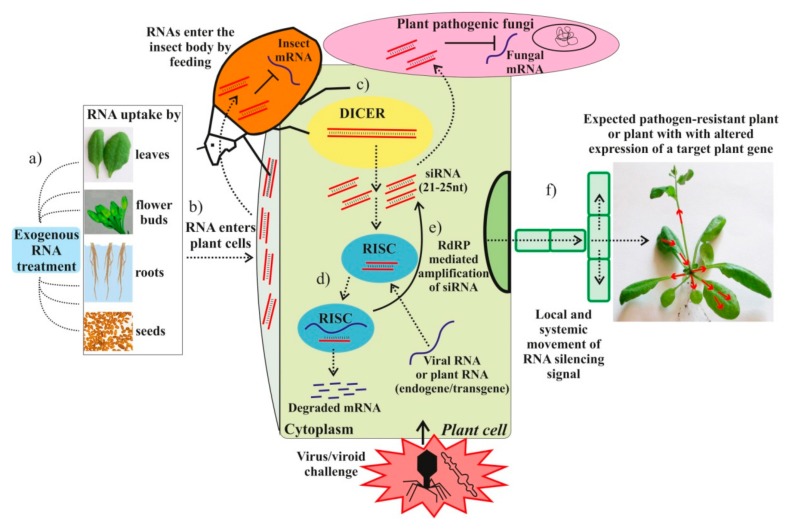
Schematic representation of exogenous RNA applications for RNA interference (RNAi) induction and degradation of the target plant pathogen or endogenous plant mRNAs. (a) Exogenous artificial RNA provided in a solution and applied onto plant leaves, flower buds, roots, or seeds. (b) The exogenous RNAs are taken up and transported into the cytoplasm via an undefined mechanism. (c) The dsRNA or hpRNA molecules are recognized by a ribonuclease, DICER-like (DICER), which cleaves the dsRNA into siRNAs. (d) The siRNAs are then incorporated in the RNA-induced silencing complex (RISC) that guides sequence-specific degradation or translational repression of homologous mRNAs. (e) The components of the siRNA/mRNA complex can be amplified into secondary siRNAs by the action of RNA-dependent RNA-polymerase (RdRP). (f) Movement of the RNA silencing signal between plant cells and through the vasculature. Dashed arrows depict different steps of the RNAi induction process and dsRNA/siRNA movement between plant cells and plant pathogens. The solid arrow depicts the RdRP-mediated amplification of siRNA. Red arrows depict the local and systemic movement of the RNA silencing signal in the plant.

References

    1. Bawa A.S., Anilakumar K.R. Genetically modified foods: Safety, risks and public concerns—A review. J. Food Sci. Technol. 2013;50:1035–1046. doi: 10.1007/s13197-012-0899-1. - DOI - PMC - PubMed
    1. Law Library of Congress (U.S.). Global Legal Research Directorate . Restrictions on Genetically Modified Organisms. Global Legal Research Center; Washington, DC, USA: 2014. p. 242.
    1. Kamthan A., Chaudhuri A., Kamthan M., Datta A. Small RNAs in plants: Recent development and application for crop improvement. Front. Plant Sci. 2015;6:208. - PMC - PubMed
    1. Guo Q., Liu Q., Smith N.A., Liang G., Wang M.B. RNA silencing in plants: Mechanisms, technologies and applications in horticultural crops. Curr. Genom. 2016;17:476–489. doi: 10.2174/1389202917666160520103117. - DOI - PMC - PubMed
    1. Tang W., Weidner D.A., Hu B.Y., Newton R.J., Hu X.H. Efficient delivery of small interfering RNA to plant cells by a nanosecond pulsed laser-inducedstress wave for posttranscriptional gene silencing. Plant Sci. 2006;171:375–381. doi: 10.1016/j.plantsci.2006.04.005. - DOI - PubMed

MeSH terms

Substances

LinkOut - more resources