. 2019 May 9;14(1):50.
doi: 10.1186/s13012-019-0895-1.

How do researchers conceptualize and plan for the sustainability of their NIH R01 implementation projects?

Affiliations

How do researchers conceptualize and plan for the sustainability of their NIH R01 implementation projects?

Alekhya Mascarenhas Johnson et al. Implement Sci. .

Abstract

Background: Inadequate sustainability of implementation of evidence-based interventions has led to calls for research on how sustainability can be optimized. To advance our understanding of intervention sustainability, we explored how implementation researchers conceptualized and planned for the sustainability of their implemented interventions with studies funded by the United States (US) National Institutes of Health (NIH).

Methods: We used sequential, mixed methods to explore how researchers conceptualized and planned for the sustainability of the health interventions using (1) a document review of all active and completed US NIH R01 Grants and Equivalents reviewed within the Dissemination and Implementation Research in Health (DIRH) Study Section between 2004 and 2016 and (2) a qualitative content analysis of semi-structured interviews with NIH R01 DIRH grant recipients.

Results: We found 277 R01 profiles within the DIRH study section listed on the US NIH RePORTER website including 84 that were eligible for screening. Of the 84 unique projects, 76 (90.5%) had primary implementation outcomes. Of the 76 implementation project profiles, 51 (67.1%) made references to sustainability and none referred to sustainability planning. In both profiles and interviews, researchers conceptualized sustainability primarily as the continued delivery of interventions, programs, or implementation strategies. Few researchers referenced frameworks with sustainability constructs and offered limited information on how they operationalized frameworks. Researchers described broad categories of approaches and strategies to promote sustainability and key factors that may influence researchers to plan for sustainability, such as personal beliefs, self-efficacy, perception of their role, and the challenges of the grant funding system.

Conclusions: We explored how US NIH R01 DIRH grant recipients conceptualized and planned for the sustainability of their interventions. Our results identified the need to test, consolidate, and provide guidance on how to operationalize sustainability frameworks, and to develop strategies on how funders and researchers can advance sustainability research.

Keywords: Frameworks; Implementation; Sustainability.


Conflict of interest statement

Ethics approval and consent to participate

We obtained ethics approval from St. Michael’s Hospital (#16-631).

Consent for publication

Not applicable.

Competing interests

Sharon Straus is an editor for Implementation Science but was not involved in decisions related to this manuscript. The remaining authors declare that they have no competing interests.

Publisher’s Note

Springer Nature remains neutral with regard to jurisdictional claims in published maps and institutional affiliations.

Figures
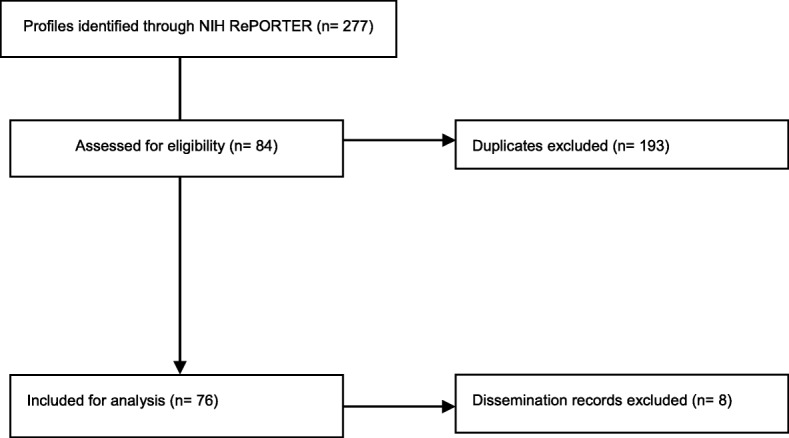
Fig. 1
Fig. 1
Flow diagram of identification, screening, and inclusion of project profiles for analysis. Between September 19 and October 05, 2016, we exported data from all R01 Grants and Equivalent project profiles listed in the NIH RePORTER Database reviewed by the DIRH study section. We removed duplicate project profiles with the same grant identification number. Two analysts independently screened project profiles and excluded profiles that did not have primary outcomes related to implementation. We defined implementation as the use of strategies to adopt and integrate evidence into practice within specific settings [15]. We only included projects with an implementation focus for further data abstraction and excluded those that had primary outcomes focused on dissemination. We defined dissemination as the targeted distribution of evidence to a specific public health or clinical practice audience (e.g., the comparative the effectiveness of two modes of delivering information to target audiences) [1]. Of the 277 active or completed R01 projects reviewed by the DIRH study section listed on the NIH RePORTER website, 84 were eligible for screening. These projects had start dates ranging from September 1, 2004, to August 25, 2016. Of the 84 projects, 76 (90.5%) had primary implementation outcomes and 8 (9.5%) had only dissemination outcomes. Analysts abstracted descriptive data from the 76 included project profiles, and inter-rater reliability was 82%. We then completed PubMed searches using the investigators’ names to identify articles related to the funded project. We identified 47 relevant articles and abstracted data from these on whether sustainability was addressed, planned for, and/or measured. Two people abstracted data independently, and kappa was calculated [15, 16]

References

    1. Glasgow R, Chambers D. Developing robust, sustainable, implementation systems using rigorous, rapid and relevant science. Clin Transl Sci. 2012;5:48–55. doi: 10.1111/j.1752-8062.2011.00383.x. - DOI - PMC - PubMed
    1. Proctor E, Luke D, Calhoun A, McMillen C, Brownson R, McCrary S, Padek M. Sustainability of evidence-based healthcare: research agenda, methodological advances, and infrastructure support. Implement Sci. 2015;10:1–13. - PMC - PubMed
    1. Wiltsey Stirman S, Kimberly J, Cook N, Calloway A, Castro F, Charns M. The sustainability of new programs and innovations: a review of the empirical literature and recommendations for future research. Implement Sci. 2012;7:1–19. - PMC - PubMed
    1. Ament S, de Groot J, Maessen J, Dirksen C, van der Weijden T, Kleijnen J. Sustainability of professionals’ adherence to clinical practice guidelines in medical care: a systematic review. BMJ Open. 2015;5:e008073. doi: 10.1136/bmjopen-2015-008073. - DOI - PMC - PubMed
    1. Iwelunmor J, Blackstone S, Veira D, Nwaozuru U, Airhihenbuwa C, Munodawafa D, Kalipeni E, Jutal A, Shelley D, Ogedegbe G. Toward the sustainability of health interventions implemented in sub-Saharan Africa: a systematic review and conceptual framework. Implement Sci. 2016;11:1–27. - PMC - PubMed

Publication types

LinkOut - more resources
