


Is every-day walking in older adults more analogous to dual-task walking or to usual walking? Elucidating the gaps between gait performance in the lab and during 24/7 monitoring
- PMID: 31073340
- PMCID: PMC6498572
- DOI: 10.1186/s11556-019-0214-5
Is every-day walking in older adults more analogous to dual-task walking or to usual walking? Elucidating the gaps between gait performance in the lab and during 24/7 monitoring
Abstract
Background: The traditional evaluation of gait in the laboratory during structured testing has provided important insights, but is limited by its "snapshot" character and observation in an unnatural environment. Wearables enable monitoring of gait in real-world environments over a week. Initial findings show that in-lab and real-world measures differ. As a step towards better understanding these gaps, we directly compared in-lab usual-walking (UW) and dual-task walking (DTW) to daily-living measures of gait.
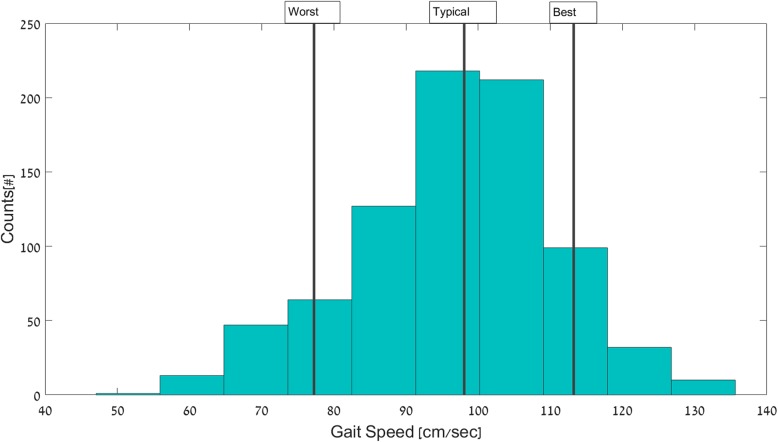
Methods: In-lab gait features (e.g., gait speed, step regularity, and stride regularity) derived from UW and DTW were compared to the same gait features during daily-living in 150 elderly fallers (age: 76.5 ± 6.3 years, 37.6% men). In both settings, features were extracted from a lower-back accelerometer. In the real-world setting, subjects were asked to wear the device for 1 week and pre-processing detected 30-s daily-living walking bouts. A histogram of all walking bouts was determined for each walking feature for each subject and then each subject's typical (percentile 50, median), worst (percentile 10) and the best (percentile 90) values over the week were determined for each feature. Statistics of reliability were assessed using Intra-Class correlations and Bland-Altman plots.
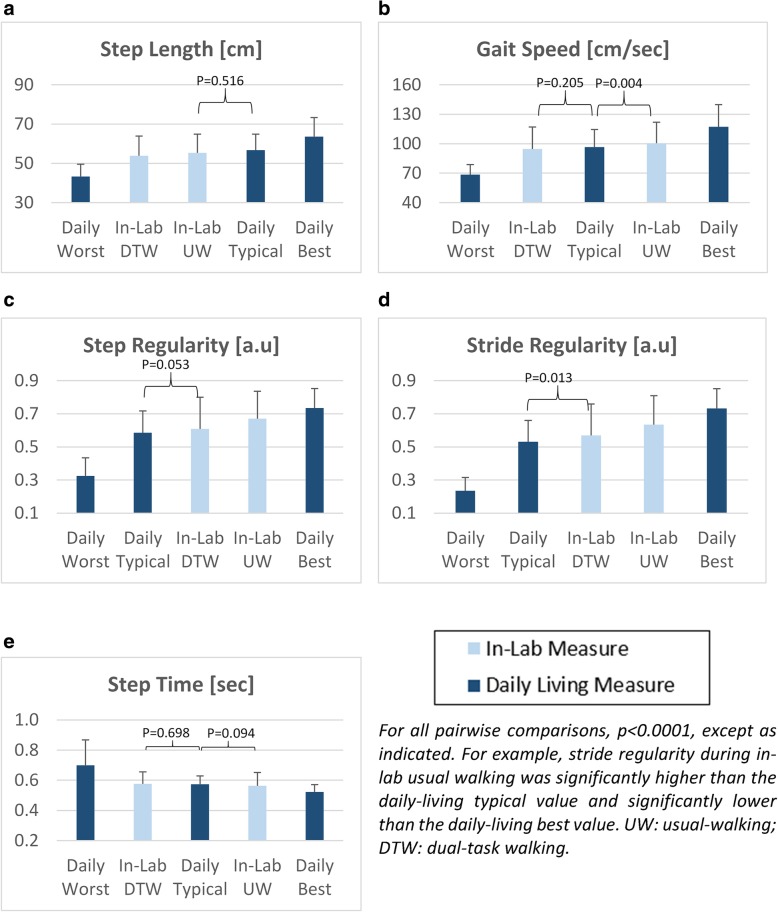
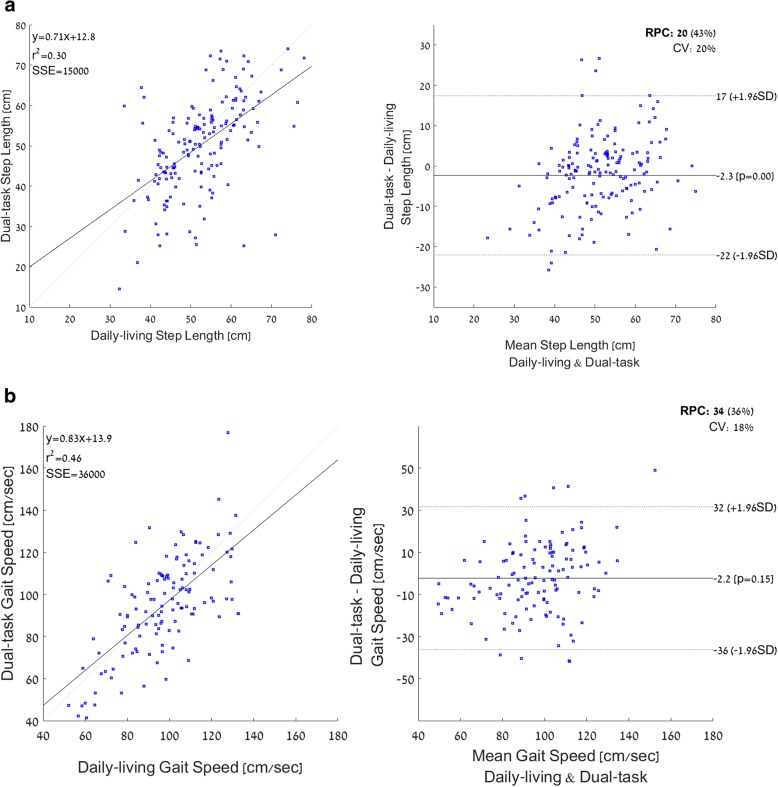
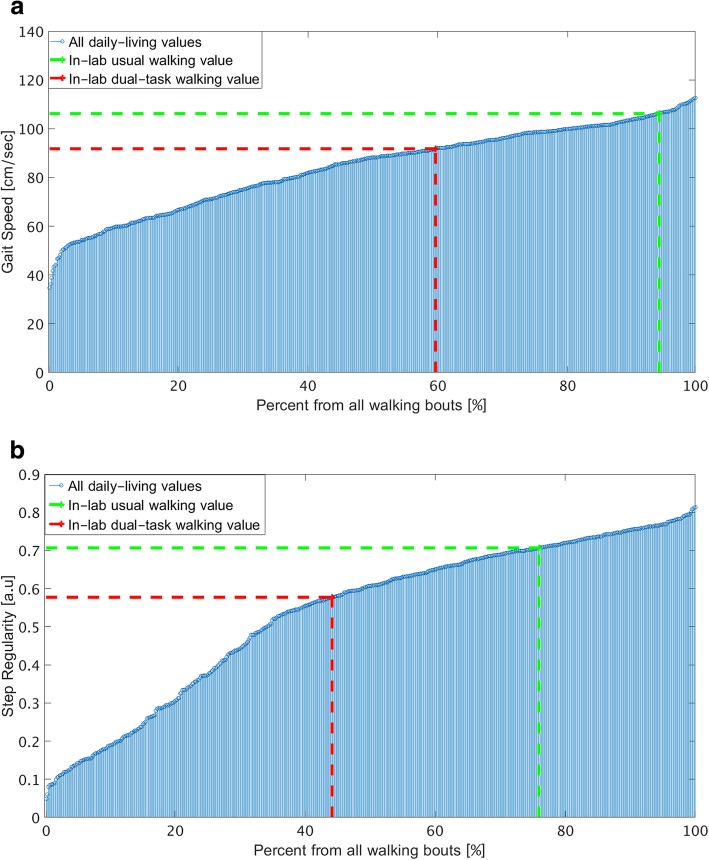
Results: As expected, in-lab gait speed, step regularity, and stride regularity were worse during DTW, compared to UW. In-lab gait speed, step regularity, and stride regularity during UW were significantly higher (i.e., better) than the typical daily-living values (p < 0.001) and different (p < 0.001) from the worst and best values. DTW values tended to be similar to typical daily-living values (p = 0.205, p = 0.053, p = 0.013 respectively). ICC assessment and Bland-Altman plots indicated that in-lab values do not reliably reflect the daily-walking values.
Conclusions: Gait values measured during relatively long (30-s) daily-living walking bouts are more similar to the corresponding values obtained in the lab during dual-task walking, as compared to usual walking. Still, gait performance during most daily-living walking bouts is worse than that measured during usual and dual-tasking in the lab. The values measured in the lab do not reliably reflect daily-living measures. That is, an older adult's typical daily-living gait cannot be estimated by simply measuring walking in a structured, laboratory setting.
Keywords: Accelerometer; Aging; Dual tasking; Gait; Mobility; Wearables.
Conflict of interest statement
The study was approved by local Helsinki committees. Written informed consent was obtained from all individual participants included in this study. All procedures performed in studies involving human participants were in accordance with the ethical standards of the institutional and/or national research committees and with the 1964 Helsinki declaration and its later amendments or comparable ethical standards.Not applicable.All authors declare that they have no competing financial interests. Nir Giladi, Anat Mirelman and Jeff Hausdorff report having submitted a patent application on the use of body-fixed sensors for assessing symptoms in patients with Parkinson’s disease, the intellectual property rights for which are held by the Tel Aviv Medical Center.Springer Nature remains neutral with regard to jurisdictional claims in published maps and institutional affiliations.
Figures
References
LinkOut - more resources
Full Text Sources
Research Materials
Miscellaneous
