. 2019 May 3;2(5):e193613.
doi: 10.1001/jamanetworkopen.2019.3613.

Assessment of the Feasibility and Cost of Hepatitis C Elimination in Pakistan

Affiliations

Assessment of the Feasibility and Cost of Hepatitis C Elimination in Pakistan

Jagpreet Chhatwal et al. JAMA Netw Open. .

Abstract

Importance: Chronic hepatitis C virus (HCV) infection is a global health problem. The World Health Assembly recently pledged to eliminate HCV by 2030. However, in Pakistan, a country with one of the highest prevalence rates, the feasibility and cost of HCV elimination are not known.

Objectives: To investigate whether and under what conditions HCV elimination is feasible in Pakistan and to estimate the cost of such elimination.

Design, setting, and participants: This decision analytical model study used a microsimulation model of the HCV epidemic in Pakistan from 2015 to 2030. Using Pakistan-specific variables, the model simulated the landscape of HCV in Pakistan and evaluated the minimum required screening and treatment rates needed to eliminate HCV in Pakistan. The study used simulated individuals chronically infected with HCV from 2015 to 2030. The analysis was performed in 2018.

Interventions: The status quo and 7 scenarios that can lead to HCV elimination in Pakistan by 2030, which were defined by different combinations of tests for screening, detection of viremia before treatment, and confirmation of treatment response.

Main outcomes and measures: Temporal trends in HCV infection prevalence, mortality, and disability-adjusted life-years and total cost of HCV infection care under the status quo and scenarios that can eliminate HCV by 2030.

Results: Under the status quo, from 2015 to 2030, 1.44 million people are projected to die of HCV infection; 48% of deaths would be among people younger than 50 years. To achieve HCV elimination in Pakistan, HCV testing would need to be scaled up to at least 25 million people to diagnose 900 000 persons and treatment to 700 000 people per year. Compared with the status quo, the elimination scenario would avert 323 000 liver-related deaths and 13.0 million HCV-associated disability-adjusted life-years from 2015 to 2030. The elimination scenario was associated with cost savings of $2.6 billion from 2018 to 2030 with use of a point-of-care test for population-wide antibody screening and detection of viremia and treatment response.

Conclusions and relevance: Substantial scale-up of HCV testing and treatment may be essential to eliminate HCV infection in Pakistan, and such a strategy may be associated with cost savings in the near future. Although HCV elimination in Pakistan may be ambitious, strategic planning and strong support from the government may aid in its elimination.


Conflict of interest statement

Conflict of Interest Disclosures: Dr Chhatwal reported receiving grants from the National Science Foundation during the conduct of the study, grants and personal fees from Gilead, and grants and personal fees from Merck & Co outside the submitted work. Dr Ayer reported receiving personal fees from Merck outside the submitted work. Dr Janjua reported receiving grants from the Canadian Institutes of Health Research outside the submitted work. No other disclosures were reported.

Figures

Figure 1.
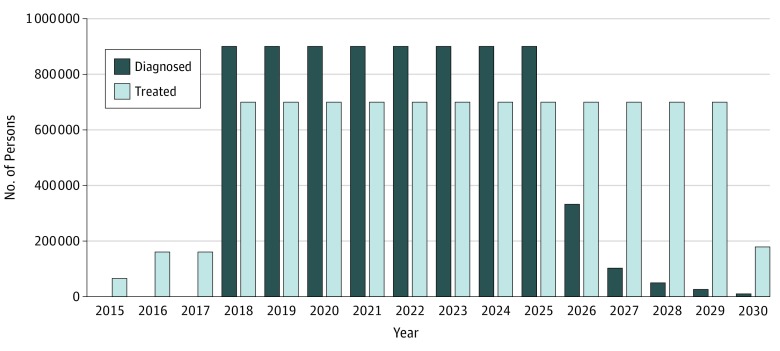
Figure 1.. Number of Persons Who Need to Be Diagnosed and Treated in Pakistan Each Year to Meet the World Health Organization Target of Hepatitis C Virus Elimination
The annual diagnosis rate would need to be scaled up to at least 900 000 cases per year, and the annual treatment rate would need to be scaled up to at least 700 000 persons per year to eliminate hepatitis C virus by 2030.
Figure 2.
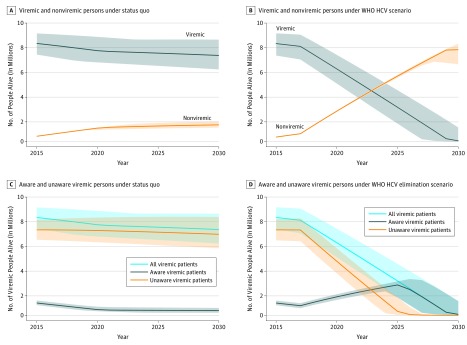
Figure 2.. Number of Viremic (Aware and Unaware) and Cured Individuals in Pakistan From 2015 to 2030 Under Status Quo vs World Health Organization (WHO) Hepatitis C Virus (HCV) Elimination Scenario
The elimination scenario was defined as an annual diagnosis rate of at least 900 000 cases per year and an annual treatment rate of at least 700 000 persons per year. Under the elimination scenario, the number of cured patients would exceed the number of viremic patients in year 2023. Bands show 95% uncertainty intervals generated by probabilistic sensitivity analysis.
Figure 3.
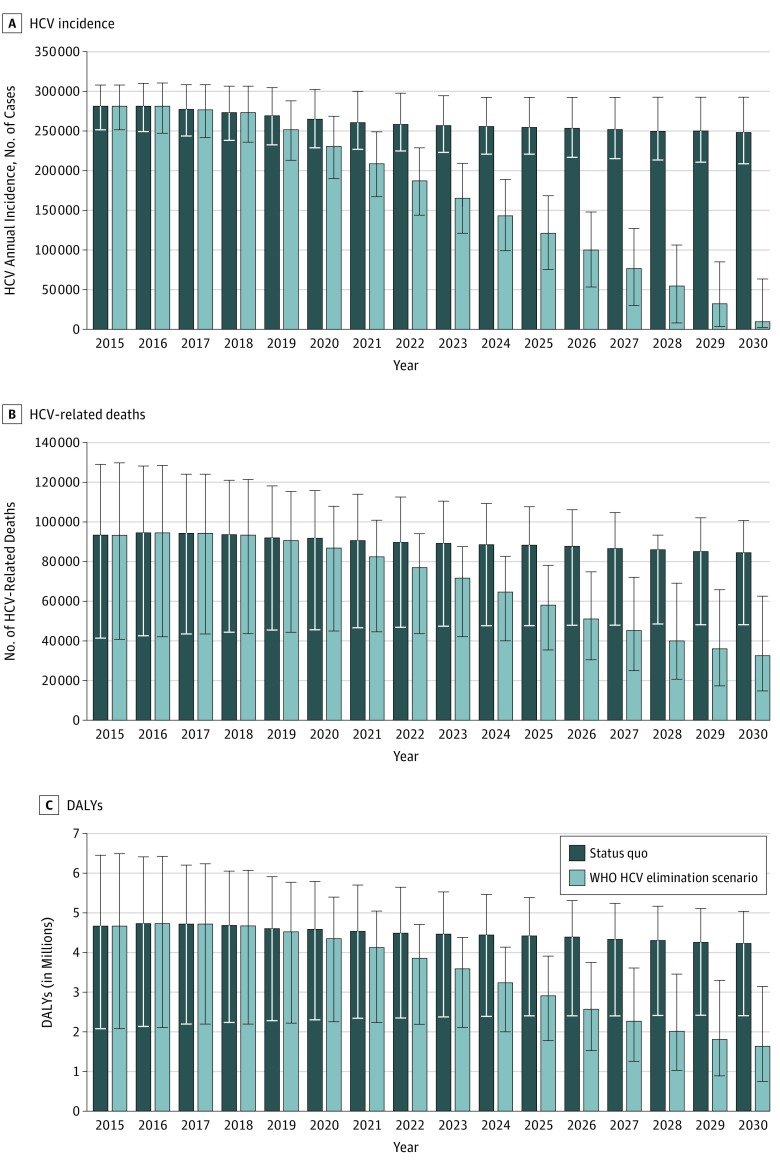
Figure 3.. Annual Incidence of Hepatitis C Virus (HCV) Infection, Number of HCV-Associated Deaths, and Disability-Adjusted Life-Years (DALYs) in Pakistan Under Status Quo and World Health Organization (WHO) HCV Elimination Scenario From 2015 to 2030
The elimination scenario was defined as annual diagnosis rate of at least 900 000 cases per year and annual treatment rate of at least 700 000 persons per year. Error bars indicate 95% uncertainty intervals.
Figure 4.
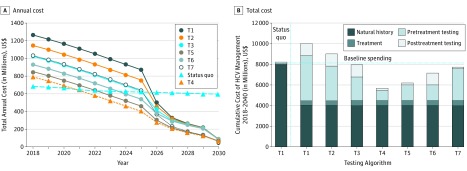
Figure 4.. Cost of Hepatitis C Virus (HCV) Management From 2018 to 2030 Under Status Quo vs World Health Organization (WHO) HCV Elimination Scenario
The elimination scenario was defined as annual diagnosis rate of at least 900 000 cases per year and annual treatment rate of at least 700 000 persons per year. A, Comparison of annual cost of HCV management under status quo vs WHO elimination scenario using different testing algorithms (as defined in the Table). B, Total cost of HCV management from 2018 to 2030 under status quo and different testing algorithms that result in HCV elimination by 2030. Testing algorithms T3 through T7 were associated with cost savings compared with the cost under status quo. The T4 algorithm provided the lowest cost of HCV management ($5.6 billion) and was associated with $2.6 billion in cost savings compared with the cost of status quo ($8.2 billion) (triangles).

References

    1. Blach S, Zeuzem S, Manns M, et al. ; Polaris Observatory HCV Collaborators . Global prevalence and genotype distribution of hepatitis C virus infection in 2015: a modelling study. Lancet Gastroenterol Hepatol. 2017;2(3):-. doi: 10.1016/S2468-1253(16)30181-9 - DOI - PubMed
    1. Moin A, Fatima H, Qadir TF. Tackling hepatitis C—Pakistan’s road to success. Lancet. 2018;391(10123):834-835. doi: 10.1016/S0140-6736(18)30462-8 - DOI - PubMed
    1. Janjua NZ, Butt ZA, Mahmood B, Altaf A. Towards safe injection practices for prevention of hepatitis C transmission in South Asia: challenges and progress. World J Gastroenterol. 2016;22(25):5837-5852. doi: 10.3748/wjg.v22.i25.5837 - DOI - PMC - PubMed
    1. Degenhardt L, Peacock A, Colledge S, et al. Global prevalence of injecting drug use and sociodemographic characteristics and prevalence of HIV, HBV, and HCV in people who inject drugs: a multistage systematic review. Lancet Glob Health. 2017;5(12):e1192-e1207. doi: 10.1016/S2214-109X(17)30375-3 - DOI - PMC - PubMed
    1. Mumtaz GR, Weiss HA, Thomas SL, et al. HIV among people who inject drugs in the Middle East and North Africa: systematic review and data synthesis. PLoS Med. 2014;11(6):e1001663. doi: 10.1371/journal.pmed.1001663 - DOI - PMC - PubMed

Publication types