


Diclofenac-Derived Hybrids for Treatment of Actinic Keratosis and Squamous Cell Carcinoma
- PMID: 31075867
- PMCID: PMC6539072
- DOI: 10.3390/molecules24091793
Diclofenac-Derived Hybrids for Treatment of Actinic Keratosis and Squamous Cell Carcinoma
Abstract
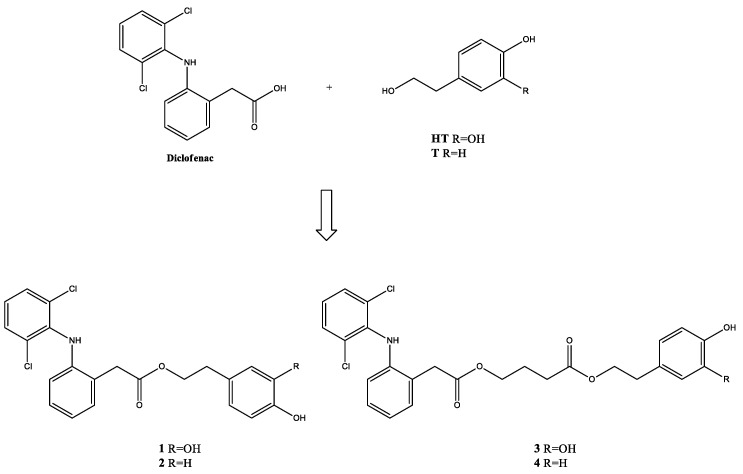
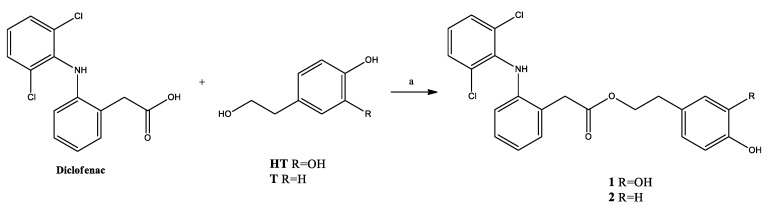
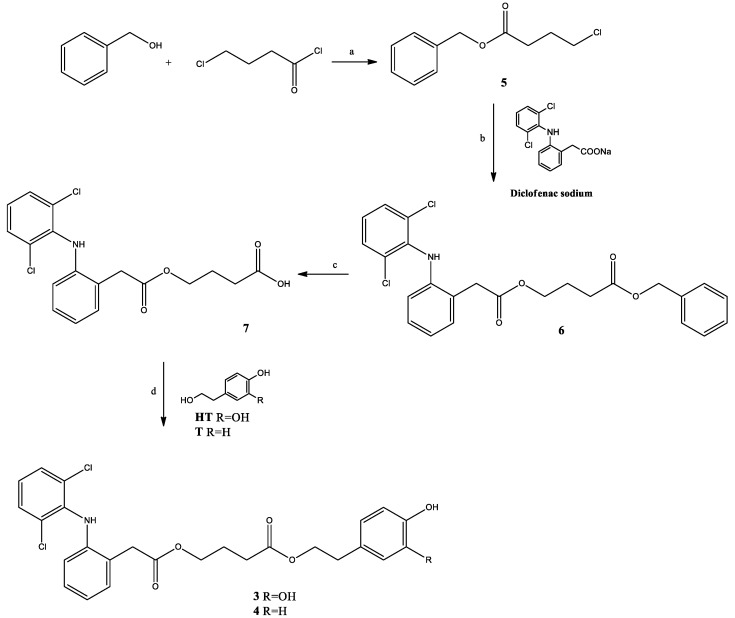
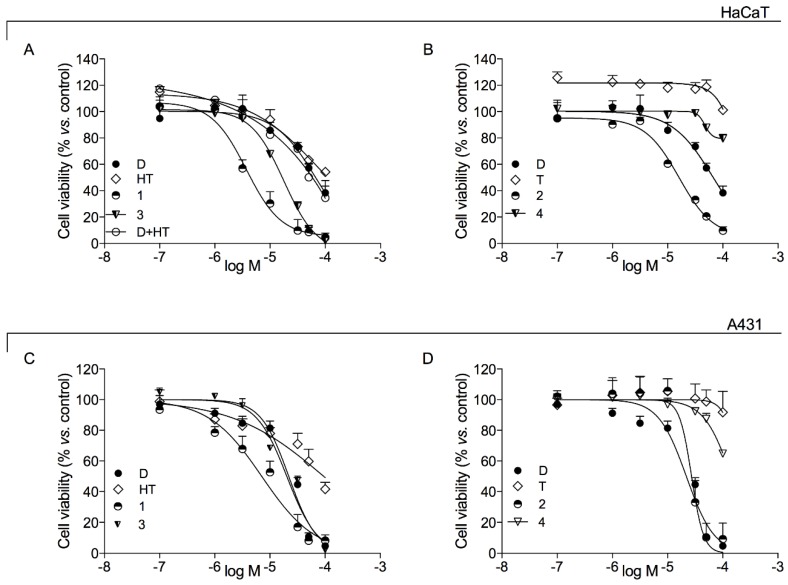
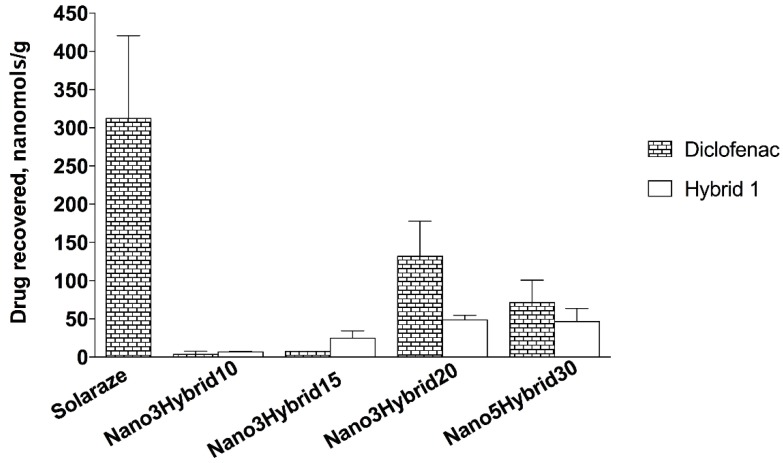
In this work, hybrid compounds 1-4 obtained by conjugation of the non-steroidal anti-inflammatory drug diclofenac, with natural molecules endowed with antioxidant and antiproliferative activity were prepared. The antiproliferative activity of these hybrids was evaluated on immortalized human keratinocyte (HaCaT) cells stimulated with epidermal growth factor (EGF), an actinic keratosis (AK) model, and on human squamous cell carcinoma (SCC) cells (A431). Hybrid 1 presented the best activity in both cell models. Self-assembling surfactant nanomicelles have been chosen as the carrier to drive the hybrid 1 into the skin; the in vitro permeation through and penetration into pig ear skin have been evaluated. Among the nanostructured formulations tested, Nano3Hybrid20 showed a higher tendency of the hybrid 1 to be retained in the skin rather than permeating it, with a desirable topical and non-systemic action. On these bases, hybrid 1 may represent an attractive lead scaffold for the development of new treatments for AK and SCC.
Keywords: actinic keratosis; antiproliferative activity; diclofenac; hybrid; in vitro skin permeation/penetration; nanomicelles; squamous cell carcinoma.
Conflict of interest statement
The authors declare no conflict of interest.
Figures
References
-
- Brinkhuizen T., Frencken K.J., Nelemans P.J., Hoff M.L., Kelleners-Smeets N.W., Zur Hausen A., van der Horst M.P., Rennspiess D., Winnepenninckx V.J., van Steensel M.A., et al. The effect of topical diclofenac 3% and calcitriol 3 mg/g on superficial basal cell carcinoma (sBCC) and nodular basal cell carcinoma (nBCC): A phase ii, randomized controlled trial. J. Am. Acad. Dermatol. 2016;75:126–134. doi: 10.1016/j.jaad.2016.01.050. - DOI - PubMed
-
- Janowska A., Dini V., Oranges T., Colombo G., Bruno G., Di Matteo S., Romanelli M. The relapse rate in patients with actinic keratosis treated with diclofenac sodium 3% gel. Int. J. Med. Sci. Clin. Invent. 2019;6:4313–4317.
MeSH terms
Substances
LinkOut - more resources
Full Text Sources
Medical
Research Materials
