. 2019 May 21;116(21):10214-10222.
doi: 10.1073/pnas.1901047116. Epub 2019 May 10.

High-intensity focused ultrasound-induced mechanochemical transduction in synthetic elastomers

Affiliations

High-intensity focused ultrasound-induced mechanochemical transduction in synthetic elastomers

Gun Kim et al. Proc Natl Acad Sci U S A. .

Abstract

While study in the field of polymer mechanochemistry has yielded mechanophores that perform various chemical reactions in response to mechanical stimuli, there is not yet a triggering method compatible with biological systems. Applications such as using mechanoluminescence to generate localized photon flux in vivo for optogenetics would greatly benefit from such an approach. Here we introduce a method of triggering mechanophores by using high-intensity focused ultrasound (HIFU) as a remote energy source to drive the spatially and temporally resolved mechanical-to-chemical transduction of mechanoresponsive polymers. A HIFU setup capable of controlling the excitation pressure, spatial location, and duration of exposure is employed to activate mechanochemical reactions in a cross-linked elastomeric polymer in a noninvasive fashion. One reaction is the chromogenic isomerization of a naphthopyran mechanophore embedded in a polydimethylsiloxane (PDMS) network. Under HIFU irradiation evidence of the mechanochemical transduction is the observation of a reversible color change as expected for the isomerization. The elastomer exhibits this distinguishable color change at the focal spot, depending on ultrasonic exposure conditions. A second reaction is the demonstration that HIFU irradiation successfully triggers a luminescent dioxetane, resulting in localized generation of visible blue light at the focal spot. In contrast to conventional stimuli such as UV light, heat, and uniaxial compression/tension testing, HIFU irradiation provides spatiotemporal control of the mechanochemical activation through targeted but noninvasive ultrasonic energy deposition. Targeted, remote light generation is potentially useful in biomedical applications such as optogenetics where a light source is used to trigger a cellular response.

Keywords: high-intensity focused ultrasound; mechanochromism; mechanoluminescence; mechanophores; spatiotemporal control.


Conflict of interest statement

The authors declare no conflict of interest.

Figures
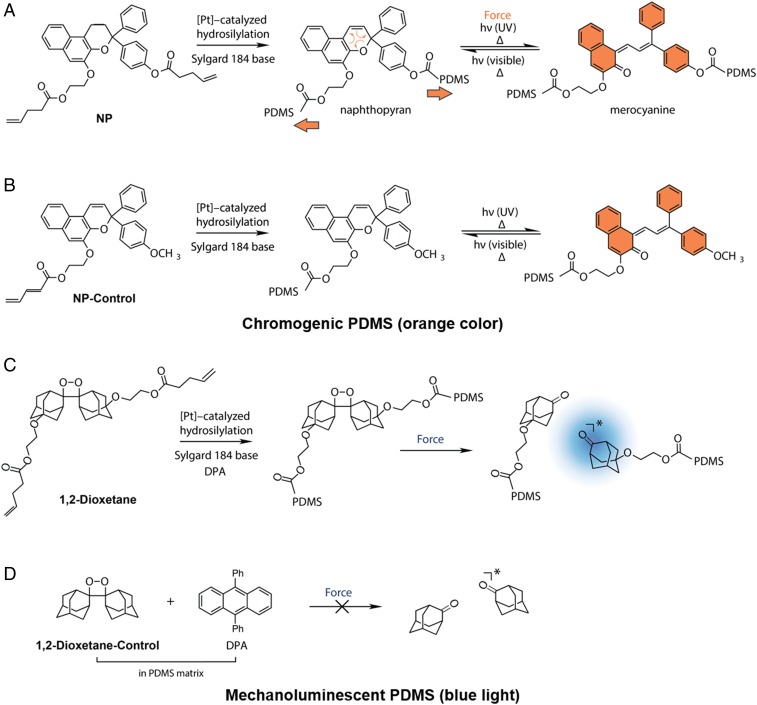
Fig. 1.
Fig. 1.
Synthesis of mechanochromic and mechanoluminescent PDMS materials: (A) NP (bisvinyl-terminated naphthopyran, 1.5 wt %) is cross-linked into the PDMS network and isomerizes in response to mechanical force to generate an orange-colored merocyanine species; (B) Monofunctional NP control (1.5 wt %) is covalently appended to PDMS and insensitive to mechanical force. Both NP and NP-control isomerize to the colored merocyanine form under UV light and high temperature; (C) Dioxetane (1.5 wt %) is cross-linked into the PDMS network and undergoes a cycloelimination reaction in response to mechanical force to generate blue light in the presence of 0.5 wt % of the sensitizer DPA; and (D) Physically incorporating 1.5 wt % dioxetane control with 0.5 wt % DPA gives an elastomeric control material that is insensitive to mechanical force.
Fig. 2.
Fig. 2.
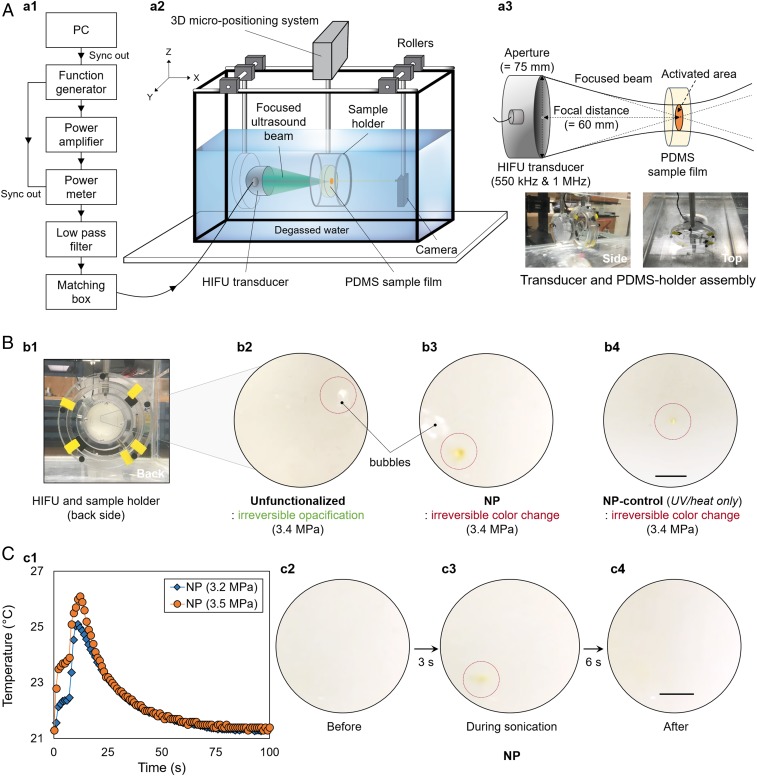
HIFU-induced mechanochromic response of the NP-PDMS elastomer under 1-MHz CW (sonication time of 7 s): (A) schematic of the experimental setup and characteristics of the HIFU transducer (SI Appendix, SI Materials and Methods); (B) irreversible material damage with thermal ablation (unfunctionalized PDMS and NP) and example of thermally induced activation at 3.4 MPa (NP control); and (C) temperature (averaged) increase during the HIFU irradiation (3.2 vs. 3.5 MPa) and observed reversible color change in the NP-PDMS elastomer. Only mild temperature increases (∼4 °C) occur at the focal spot during sonication. (Scale bar: 2.5 mm.)
Fig. 3.
Fig. 3.
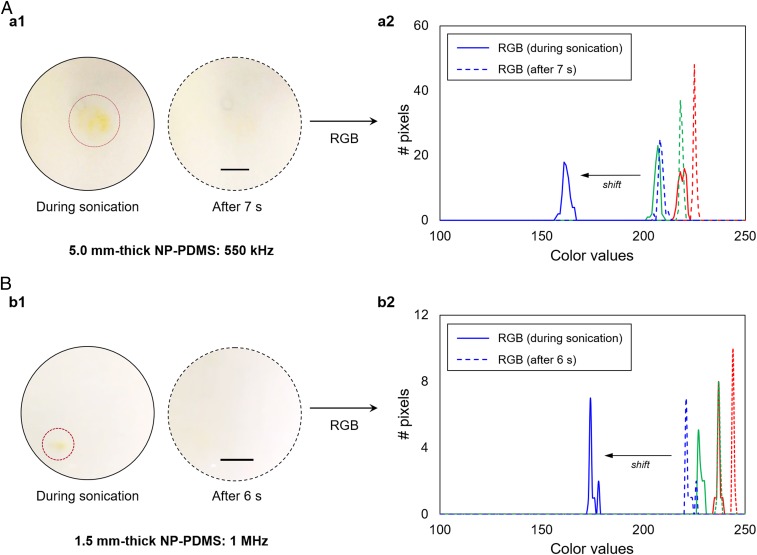
Dependency of color change on the excitation frequency. Size of activated area correlates to the wavelength and beamwidth of the transducer. (A) A 550-kHz HIFU transducer results in the colored area having a diameter of 2.7 mm. (B) A 1-MHz HIFU transducer results in the colored area having a diameter of 1.2 mm. The RGB analysis during sonication provides a color profile that is consistent with NP electrocyclic ring opening. (Scale bar: 2.5 mm.)
Fig. 4.
Fig. 4.
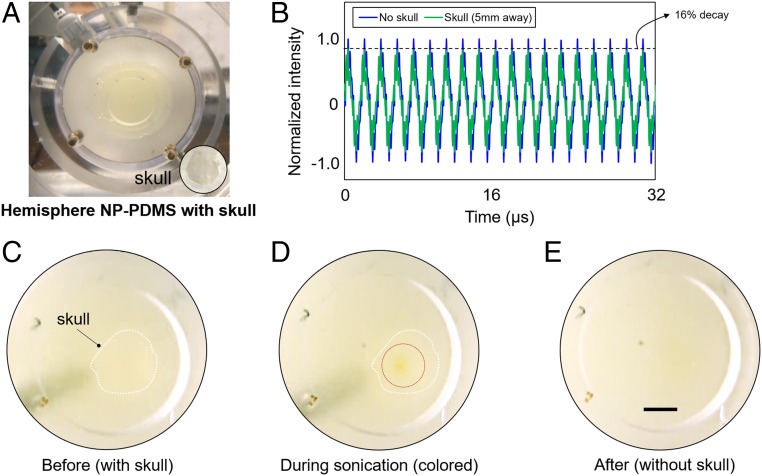
Sonication of the hemisphere NP-PDMS through mouse skull tissue (maximum length of 1 cm) with 3.2 MPa: (A) Image of the hemispherical NP-PDMS and prepared skull; (B) attenuated intensity in the time-domain signal due to the existence of the skull from hydrophone measurements; (C) skull–NP-PDMS assembly without sonication; (D) colored (orange) area by through-skull sonication (approximate diameter of 1.4 mm); and (E) disappearance of color after sonication. (Scale bar: 2.5 mm.)
Fig. 5.
Fig. 5.
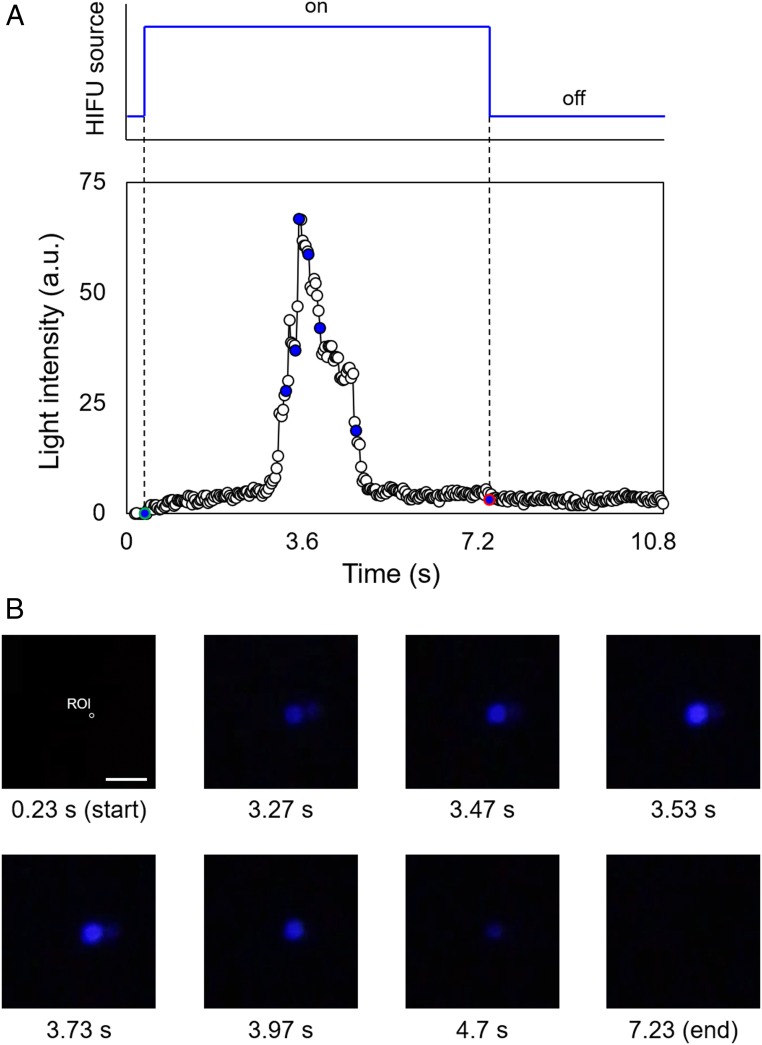
Mechanoluminescent behavior of dioxetane-functionalized PDMS: (A) Plot of the generated blue-light intensity versus time (a.u., arbitrary units); and (B) optical images showing the intensity versus HIFU irradiation time. The intensity plot is based on light generated in the focal spot (∼2.25 mm, 550 kHz). Green- and red-colored points in the plot indicate the start and end points of sonication, respectively. (Scale bar: 5.0 mm.)

References

    1. Caruso MM, et al. (2009) Mechanically-induced chemical changes in polymeric materials. Chem Rev 109:5755–5798. - PubMed
    1. Li J, Nagamani C, Moore JS (2015) Polymer mechanochemistry: From destructive to productive. Acc Chem Res 48:2181–2190. - PubMed
    1. Davis DA, et al. (2009) Force-induced activation of covalent bonds in mechanoresponsive polymeric materials. Nature 459:68–72. - PubMed
    1. Robb MJ, et al. (2016) Regioisomer-specific mechanochromism of naphthopyran in polymeric materials. J Am Chem Soc 138:12328–12331. - PubMed
    1. Göstl R, Sijbesma RP (2016) π-extended anthracenes as sensitive probes for mechanical stress. Chem Sci (Camb) 7:370–375. - PMC - PubMed

Publication types

MeSH terms

LinkOut - more resources