. 2019 Aug;29(4):443-455.
doi: 10.1007/s10286-019-00607-x. Epub 2019 May 10.

Physical activity and dietary interventions in diabetic neuropathy: a systematic review

Affiliations

Physical activity and dietary interventions in diabetic neuropathy: a systematic review

Lindsay A Zilliox et al. Clin Auton Res. 2019 Aug.

Abstract

Purpose: Diabetic neuropathy is a common and disabling disorder, and there are currently no proven effective disease-modifying treatments. Physical activity and dietary interventions in patients with diabetes and diabetic neuropathy have multiple beneficial effects and are generally low risk, which makes lifestyle interventions an attractive treatment option. We reviewed the literature on the effects of physical activity and dietary interventions on length-dependent peripheral neuropathy and cardiac autonomic neuropathy in diabetes.

Methods: The electronic database PubMed was systematically searched for original human and mouse model studies examining the effect of either dietary or physical activity interventions in subjects with diabetes, prediabetes, or metabolic syndrome.

Results: Twenty studies are included in this review. Fourteen studies were human studies and six were in mice. Studies were generally small with few controlled trials, and there are no widely agreed upon outcome measures.

Conclusions: Recent research indicates that dietary interventions are effective in modifying diabetic neuropathy in animal models, and there are promising data that they may also ameliorate diabetic neuropathy in humans. It has been known for some time that lifestyle interventions can prevent the development of diabetic neuropathy in type 2 diabetes mellitus subjects. However, there is emerging evidence that lifestyle interventions are effective in individuals with established diabetic neuropathy. In addition to the observed clinical value of lifestyle interventions, there is emerging evidence of effects on biochemical pathways that improve muscle function and affect other organ systems, including the peripheral nerve. However, data from randomized controlled trials are needed.

Keywords: Diabetic neuropathy; Diet; Dysautonomia; Exercise; Sirtuins.


Figures
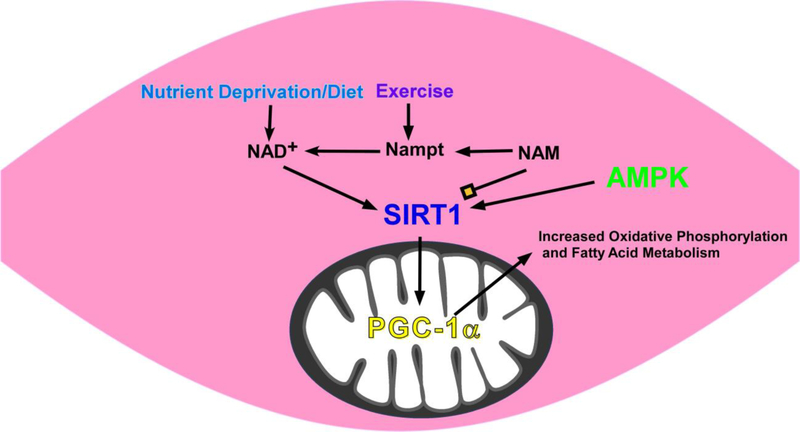
Figure 1
Figure 1. Effect of Diet and Exercise on energy signaling pathways that regulate mitochondrial metabolism in a skeletal muscle fiber.
Nutrient deprivation leads to an increase in NAD+ and a decrease in nicotinamide (NAM), which in turn leads to activation of SIRT1 and 35kDa peroxisome proliferator-activated receptor-gamma co-activator-1□ (PGC1-α) in the mitochondrion resulting in an increase in oxidative phosphorylation and fatty acid metabolism. NAM and NADH act as inhibitors of SIRT1. NAM phosphoribosyltransferase (Nampt) catalyzes conversion of NAM to NAD+. Exercise has been shown to increase Nampt activity in human muscle and also circulates to increase insulin sensitivity. In turn, Nampt decreases NAM and increases NAD+ resulting in further activation of the SIRT1- PGC1-α pathway and increasing mitochondrial function. AMP-activated protein kinase (AMPK) likely regulates SIRT1 by acting as an energy sensor and activates Nampt. Thus, the net effect of nutritional restriction and exercise is to increase NAD+ and drive the SIRT1- PGC1-α pathway towards improved mitochondrial function.
Figure 2
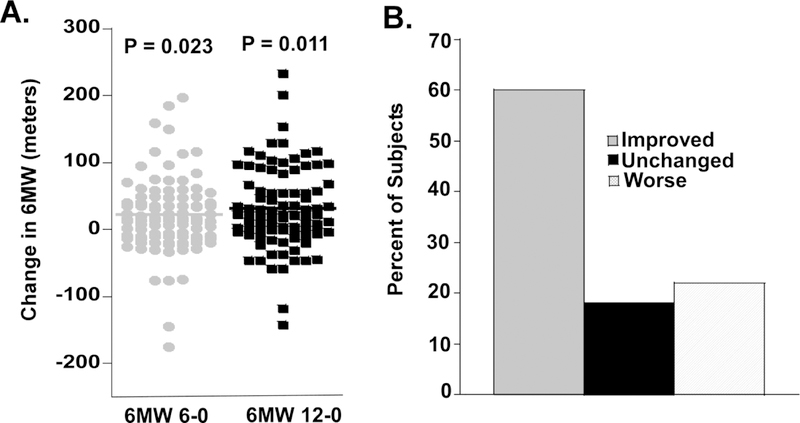
Figure 2. Improvement in the 6 minute walk in subjects with diabetic neuropathy receiving “standard of care” dietary and exercise counselling over a 12 month period. Participants had mild, recently diagnosed type 2 diabetes mellitus or impaired glucose tolerance.
(A) Change in the 6MW between baseline and 6 months (n = 74) and baseline and 12 months (n = 64). The 6MW was performed prospectively, was masked, and completed in accordance with a standardized protocol. “Standard of care” advice included recommendations for 150 minutes per week of aerobic exercise, up to 30 minutes per session, and a goal of reducing baseline weight by 7 percent. The change in the 6MW was statistically significant at 6 months (P = 0.023) and 12 months (P = 0.011). (B) Percent subjects showing an improvement in the 6MW at 12 months (≥5% improvement in the 6MW), no change (<5% improvement), or worse 6MW with “standard of care” dietary and exercise counselling.
Figure 3.
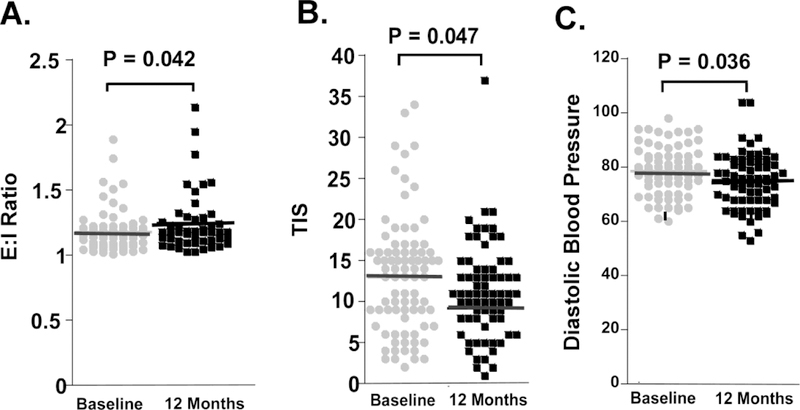
Figure 3.. Improvement in measures of autonomic function in subjects with neuropathy and impaired glucose tolerance or type 2 diabetes mellitus receiving “standard of care” dietary and exercise counselling over a 12 month period.
The protocol was performed prospectively, was masked, and standardized. “Standard of care” advice included recommendations to undertake aerobic exercise for 150 minutes/week, up to 30 minutes per session, and a goal of reducing baseline weight by 7 percent. However, none of the recommendations were enforced or monitored. The technician performing the outcome measures was masked to the patient intervention. (A) Increased expiration:inspiration (E:I ratio, n = 50) after 1 year (P=0.042). Base 95% CI:1.14, 1.22. 1 year 95% CI: 1.20, 1.44. (B) Decreased Total Impact Score (TIS) on the Survey of Autonomic Symptoms (SAS, n = 71), (C) Decreased resting diastolic blood pressure (n = 72).
Figure 4
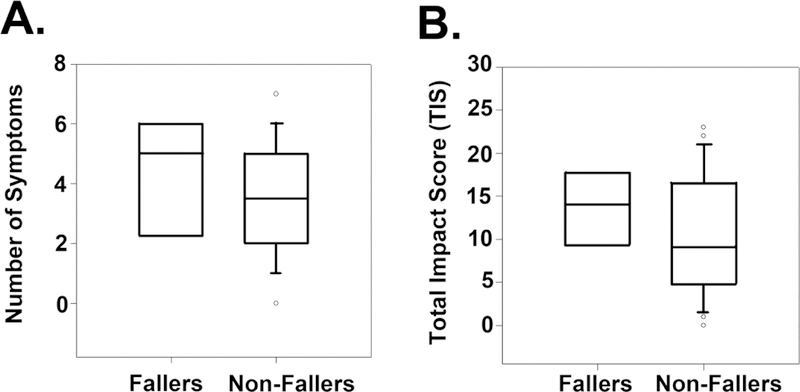
Figure 4. An increase in the symptom score and the Total Impact Score (TIS) on the Survey of Autonomic Symptoms (SAS) is associated with worse symptoms of dysautonomia and an increase in falls.
(A) Number of symptoms. (B) TIS.

References

    1. DCCT (1998) The effect of intensive diabetes therapy on measures of autonomic nervous system function in the Diabetes Control and Complications Trial (DCCT). Diabetologia 41:416–423 - PMC - PubMed
    1. UKPDS (1998) Intensive blood-glucose control with sulphonylureas or insulin compared with conventional treatment and risk of complications in patients with type 2 diabetes (UKPDS 33). UK Prospective Diabetes Study (UKPDS) Group. Lancet 352:837–853 - PubMed
    1. Albers JW, Herman WH, Pop-Busui R, Martin CL, Cleary P, Waberski B (2007) Subclinical neuropathy among Diabetes Control and Complications Trial participants without diagnosable neuropathy at trial completion: possible predictors of incident neuropathy? Diabetes Care 30:2613–2618 - PMC - PubMed
    1. American Diabetes A (2018) 2. Classification and Diagnosis of Diabetes: Standards of Medical Care in Diabetes-2018. Diabetes Care 41:S13–S27 - PubMed
    1. Ametov AS, Barinov A, Dyck PJ, Hermann R, Kozlova N, Litchy WJ, Low PA, Nehrdich D, Novosadova M, O’Brien PC, Reljanovic M, Samigullin R, Schuette K, Strokov I, Tritschler HJ, Wessel K, Yakhno N, Ziegler D (2003) The sensory symptoms of diabetic polyneuropathy are improved with a-lipoic acid: The Sydney trial. Diabetes Care 26:770–776 - PubMed

Publication types

MeSH terms