Review
. 2019 Aug 20:140:206-223.
doi: 10.1016/j.freeradbiomed.2019.05.007. Epub 2019 May 9.

Cyanobacteria evolution: Insight from the fossil record

Affiliations
Review

Cyanobacteria evolution: Insight from the fossil record

Catherine F Demoulin et al. Free Radic Biol Med. .

Abstract

Cyanobacteria played an important role in the evolution of Early Earth and the biosphere. They are responsible for the oxygenation of the atmosphere and oceans since the Great Oxidation Event around 2.4 Ga, debatably earlier. They are also major primary producers in past and present oceans, and the ancestors of the chloroplast. Nevertheless, the identification of cyanobacteria in the early fossil record remains ambiguous because the morphological criteria commonly used are not always reliable for microfossil interpretation. Recently, new biosignatures specific to cyanobacteria were proposed. Here, we review the classic and new cyanobacterial biosignatures. We also assess the reliability of the previously described cyanobacteria fossil record and the challenges of molecular approaches on modern cyanobacteria. Finally, we suggest possible new calibration points for molecular clocks, and strategies to improve our understanding of the timing and pattern of the evolution of cyanobacteria and oxygenic photosynthesis.

Keywords: Biosignatures; Cyanobacteria; Evolution; Microfossils; Molecular clocks; Precambrian.


Figures

Image 1
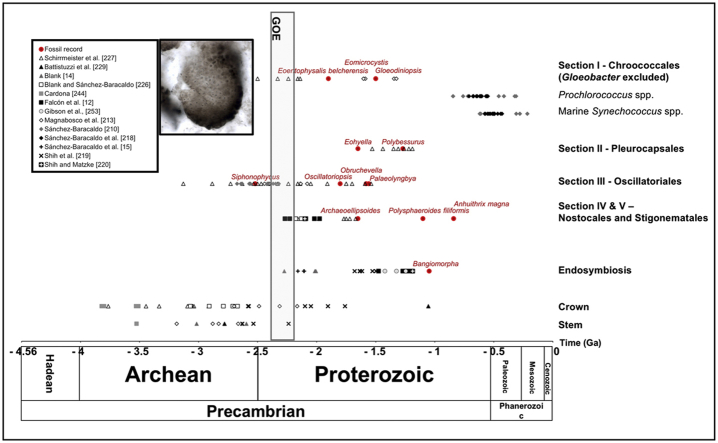
Graphical abstract
Fig. 1
Fig. 1
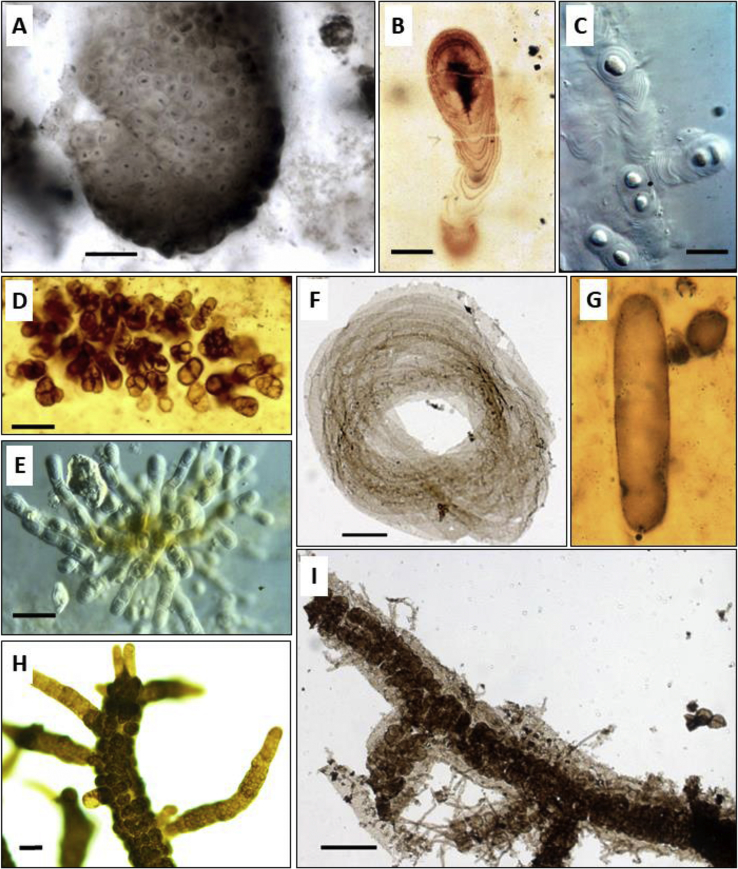
Microphotographs of fossils with some of their modern analogues. A) Eoentophysalis belcherensis from the 1.89–1.84 Ga Kasegalik Formation, Belcher Supergroup, Canada; B) Polybessurus from the 800-750 Ma Draken Formation, Svalbard, photo courtesy of A. H. Knoll; C) Cyanostylon, the modern analogue of Polybessurus, photo courtesy of A. H. Knoll; D) Eohyella, the euendolithic cyanobacterium from the 950-680 Ma Eleonore Bay Group, central East Greenland, photo courtesy of A. H. Knoll; E) Hyella, the modern analogue of Eohyella, photo courtesy of A. H. Knoll; F) Obruchevella from the 1.03–0.95 Ga Mbuji-Mayi Supergroup, Democratic Republic of the Congo, photo courtesy of B. K. Baludikay; G) Archaeoellipsoides from the 1.48–1.3 Ga Billyakh Group, Siberia, photo courtesy of A. H. Knoll; H) Stigonema robustum, the modern analogue of Polysphaeroides filiformis, photo courtesy of T. Hauer; I) Polysphaeroides filiformis of the 1.03–0.95 Ga Mbuji-Mayi Supergroup, Democratic Republic of the Congo, photo courtesy of B. K. Baludikay. Scale bars = 20 μm in A, B, E, F, G and H; = 10 μm in C; = 100 μm in D; = 50 μm in I.
Fig. 2
Fig. 2
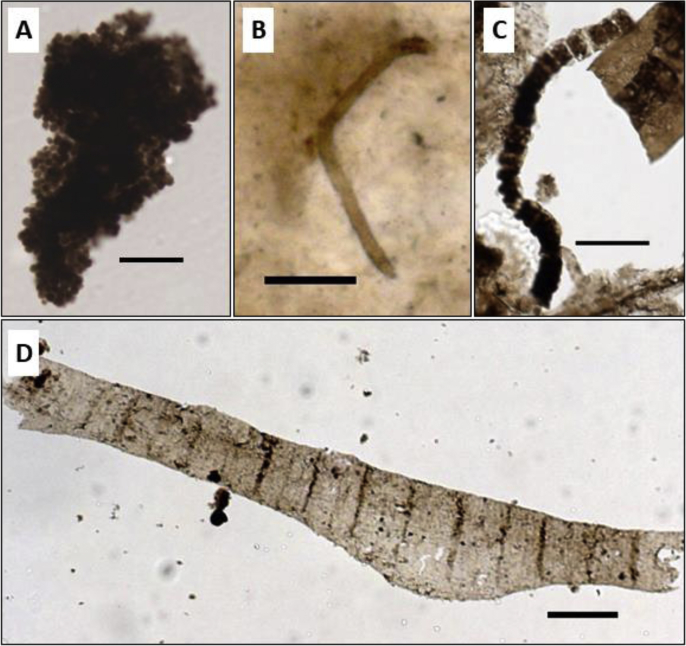
Microphotographs of fossils considered as probable or possible cyanobacteria. A) Eomicrocystis from the 1.1 Ga Atar/El Mreïti Group, Taoudeni Basin, Mauritania. B) Siphonophycus from the 1.48–1.3 Ga Billyakh Group, Siberia; C) Palaeolyngbya from the 1.03–0.95 Ga Mbuji-Mayi Supergroup, Democratic Republic of the Congo, photo courtesy of B. K. Baludikay; D) Tortunema from the 1.03–0.95 Ga Mbuji-Mayi Supergroup, Democratic Republic of the Congo, photo courtesy of B. K. Baludikay. Scale bars = 20 μm.
Fig. 3
Fig. 3
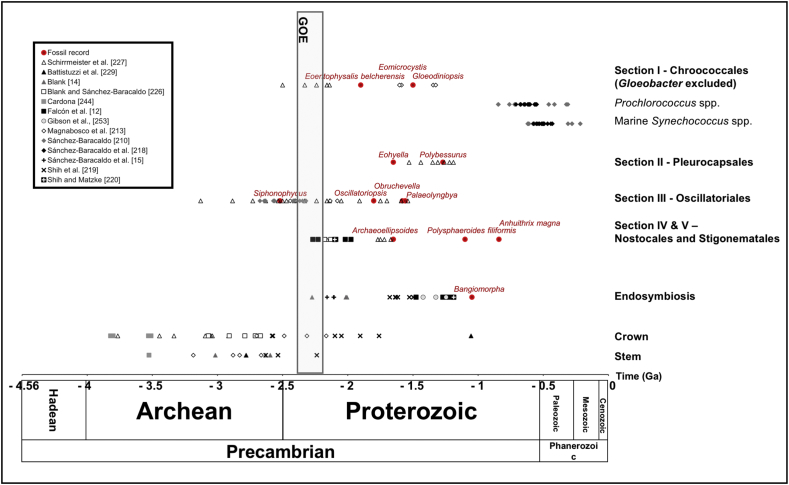
Microfossils record of unambiguous, probable and possible cyanobacteria (see text for discussion, Table 1, and Supplementary Table 1), and of Bangiomorpha as an unambiguous red alga, and minimum median age estimates for the divergence of sections I, II, III, IV and V as described by Rippka et al. [45]; for phylogenetic nodes supporting stem and crown group cyanobacteria according to the literature; and for the primary endosymbiosis. Note that the age of Polysphaeroides filiformis considered here corresponds to its record in Baludikay et al. [165].

References

    1. Bekker A., Holland H.D., Wang P., Iii D.R., Stein H.J., Hannah J.L., Coetzee L.L., Beukes N.J. Dating the rise of atmospheric oxygen. Nature. 2004;427:117–120. - PubMed
    1. Hannah J.L., Bekker A., Stein H.J., Markey R.J., Holland H.D. Primitive Os and 2316 Ma age for marine shale: implications for Paleoproterozoic glacial events and the rise of atmospheric oxygen. Earth Planet. Sci. Lett. 2004;225:43–52.
    1. Kasting J.F. What caused the rise of atmospheric O2? Chem. Geol. 2013;362:13–25.
    1. Lewis L.A. Hold the salt: freshwater origin of primary plastids. Proc. Natl. Acad. Sci. Unit. States Am. 2017;114:9759–9760. - PMC - PubMed
    1. Gold D.A., Caron A., Fournier G.P., Summons R.E. Paleoproterozoic sterol biosynthesis and the rise of oxygen. Nature. 2017;543:420–423. - PubMed

Publication types