Review
. 2019 Jun;40(6):430-445.
doi: 10.1016/j.tips.2019.04.006. Epub 2019 May 9.

Deciphering the Chemical Lexicon of Host-Gut Microbiota Interactions

Affiliations
Review

Deciphering the Chemical Lexicon of Host-Gut Microbiota Interactions

Gael R Nicolas et al. Trends Pharmacol Sci. 2019 Jun.

Abstract

The human intestine harbors an immense, diverse, and critical population of bacteria that has effects on numerous aspects of host physiology, immunity, and disease. Emerging evidence suggests that many of the interactions between the host and the gut microbiota are mediated via the microbial metabolome, or the collection of small-molecule metabolites produced by intestinal bacteria. This review summarizes findings from recent work by focusing on different classes of metabolites produced by the gut microbiota and their effects in modulating host health and disease. These metabolites ultimately serve as a form of communication between the gut microbiome and the host, and a better understanding of this chemical language could potentially lead to novel strategies for treating a wide variety of human disorders.

Keywords: gut microbiota; immunity; inflammation; metabolites; metabolome; microbiome.


Figures

Figure 1.
Figure 1.
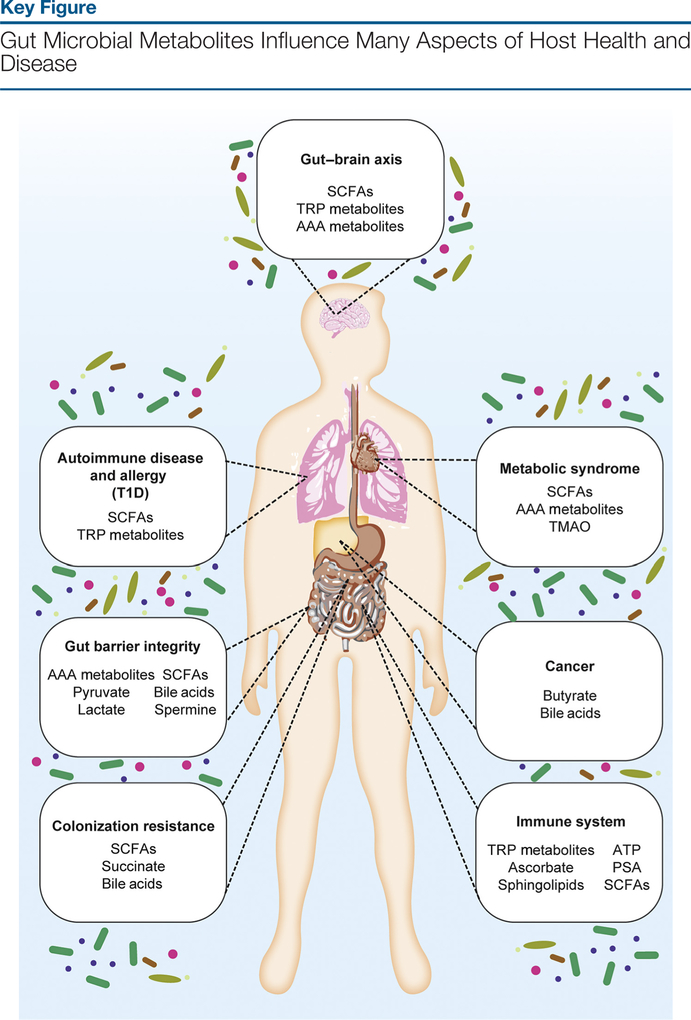
Small-molecule metabolites that are produced by the gut microbiota can modulate myriad physiological processes in the host, thereby impacting disease outcomes in many inflammatory disorders, including metabolic syndrome, cancer, autoimmune diseases including type 1 diabetes (T1D), allergy, and inflammatory bowel diseases. Furthermore, these metabolites can also influence the gut-brain axis and regulate the immune system and host susceptibility to gastrointestinal infection via colonization resistance. Abbreviations: AAA, aromatic amino acid; PSA, polysaccharide A; SCFAs, short-chain fatty acids; TMAO, trimethylamine N-oxide; TRP, tryptophan.
Figure 2.
Figure 2.. Gut Microbial Metabolites Regulate Specific Immune Cell Types.
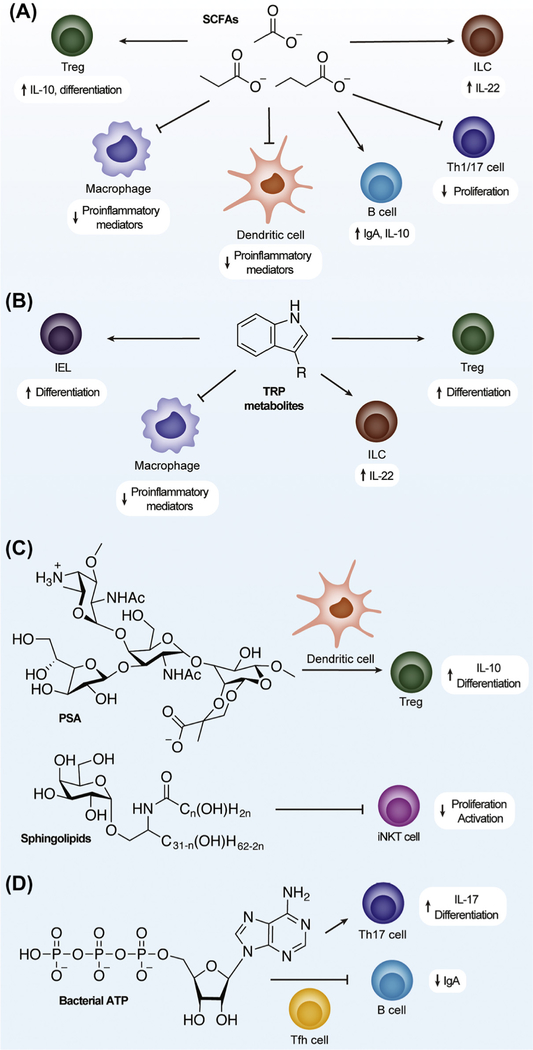
Microbial metabolites regulate immune responses in the gut by modulating the activities of different immune cell types as indicated. The schematic shows immune cell types that are affected by metabolites: (A) short-chain fatty acids (SCFAs); (B) tryptophan (TRP); (C) polysaccharide A (PSA) and sphingolipids; and (D) bacterial ATP. Abbreviations: IEL, intraepithelial lymphocyte; IL, interleukin; ILC, innate lymphoid cell; iNKT, invariant natural killer T; Tfh, T follicular helper; Th1/17, T helper 1/17; Treg, T regulatory cell.
Figure 3.
Figure 3.. Gut Microbial Metabolites Regulate Intestinal Epithelial Barrier Integrity.
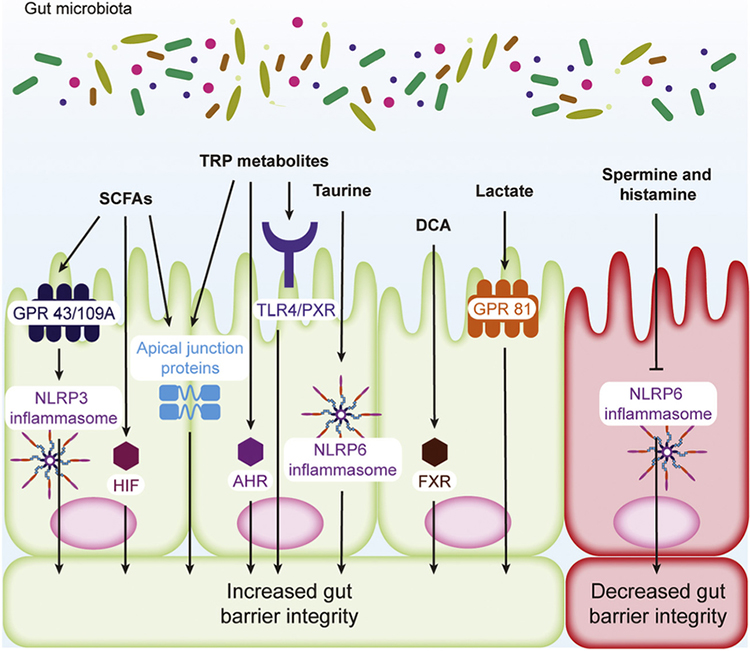
Metabolites produced by the gut microbiota, such as short-chain fatty acids (SCFAs), tryptophan (TRP) metabolites, taurine, deoxycholic acid (DCA), lactate, spermine, and histamine, can modulate the barrier function of the intestinal epithelium by regulating receptor expression and/or activation, transcription factor activation, increasing the expression of cytokines that confer barrier protection, and modulating apical junction proteins, which directly regulate epithelial permeability. Abbreviations: AHR, aryl hydrocarbon receptor; FXR, farnesoid X receptor; GPR, G protein receptor; HIF, hypoxia inducible factor; NLRP, NOD-like receptor protein; PXR, pregnane X receptor; TLR4, Toll-like receptor 4.

References

    1. Sonnenburg JL and Bäckhed F (2016) Diet-microbiota interactions as moderators of human metabolism. Nature 535, 56–64 - PMC - PubMed
    1. Garrett WS (2015) Cancer and the microbiota. Science 348, 80–86 - PMC - PubMed
    1. Belkaid Y and Hand TW (2014) Role of the microbiota in immunity and inflammation. Cell 157, 121–141 - PMC - PubMed
    1. Smith PM et al. (2013) The microbial metabolites, short-chain fatty acids, regulate colonic Treg cell homeostasis. Science 341, 569–573 - PMC - PubMed
    1. Arpaia N et al. (2013) Metabolites produced by commensal bacteria promote peripheral regulatory T-cell generation. Nature 504, 451–455 - PMC - PubMed

Publication types

MeSH terms